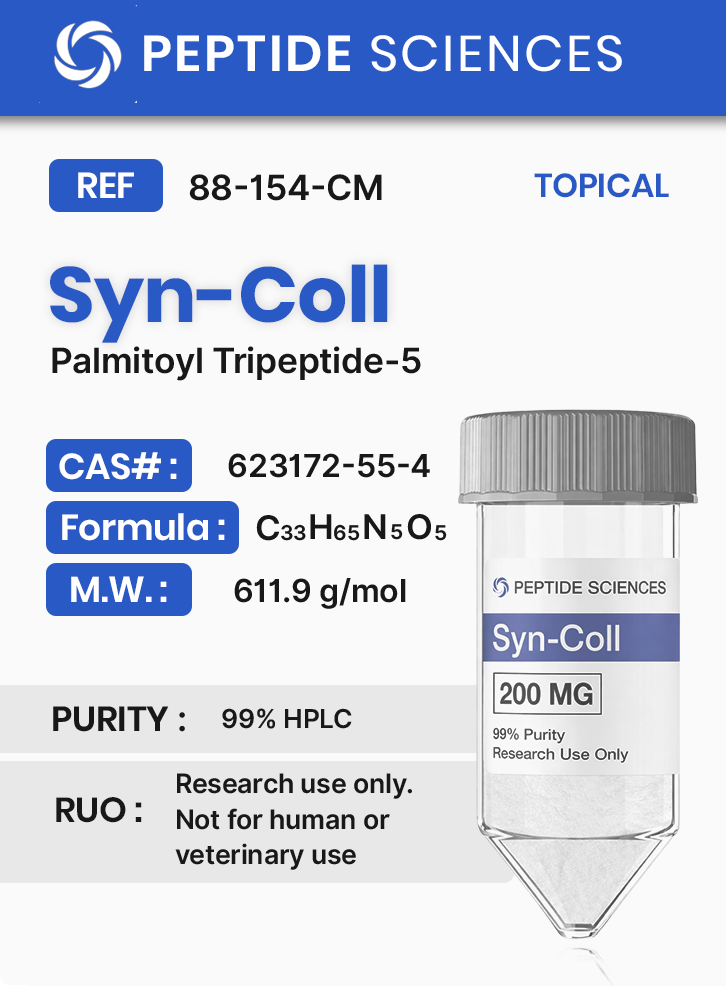
Syn-Coll (Palmitoyl Tripeptide-5) 200mg (Topical)
$230.00
Syn-Coll (Palmitoyl Tripeptide-5) is a research peptide consisting of a tripeptide conjugated to a palmitic acid chain, designed to enhance stability and skin permeability for in vitro studies. It has been shown in preclinical models to influence transforming growth factor-β (TGF-β) signaling, modulate fibroblast activity, and stimulate collagen synthesis through Smad-dependent pathways. Syn-Coll is utilized in research examining peptide-mediated extracellular matrix regulation, dermal remodeling, and cellular communication mechanisms.
For research use only. Not for human consumption.
References:
Katayama K et al., J Biochem, 2010;147(1):61–69
Lintner K et al., Int J Cosmet Sci, 2005;27(3):183–190
Zhang L et al., Int J Cosmet Sci, 2020;42(3):302–310
Overview
Syn-Coll (Palmitoyl Tripeptide-5) is a synthetically produced palmitoylated tripeptide supplied exclusively for laboratory research applications. The peptide sequence is derived from a functional motif of thrombospondin-1, an extracellular matrix-associated glycoprotein involved in regulation of latent transforming growth factor-β (TGF-β) activation. In preclinical and in vitro research systems, Syn-Coll is utilized as a molecular probe to investigate collagen-associated signaling pathways and extracellular matrix regulatory mechanisms.
Biochemical Characteristics
Sequence (Three-Letter Code): Palmitoyl-Lys-Val-Lys
Molecular formula: C33H65N5O5
Molecular weight: 611.9 g/mol
The palmitoyl modification increases hydrophobicity and facilitates peptide interaction with lipid-associated environments in experimental systems. The Lys-Val-Lys motif corresponds to a thrombospondin-1–associated region implicated in extracellular growth factor modulation.
Research Applications
Syn-Coll is employed in laboratory research to examine molecular regulation of type I and type III collagen synthesis and extracellular matrix turnover. Type I collagen represents a principal fibrillar component of connective tissue matrices, while type III collagen contributes to organization of compliant matrix systems. Experimental use includes in vitro fibroblast cultures and in vivo animal models to assess collagen-associated gene expression, protein synthesis, and matrix deposition under controlled experimental conditions.
Pathway / Mechanistic Context
Syn-Coll facilitates activation of latent transforming growth factor-β within extracellular environments via a thrombospondin-1–associated mechanism. Activated TGF-β engages SMAD-dependent transcriptional signaling cascades that regulate expression of extracellular matrix–associated genes, including those encoding type I and type III collagen.
Additional preclinical investigations evaluate modulation of matrix metalloproteinases, including MMP1 and MMP3, enzymes involved in collagen fibril degradation and extracellular matrix turnover.
Preclinical Research Summary
Preclinical and in vitro studies involving Palmitoyl Tripeptide-5 report increased collagen-associated transcriptional and protein expression markers alongside altered matrix metalloproteinase activity in experimental models. These findings are used to characterize extracellular matrix signaling and remodeling mechanisms without implication of applied, cosmetic, physiological, or therapeutic outcomes.
Form & Analytical Testing
Syn-Coll is supplied as a synthetic research-grade peptide. Identity and purity are commonly verified using high-performance liquid chromatography (HPLC) and mass spectrometry (MS). Handling and storage should follow standard laboratory protocols appropriate for synthetic peptides.
Referenced Citations
- Thorsen, M., Yde, B., Pedersen, U., Clauden, K. & Lawesson, S.-O. Studies on amino acids and peptides-V. Tetrahedron 39, 3429–3435 (1983).
- Trookman, N. S., Rizer, R. L., Ford, R., Ho, E. & Gotz, V. Immediate and Long-term Clinical Benefits of a Topical Treatment for Facial Lines and Wrinkles. J. Clin. Aesthetic Dermatol. 2, 38–43 (2009).
- Varga, J., Rosenbloom, J. & Jimenez, S. A. Transforming growth factor beta (TGF beta) causes a persistent increase in steady-state amounts of type I and type III collagen and fibronectin mRNAs in normal human dermal fibroblasts. Biochem. J. 247, 597–604 (1987).
- Murphy-Ullrich, J. E. & Poczatek, M. Activation of latent TGF-beta by thrombospondin-1: mechanisms and physiology. Cytokine Growth Factor Rev. 11, 59–69 (2000).
- Palmitoyl Tripeptide-5: How to Boost and Protect Skin’s Collagen. Available at: http://www.henrytianus.com/site/1345939/page/4655482. (Accessed: 29th July 2016)
- Bucay, V. W. & Day, D. Adjunctive Skin Care of the Brow and Periorbital Region. Clin. Plast. Surg. 40, 225–236 (2013).
ALL ARTICLES AND PRODUCT INFORMATION PROVIDED ON THIS WEBSITE ARE FOR INFORMATIONAL AND EDUCATIONAL PURPOSES ONLY.
RUO Disclaimer
The products offered on this website are furnished for in-vitro studies only. In-vitro studies (Latin: in glass) are performed outside of the body. These products are not medicines or drugs and have not been approved by the FDA to prevent, treat or cure any medical condition, ailment or disease. Bodily introduction of any kind into humans or animals is strictly forbidden by law.
For Laboratory Research Only. Not for human use, medical use, diagnostic use, or veterinary use.