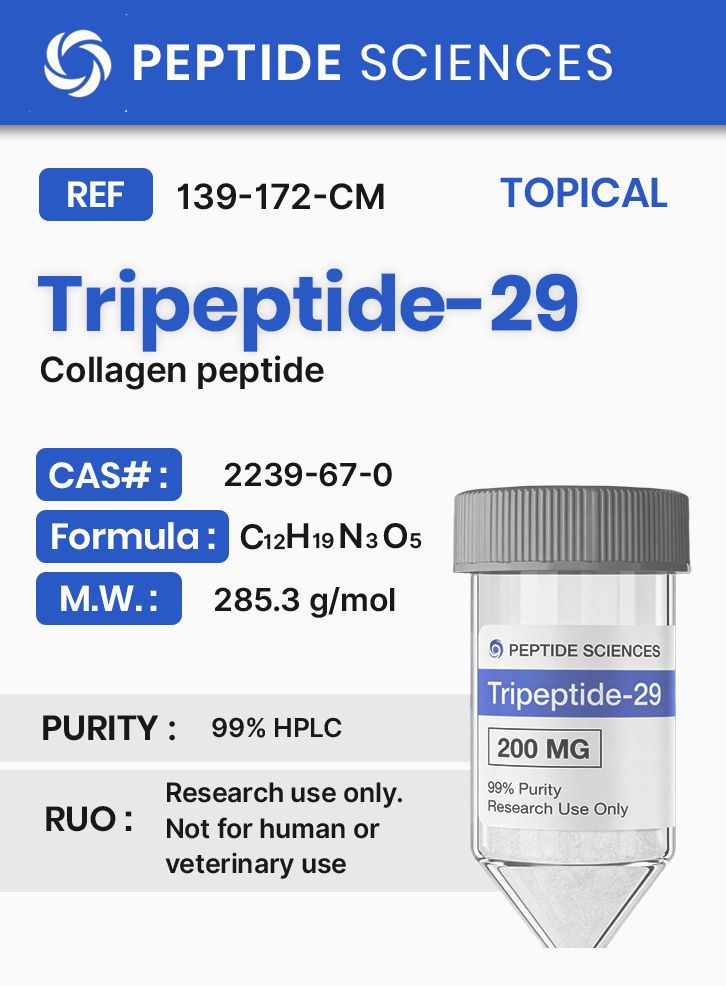
Tripeptide-29 200mg (Collagen peptide) (Topical)
$200.00
Tripeptide-29 is a research peptide composed of Gly-Pro-Hyp, a collagen-derived tripeptide fragment studied for its role in extracellular matrix synthesis and fibroblast regulation. Experimental studies show that Tripeptide-29 modulates collagen type I gene expression, enhances ECM remodeling, and stabilizes dermal protein architecture in in-vitro models. It serves as a model compound for research on peptide-mediated tissue repair, structural protein turnover, and cellular communication within connective tissue systems.
For research use only. Not for human consumption.
References:
Katayama K et al., J Biochem, 2010;147(1):61–69
Shigemura Y et al., J Agric Food Chem, 2009;57(9):4447–4452
Ohara H et al., J Dermatol Sci, 2010;58(3):227–233
Overview
Tripeptide-29 is a synthetic collagen-mimetic tripeptide corresponding to the Gly-Pro-Hyp motif commonly observed in collagen triple-helix repeating units (e.g., Gly-X-Y, where X/Y are frequently proline and hydroxyproline). In laboratory settings, short collagen-like sequences are used as defined molecular probes to study collagen–protein recognition, supramolecular assembly rules, and sequence-dependent changes in triple-helix stability and higher-order fibrillar organization.
This product page describes Tripeptide-29 strictly in a research context, emphasizing biochemical properties, mechanistic endpoints, and experimentally tractable pathways relevant to extracellular matrix (ECM) biology, receptor–ligand interactions, and peptide-based model systems.
Biochemical Characteristics
Tripeptide-29 200mg (Collagen peptide)
Tripeptide-29 is a defined, three–amino-acid collagen-like sequence designed to model a minimal repeat unit found within collagenous domains. Collagen model peptides are widely used to isolate sequence effects on triple-helix formation, thermal stability, and binding determinants for collagen-interacting proteins.
Tripeptide-29 Peptide
Chemical Formula: C12H19N3O5
Molecular Weight: 285.3 g/mol
Amino Acid Sequence: Gly-Pro-Hyp
Research Applications
Tripeptide-29 and related collagen-mimetic tripeptides are used in controlled laboratory workflows as:
- Minimal motifs for collagen-recognition studies (e.g., receptor binding assays and competitive inhibition formats).
- Building blocks for collagen model peptides or hydrolysate mixtures to evaluate sequence-dependent physicochemical properties (e.g., solubility, aggregation propensity, and redox-relevant readouts in defined chemical systems).
- Tools for studying enzyme interactions with collagen-derived peptides (e.g., peptidase inhibition assays in vitro) and downstream pathway mapping in cell-based models where appropriate.
- Components in biomaterials and ECM-inspired research where short motifs are used to tune assembly or interaction profiles in synthetic matrices.
Pathway / Mechanistic Context
Collagen-Receptor Recognition (GPVI as an Experimental Target)
Collagen is a ligand class for multiple binding proteins and receptors. In platelet biology research, glycoprotein VI (GPVI) is a collagen-responsive receptor studied for its role in collagen-triggered signaling cascades. In vitro literature has reported that defined collagen-like repeat sequences can act as partial agonists in GPVI-driven activation paradigms, supporting mechanistic interrogation of sequence length, valency, and presentation effects on receptor activation.
Sequence-Dependent Triple-Helix Stability
Collagen model systems use short peptides to decouple the contribution of specific residue positions (e.g., Gly-X-Y) to helix stability. In these frameworks, the identity of residues within a tripeptide unit can measurably influence melting behavior, hydrogen-bonding networks, and hydration shells that collectively shape helix persistence and supramolecular organization.
DPP4 (Dipeptidyl Peptidase-IV) as a Biochemical Node
Collagen-derived tripeptides have been studied as inhibitors of DPP4 activity in biochemical assays. DPP4 is a membrane-associated and soluble protease with broad substrate scope (including peptide hormones, chemokines, and regulatory peptides), making it a relevant enzymatic node for mechanistic studies of peptide turnover, signaling peptide half-life, and protease–substrate selectivity in vitro. Where reported, DPP4 modulation has also been used in animal-model research as a mechanistic lever to examine fibrosis-associated pathways and immune–stromal signaling interfaces.
Preclinical Research Summary
Collagen-Mimetic Repeats and GPVI Signaling (In Vitro)
Published in vitro work has described monomeric collagen-like repeat sequences as partial agonists of GPVI in platelet-focused experimental designs, and has further evaluated how multivalency/crosslinking can alter activation magnitude. These systems are used to parse receptor activation rules (e.g., avidity and spatial presentation) under defined assay conditions.
Collagen Model Peptides: Stability Determinants
Benchtop studies of collagen model peptides have examined how specific tripeptide units contribute to stability readouts. Such work is commonly used to guide rational design of collagen-mimetic sequences in structural biology and biomaterials research.
Collagen Hydrolysates and Chemical Redox Readouts
Preclinical and biochemical literature has evaluated collagen hydrolysates in chemical radical-scavenging assays, with emphasis on how peptide composition and sequence influence assay performance. These findings are generally applied as mechanistic inputs to formulation and structure–activity discussions in controlled experimental contexts (without implying biological outcomes in humans).
DPP4 Inhibition by Collagen-Derived Tripeptides
In vitro studies have reported inhibitory activity of collagen-derived tripeptides against DPP4 enzymatic function. Separately, animal-model studies have investigated DPP4 inhibition as a mechanistic variable in fibrosis-associated endpoints. Together, these reports support continued mechanistic investigation of how defined short peptides interact with peptidases and how protease modulation maps onto pathway-level readouts in preclinical systems.
Important RUO Note: Any research discussion on this page is limited to mechanistic, in vitro, or preclinical animal-model contexts. No statements are made regarding human safety, efficacy, or intended use.
Form & Analytical Testing
Tripeptide-29 is supplied as a synthetic research peptide intended for controlled laboratory use. Researchers typically verify identity and suitability for an intended experimental workflow using established analytical approaches such as chromatographic purity assessment and mass-based confirmation, consistent with internal laboratory qualification practices.
For sequence-defined collagen-mimetic peptides, common lab considerations include: hygroscopicity, handling under dry conditions, and documenting reconstitution solvents/conditions as dictated by the experimental design.
Referenced Citations
- J. Asselin, C. G. Knight, R. W. Farndale, M. J. Barnes, and S. P. Watson, “Monomeric (glycine-proline-hydroxyproline)10 repeat sequence is a partial agonist of the platelet collagen receptor glycoprotein VI,” Biochem. J., vol. 339 ( Pt 2), pp. 413–418, Apr. 1999.
- K. Mizuno, D. H. Peyton, T. Hayashi, J. Engel, and H. P. Bächinger, “Effect of the -Gly-3(S)-hydroxyprolyl-4(R)-hydroxyprolyl- tripeptide unit on the stability of collagen model peptides,” FEBS J., vol. 275, no. 23, pp. 5830–5840, Dec. 2008.
- M. Z. Abedin et al., “Biochemical and radical-scavenging properties of sea cucumber (Stichopus vastus) collagen hydrolysates,” Nat. Prod. Res., vol. 28, no. 16, pp. 1302–1305, 2014.
- T. Hatanaka, K. Kawakami, and M. Uraji, “Inhibitory effect of collagen-derived tripeptides on dipeptidylpeptidase-IV activity,” J. Enzyme Inhib. Med. Chem., vol. 29, no. 6, pp. 823–828, Dec. 2014.
- H. S. Min et al., “Dipeptidyl peptidase IV inhibitor protects against renal interstitial fibrosis in a mouse model of ureteral obstruction,” Lab. Investig. J. Tech. Methods Pathol., vol. 94, no. 6, pp. 598–607, Jun. 2014.
- A. Garre, G. Martinez-Masana, J. Piquero-Casals, and C. Granger, “Redefining face contour with a novel anti-aging cosmetic product: an open-label, prospective clinical study,” Clin. Cosmet. Investig. Dermatol., vol. 10, pp. 473–482, 2017.
- A. Reivitis, K. Karimi, C. Griffiths, and A. Banayan, “A single-center, pilot study evaluating a novel TriHex peptide- and botanical-containing eye treatment compared to baseline,” J. Cosmet. Dermatol., vol. 17, no. 3, pp. 467–470, Jun. 2018.
ALL ARTICLES AND PRODUCT INFORMATION PROVIDED ON THIS WEBSITE ARE FOR INFORMATIONAL AND EDUCATIONAL PURPOSES ONLY.
RUO Disclaimer
The products offered on this website are furnished for in-vitro studies only. In-vitro studies (Latin: in glass) are performed outside of the body. These products are not medicines or drugs and have not been approved by the FDA to prevent, treat or cure any medical condition, ailment or disease. Bodily introduction of any kind into humans or animals is strictly forbidden by law.
For Laboratory Research Only. Not for human use, medical use, diagnostic use, or veterinary use.