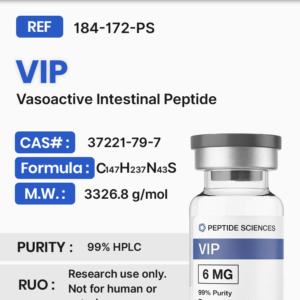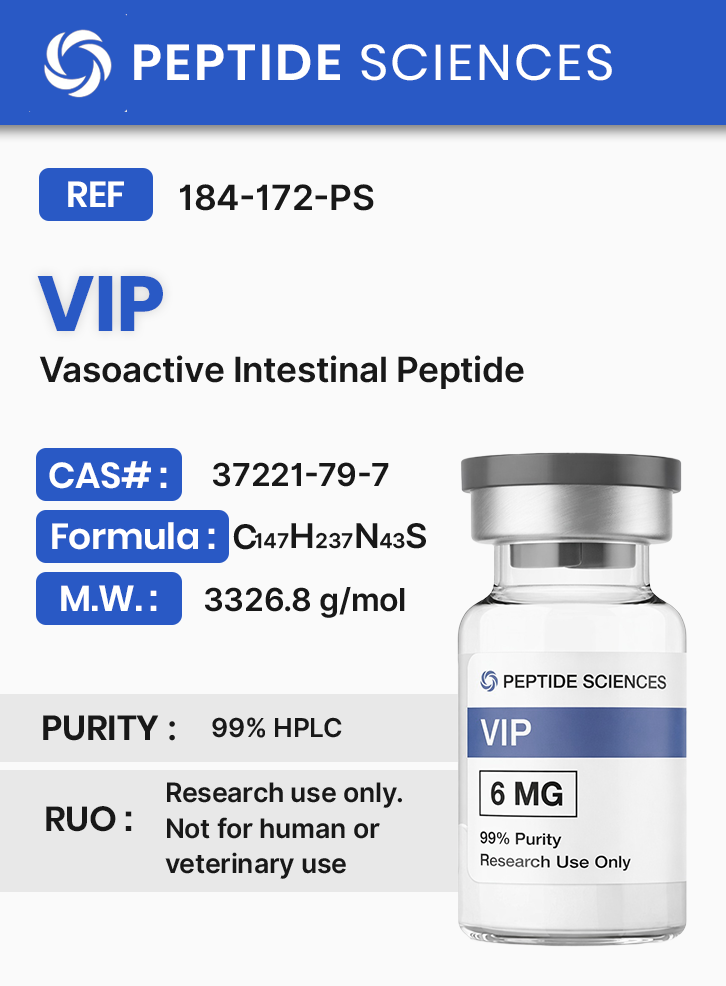
VIP 6mg
$75.00
VIP (Vasoactive Intestinal Peptide) is a 28 amino acid neuropeptide that functions as a potent endogenous ligand for VPAC1 and VPAC2 receptors. It activates cAMP-dependent signaling cascades regulating smooth muscle relaxation, vasodilation, and immune modulation in preclinical studies. VIP is widely used in research examining neuroendocrine signaling, inflammatory regulation, and peptide-mediated vascular homeostasis.
For research use only. Not for human consumption.
References:
Gozes I et al., Front Endocrinol (Lausanne), 2017 8:282
Laburthe M et al., Biochim Biophys Acta, 2007 1768(4):955–972
Delgado M et al., Trends Mol Med, 2004 10(4):201–208
Overview
Vasoactive intestinal peptide (VIP; PHM27) is a 28–amino acid neuropeptide encoded by the VIP gene and conserved across vertebrate species. VIP is classified as a class II secretin/glucagon family peptide and interacts primarily with the G protein–coupled receptors VPAC1 and VPAC2. Experimental studies have characterized VIP as a signaling molecule involved in neuroimmune communication, epithelial barrier regulation, and intracellular second-messenger modulation.
All information presented herein is derived exclusively from molecular, cellular, tissue-level, and in-vivo animal research models. No clinical, diagnostic, or therapeutic interpretation is implied.
Biochemical Characteristics
Amino Acid Sequence: HSDAVFTDNYTRLRKQMAVKKYLNSILN
Molecular Formula: C147H237N43O43S
Molecular Weight: ~3326.7 g/mol
Receptor Class: Class II GPCRs (VPAC1, VPAC2)
Biochemical studies indicate that VIP signaling is primarily mediated through adenylate cyclase activation, intracellular cAMP accumulation, and downstream PKA-dependent transcriptional regulation.
Research Applications
VIP is widely utilized in experimental systems investigating:
- Neuroimmune signaling and cytokine network modulation
- Epithelial barrier integrity and tight-junction dynamics
- Smooth muscle cell proliferation and differentiation
- Fibrotic pathway regulation in pulmonary and cardiac tissue models
- Neurotrophic factor expression and synaptic maintenance
Use of VIP in these contexts is restricted to mechanistic and observational research frameworks.
Pathway / Mechanistic Context
Preclinical studies report that VIP signaling influences intracellular pathways including:
- cAMP/PKA-dependent transcriptional modulation
- NFAT-associated immune cell activation pathways
- Regulatory T-cell differentiation signaling networks
- Angiotensin-associated fibrotic gene expression cascades
Observed pathway interactions vary by tissue type and experimental model, highlighting context-dependent receptor coupling and downstream signaling specificity.
Preclinical Research Summary
In animal and ex-vivo tissue models, VIP has been associated with measured changes in:
- Immune cell infiltration indices
- Fibrosis-associated gene expression profiles
- Epithelial permeability and tight-junction protein distribution
- Neurotrophic factor secretion levels
These findings represent reported experimental endpoints and observed associations within controlled research environments and do not imply functional outcomes outside laboratory models.
Form & Analytical Testing
This material is supplied as a synthetic peptide intended for laboratory research use. Identity and purity are evaluated using analytical techniques such as:
- High-Performance Liquid Chromatography (HPLC)
- Mass Spectrometry (MS)
Analytical documentation is provided for structural confirmation and batch consistency assessment only.
Article Author
The above literature was researched, edited and organized by Dr. E. Logan, M.D. Dr. E. Logan holds a doctorate degree from Case Western Reserve University School of Medicine and a B.S. in molecular biology.
Scientific Journal Author
Dr. Jonathan Javitt is a physician with a background in information technology, health economics, and public health. Dr. Javitt graduated in 1978 with honors in Biochemistry from Princeton University and earned his M.D. at Cornell University Medical College. He was awarded a Kellogg Foundation Fellowship to attend the Harvard School of Public Health, from which he graduated with an M.P.H. in Health Policy and Management. In 2015, he was designated an Alumnus of Merit, the highest honor bestowed by Harvard University to graduates of the School of Public Health. His scientific publications have been cited by more than 17,000 people and he is ranked among the top 1% of quoted scientists worldwide. At the Potomac Institute, he has focused on projects related to biodefense, drug and device approval policy, and the needs of first responders. Dr. Javitt previously served as a commissioned Presidential appointee in the areas of health care and biodefense.
Dr. Jonathan Javitt is being referenced as one of the leading scientists involved in the research and development of VIP. In no way is this doctor/scientist endorsing or advocating the purchase, sale, or use of this product for any reason. There is no affiliation or relationship, implied or otherwise, between Peptide Sciences and this doctor. The purpose of citing the doctor is to acknowledge, recognize, and credit the exhaustive research and development efforts conducted by the scientists studying this peptide. Dr. Jonathan Javitt is listed in [18] under the referenced citations.
Referenced Citations
- E. Gonzalez-Rey and M. Delgado, “Role of vasoactive intestinal peptide in inflammation and autoimmunity,” Curr. Opin. Investig. Drugs Lond. Engl. 2000, vol. 6, no. 11, pp. 1116–1123, Nov. 2005.
- M. Delgado, D. Pozo, and D. Ganea, “The Significance of Vasoactive Intestinal Peptide in Immunomodulation,” Pharmacol. Rev., vol. 56, no. 2, pp. 249–290, Jun. 2004, doi: 10.1124/pr.56.2.7.
- S. Seo et al., “Vasoactive intestinal peptide decreases inflammation and tight junction disruption in experimental necrotizing enterocolitis,” J. Pediatr. Surg., vol. 54, no. 12, pp. 2520–2523, Dec. 2019, doi: 10.1016/j.jpedsurg.2019.08.038.
- E. Gonzalez-Rey and M. Delgado, “Therapeutic treatment of experimental colitis with regulatory dendritic cells generated with vasoactive intestinal peptide,” Gastroenterology, vol. 131, no. 6, pp. 1799–1811, Dec. 2006, doi: 10.1053/j.gastro.2006.10.023.
- S. I. Said, “The vasoactive intestinal peptide gene is a key modulator of pulmonary vascular remodeling and inflammation,” Ann. N. Y. Acad. Sci., vol. 1144, pp. 148–153, Nov. 2008, doi: 10.1196/annals.1418.014.
- A. M. Szema et al., “NFATc3 and VIP in Idiopathic Pulmonary Fibrosis and Chronic Obstructive Pulmonary Disease,” PloS One, vol. 12, no. 1, p. e0170606, 2017, doi: 10.1371/journal.pone.0170606.
- “Vasoactive Intestinal Peptide – an overview | ScienceDirect Topics.” https://www.sciencedirect.com/topics/neuroscience/vasoactive-intestinal-peptide (accessed Jan. 01, 2021).
- V. Petkov et al., “Vasoactive intestinal peptide as a new drug for treatment of primary pulmonary hypertension,” J. Clin. Invest., vol. 111, no. 9, pp. 1339–1346, May 2003, doi: 10.1172/JCI17500.
- A. Chorny, E. Gonzalez-Rey, and M. Delgado, “Regulation of dendritic cell differentiation by vasoactive intestinal peptide: therapeutic applications on autoimmunity and transplantation,” Ann. N. Y. Acad. Sci., vol. 1088, pp. 187–194, Nov. 2006, doi: 10.1196/annals.1366.004.
- D. R. Staines, E. W. Brenu, and S. Marshall-Gradisnik, “Postulated vasoactive neuropeptide immunopathology affecting the blood–brain/blood–spinal barrier in certain neuropsychiatric fatigue-related conditions: A role for phosphodiesterase inhibitors in treatment?,” Neuropsychiatr. Dis. Treat., vol. 5, pp. 81–89, 2009, Accessed: Jan. 01, 2021. [Online]. Available: https://www.ncbi.nlm.nih.gov/pmc/articles/PMC2695238/.
- F. R. O. de Souza, F. M. Ribeiro, and P. M. d’ Almeida Lima, “Implications of VIP and PACAP in Parkinson’s disease: what do we know so far?,” Curr. Med. Chem., Mar. 2020, doi: 10.2174/0929867327666200320162436.
- O. T. Korkmaz et al., “Vasoactive Intestinal Peptide Decreases β-Amyloid Accumulation and Prevents Brain Atrophy in the 5xFAD Mouse Model of Alzheimer’s Disease,” J. Mol. Neurosci. MN, vol. 68, no. 3, pp. 389–396, Jul. 2019, doi: 10.1007/s12031-018-1226-8.
- P. Gressens, L. Besse, P. Robberecht, I. Gozes, M. Fridkin, and P. Evrard, “Neuroprotection of the developing brain by systemic administration of vasoactive intestinal peptide derivatives,” J. Pharmacol. Exp. Ther., vol. 288, no. 3, pp. 1207–1213, Mar. 1999.
- R. L. Mosley et al., “A Synthetic Agonist to Vasoactive Intestinal Peptide Receptor-2 Induces Regulatory T Cell Neuroprotective Activities in Models of Parkinson’s Disease,” Front. Cell. Neurosci., vol. 13, p. 421, 2019, doi: 10.3389/fncel.2019.00421.
- M. Yasuda, K. Maeda, T. Kakigi, N. Minamitani, T. Kawaguchi, and C. Tanaka, “Low cerebrospinal fluid concentrations of peptide histidine valine and somatostatin-28 in Alzheimer’s disease: altered processing of prepro-vasoactive intestinal peptide and prepro-somatostatin,” Neuropeptides, vol. 29, no. 6, pp. 325–330, Dec. 1995, doi: 10.1016/0143-4179(95)90003-9.
- R. H. Perry, G. J. Dockray, R. Dimaline, E. K. Perry, G. Blessed, and B. E. Tomlinson, “Neuropeptides in Alzheimer’s disease, depression and schizophrenia. A post mortem analysis of vasoactive intestinal peptide and cholecystokinin in cerebral cortex,” J. Neurol. Sci., vol. 51, no. 3, pp. 465–472, Sep. 1981, doi: 10.1016/0022-510x(81)90123-4.
- K. A. Duggan, G. Hodge, J. Chen, and T. Hunter, “Vasoactive intestinal peptide infusion reverses existing myocardial fibrosis in the rat,” Eur. J. Pharmacol., vol. 862, p. 172629, Nov. 2019, doi: 10.1016/j.ejphar.2019.172629.
- C. Smith, BGR, Aug. 03, 2020. https://bgr.com/2020/08/03/coronavirus-cure-rlf-100-aviptadil-phase-3-trial/ (accessed Jan. 01, 2021).
ALL ARTICLES AND PRODUCT INFORMATION PROVIDED ON THIS WEBSITE ARE FOR INFORMATIONAL AND EDUCATIONAL PURPOSES ONLY.
RUO Disclaimer
The products offered on this website are furnished for in-vitro studies only. In-vitro studies (Latin: in glass) are performed outside of the body. These products are not medicines or drugs and have not been approved by the FDA to prevent, treat or cure any medical condition, ailment or disease. Bodily introduction of any kind into humans or animals is strictly forbidden by law.
For Laboratory Research Only. Not for human use, medical use, diagnostic use, or veterinary use.