Thymosin Beta-4 Fragment (1-4) (Ac-SDKP) 500mcg (60 Capsules)
$160.00
Thymosin Beta-4 Fragment (1-4) (Ac-SDKP) is a synthetic research peptide corresponding to a segment of Thymosin Beta-4, a 43-amino-acid actin-binding protein involved in cytoskeletal organization. Preclinical studies demonstrate that TB-500 modulates actin polymerization, cell migration, and angiogenic signaling, primarily through the β-actin/G-actin regulatory cycle. It is widely studied for its role in tissue modeling, cellular motility, and regeneration mechanisms in controlled laboratory settings.
References:
Goldstein AL et al., Ann NY Acad Sci, 2007 1112:148-154
Huff T et al., J Mol Biol, 2001 312(3): 593-606
Malinda KM et al., FASEB J, 1999 13(14): 2106-2114
These capsules are provided exclusively as inert containers for the dry transport, storage, and handling of laboratory research materials. They are not dosage forms and are not intended for ingestion or administration. They must not be used as drug delivery systems, consumed, or administered in any form. For Research Use Only: Not for use in humans or animals. Not for diagnostic or therapeutic purposes.
Overview
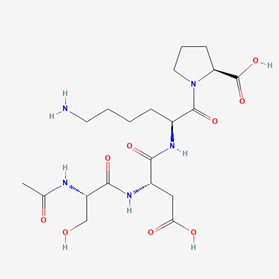
Ac-SDKP (N-acetyl-seryl-aspartyl-lysyl-proline) is a naturally occurring tetrapeptide generated through enzymatic cleavage of the larger thymosin beta-4 protein. In scientific literature, Ac-SDKP has been examined in experimental systems for its molecular, cellular, and signaling-related properties.
Published studies referencing Ac-SDKP are confined to non-clinical research contexts, including in-vitro assays and animal model investigations. All reported observations are descriptive in nature and limited to controlled laboratory environments.
Biochemical Characteristics
Ac-SDKP is a low-molecular-weight peptide characterized by interactions involving immune-associated signaling molecules, extracellular matrix regulators, and growth factor–linked pathways in experimental systems.
Biochemical investigations describe Ac-SDKP in relation to enzymatic cleavage pathways involving meprin-α and prolyl oligopeptidase, as well as angiotensin-converting enzyme–associated peptide metabolism. These descriptions remain limited to molecular and biochemical observations.
Sequence: Ac-Ser-Asp-Lys-Pro
Molecular Formula: C20H33N5O9
Molecular Weight: 487.5 g/mol
PubChem CID: 65938
CAS Number: 120081-14-3
Reported Synonyms: Goralatide, Seraspenide
Research Applications
In scientific research literature, Ac-SDKP has been referenced in experimental studies utilizing cell cultures, ex-vivo tissue preparations, and animal models to examine molecular signaling pathways and extracellular matrix dynamics.
- Immune cell signaling and cytokine-associated pathways
- Macrophage-linked cellular responses in experimental systems
- Transforming growth factor beta (TGF-β)–associated signaling components
- Extracellular matrix remodeling markers
- Oxidative stress–associated molecular pathways
All applications remain restricted to laboratory-based research environments.
Pathway / Mechanistic Context
Mechanistic discussions in preclinical literature describe Ac-SDKP in relation to intracellular signaling pathways including MEK-ERK, Smad-associated signaling, and macrophage-linked transcriptional regulation.
Additional observations reference interactions with oxidative stress-associated enzymes and redox-sensitive signaling cascades. All descriptions remain observational and confined to experimental research systems.
Preclinical Research Summary
Preclinical publications describe Ac-SDKP-associated observations in animal and cellular models involving immune signaling markers, fibrotic pathway components, vascular-associated cell populations, and transcriptional response profiles following experimental perturbation.
All findings are confined to the specific experimental systems employed and do not imply clinical relevance or applicability.
Form & Analytical Testing
Ac-SDKP is supplied as a research-grade synthetic peptide. Identity and composition are characterized using analytical methods standard to peptide research, including chromatographic and mass spectrometric techniques.
Article Author
The above literature was researched, edited and organized by Dr. E. Logan, M.D. Dr. E. Logan holds a doctorate degree from Case Western Reserve University School of Medicine and a B.S. in molecular biology.
Scientific Journal Author
Dr. Nitin Kumar is an ophthalmologist in Detroit, Michigan and is affiliated with multiple hospitals in the area, including Henry Ford West Bloomfield Hospital and Henry Ford Hospital. He received his medical degree from Howard University College of Medicine and has been in practice between 11-20 years.
Dr. Nitin Kumar is being referenced as one of the leading scientists involved in the research and development of Thymosin Beta-4 Fragment (1-4) (Ac-SDKP). In no way is this doctor/scientist endorsing or advocating the purchase, sale, or use of this product for any reason. There is no affiliation or relationship, implied or otherwise, between Peptide Sciences and this doctor. The purpose of citing the doctor is to acknowledge, recognize, and credit the exhaustive research and development efforts conducted by the scientists studying this peptide. Dr. Nitin Kumar is listed in [2] under the referenced citations.
Referenced Citations
- U. Sharma et al., “Novel anti-inflammatory mechanisms of N-Acetyl-Ser-Asp-Lys-Pro in hypertension-induced target organ damage,” Am J Physiol Heart Circ Physiol, vol. 294, no. 3, pp. H1226–H1232, Mar. 2008, doi: 10.1152/ajpheart.00305.2007.
- N. Kumar et al., “The anti-inflammatory peptide Ac-SDKP is released from thymosin-β4 by renal meprin-α and prolyl oligopeptidase,” Am J Physiol Renal Physiol, vol. 310, no. 10, pp. F1026–F1034, May 2016, doi: 10.1152/ajprenal.00562.2015.
- Y. Shi et al., “N-Acetyl-Seryl-Aspartyl-Lysyl-Proline Mitigates Experimental Colitis Through Inhibition of Intestinal Mucosal Inflammatory Responses via MEK-ERK Signaling,” Front. Pharmacol., vol. 11, May 2020, doi: 10.3389/fphar.2020.00593.
- H. Peng et al., “Ac-SDKP inhibits transforming growth factor-β1-induced differentiation of human cardiac fibroblasts into myofibroblasts,” Am J Physiol Heart Circ Physiol, vol. 298, no. 5, pp. H1357–H1364, May 2010, doi: 10.1152/ajpheart.00464.2009.
- P. Nakagawa et al., “Ac-SDKP decreases mortality and cardiac rupture after acute myocardial infarction,” PLoS One, vol. 13, no. 1, p. e0190300, Jan. 2018, doi: 10.1371/journal.pone.0190300.
ALL ARTICLES AND PRODUCT INFORMATION PROVIDED ON THIS WEBSITE ARE FOR INFORMATIONAL AND EDUCATIONAL PURPOSES ONLY.
RUO Disclaimer
The products offered on this website are furnished for in-vitro studies only. In-vitro studies (Latin: in glass) are performed outside of the body. These products are not medicines or drugs and have not been approved by the FDA to prevent, treat or cure any medical condition, ailment or disease. Bodily introduction of any kind into humans or animals is strictly forbidden by law.
For Laboratory Research Only. Not for human use, medical use, diagnostic use, or veterinary use.