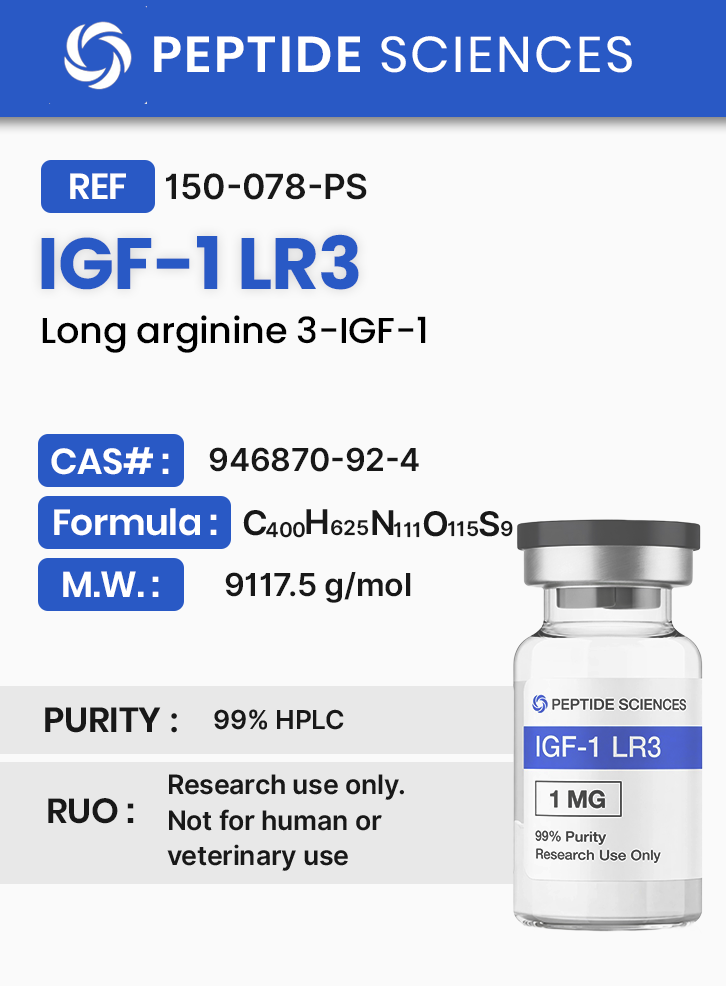
IGF-1 LR3 1mg
$110.00
IGF-1 LR3 is a research peptide analog of human insulin-like growth factor 1 (IGF-1) containing a 13–amino acid N-terminal extension that enhances stability and receptor binding. It interacts with the IGF-1 receptor to activate PI3K/Akt and MAPK/ERK pathways involved in cellular growth, differentiation, and metabolic regulation. IGF-1 LR3 is used in experimental models to study peptide-mediated anabolic signaling, receptor kinetics, and tissue remodeling mechanisms.
For research use only. Not for human consumption.
References:
Yakar S et al., Endocr Rev, 2001 22(6):803–817
Bach LA et al., Mol Cell Endocrinol, 2018 473:1–9
Humbel RE et al., Eur J Biochem, 1990 190(3):445–462
Overview
IGF-1 LR3 (Long Arg3 Insulin-Like Growth Factor-1) is a synthetic peptide analog engineered for laboratory investigation of insulin-like growth factor receptor (IGF-1R) signaling. Structural modification relative to native IGF-1 reduces affinity for insulin-like growth factor binding proteins (IGFBPs), resulting in altered receptor engagement kinetics and extended availability in controlled experimental systems.
This Receptor Grade material is supplied as a research reagent intended for mechanistic studies of IGF-1R-mediated signal transduction, cellular proliferation pathways, and survival signaling networks in in-vitro and preclinical in-vivo (animal) models.
Biochemical Characteristics
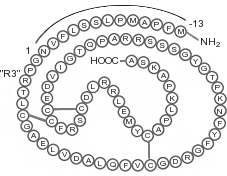
Sequence: MFPAMPLSSLFVNGPRTLCGAELVDALQFVCGDRGFYFNKPTGYGSSSRRAPQTGIVDECCFRSCDLRRLEMYCAPLKPAKSA
Molar Mass: 9,111 Da
Synonyms: Long Arg3 IGF-1 (Receptor Grade), Long R3 IGF-1
IGF-1 LR3 differs from native IGF-1 through amino-acid substitution and N-terminal extension, which collectively reduce IGFBP interaction while preserving high-affinity binding to IGF-1R. These properties make IGF-1 LR3 a useful probe for isolating receptor-specific signaling events without confounding sequestration by endogenous binding proteins in experimental matrices.
Research Applications
- IGF-1 receptor binding and activation assays
- Signal transduction studies involving PI3K/AKT and MAPK/ERK pathways
- Comparative analyses of IGFBP-dependent versus IGFBP-resistant IGF analogs
- Cell proliferation, differentiation, and apoptosis modeling in cultured cell systems
- Receptor kinetics and downstream phosphorylation mapping
- Preclinical in-vivo (animal) studies examining IGF-axis biology
Receptor Grade IGF-1 LR3 is commonly selected for experiments requiring robust and sustained IGF-1R engagement under tightly controlled laboratory conditions.
Pathway / Mechanistic Context
IGF-1 LR3 primarily interacts with the insulin-like growth factor-1 receptor (IGF-1R), a transmembrane tyrosine kinase receptor. Ligand binding induces receptor autophosphorylation, initiating downstream signaling cascades including:
- PI3K → AKT signaling associated with cellular survival and metabolic regulation
- RAS → RAF → MEK → ERK signaling involved in cell cycle progression and differentiation
Due to its reduced affinity for IGFBPs, IGF-1 LR3 demonstrates prolonged receptor availability in experimental systems, enabling extended interrogation of receptor-proximal and downstream signaling events. Limited cross-interaction with the insulin receptor has also been reported in biochemical assays, providing additional context for comparative receptor specificity studies.
Preclinical Research Summary
Preclinical investigations utilizing IGF-1 LR3 focus on elucidating IGF-axis biology rather than organism-level outcomes. In cell-based and animal models, IGF-1 LR3 has been employed to:
- Characterize receptor binding affinity and internalization dynamics
- Quantify downstream phosphorylation profiles of IGF-1R substrates
- Model regulatory mechanisms governing cell survival and programmed cell death
- Examine differentiation pathways in lineage-specific progenitor cells
All findings reported in the literature are derived from controlled in-vitro or animal-based experimental systems and are interpreted strictly within a mechanistic research framework.
Form & Analytical Testing
This product is supplied as a lyophilized peptide for laboratory research use. Analytical characterization typically includes identity confirmation and purity assessment using orthogonal methods such as high-performance liquid chromatography (HPLC) and mass spectrometry (MS).
Researchers should employ standard peptide handling practices, including controlled reconstitution, appropriate buffer selection, and minimization of adsorption or degradation, to ensure experimental consistency.
RUO Disclaimer
The products offered on this website are furnished for in-vitro studies only. In-vitro studies (Latin: in glass) are performed outside of the body. These products are not medicines or drugs and have not been approved by the FDA to prevent, treat or cure any medical condition, ailment or disease. Bodily introduction of any kind into humans or animals is strictly forbidden by law.
For Laboratory Research Only. Not for human use, medical use, diagnostic use, or veterinary use.