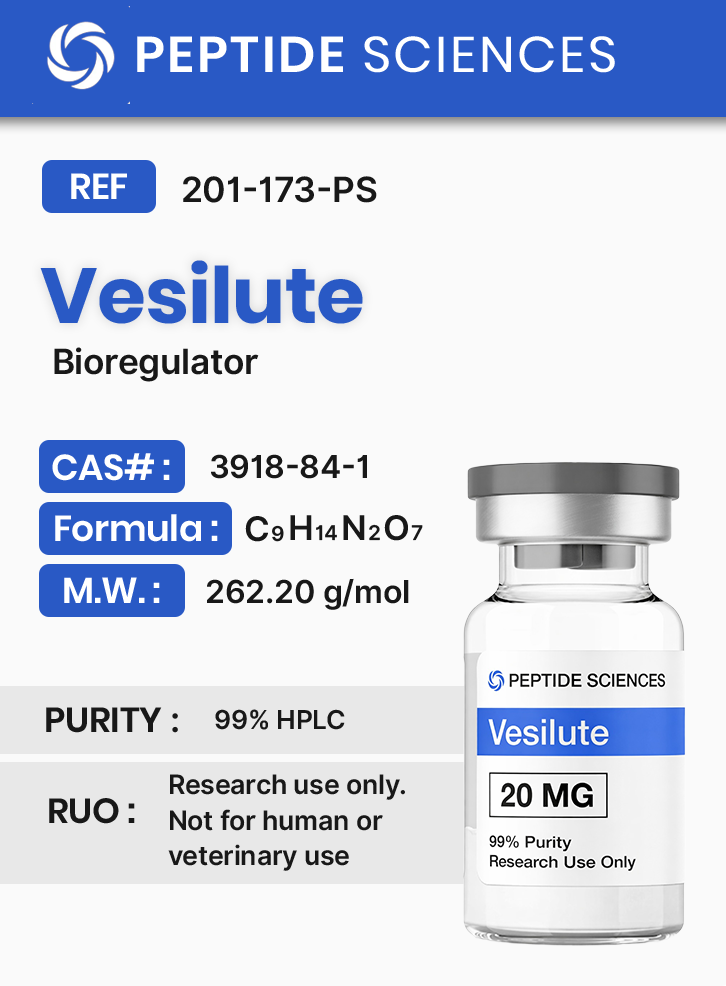
Vesilute 20mg (Bioregulator)
$65.00
Vesilute is a synthetic peptide complex isolated from bladder tissue extracts. It has been shown in experimental models to modulate urothelial regeneration, smooth muscle tone, and epithelial cell signaling. Vesilute is used in research exploring peptide-based regulation of urogenital tract homeostasis and cellular communication in epithelial systems.
For research use only. Not for human consumption.
References:
Khavinson VK et al., Bull Exp Biol Med, 2004 137(5):593–596
Linkova NS et al., Adv Gerontol, 2012 25(1):120–124
Anisimov VN et al., Arch Gerontol Geriatr, 2017 71:142–146
Overview
Vesilute is a dipeptide (Glu-Asp; ED) discussed in peptide bioregulator / cytomedine research literature and reported to be present in multiple tissues. While it is among the less extensively characterized peptides in this class, research discussions have focused on bladder and genitourinary system tissues, including investigational observations relevant to urinary tract function in aging-related contexts and proposed organotrophic effects in prostate-focused research settings.
Additional publications on cytomedines have described experimental findings related to sperm quality and fertility parameters (e.g., reported changes in sperm concentration, morphology, and viability) in prostatitis-associated contexts. Separately, Glu-Asp (ED), along with other dipeptides, has been reported as a contributor to umami taste in food chemistry research, which is sometimes mentioned as a biochemical characteristic relevant to dietary presence and oral exposure in experimental discussions.
Biochemical Characteristics
Amino Acid Sequence: Glu-Asp (ED)
Molecular Formula: C9H14N2O7
Molecular Weight: 262.20 g/mol
PubChem CID: 99716
CAS Number: 3918-84-1
Synonyms: alpha-glutamylaspartic acid, SCHEMBL1674753, vesilut, ED dipeptide
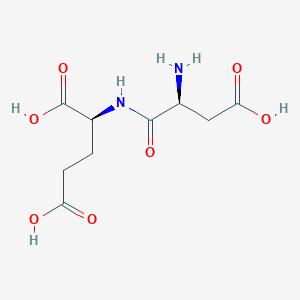 Source: PubChem
Research Applications
In laboratory research contexts, vesilute is discussed in experimental designs exploring smooth muscle regulation in the urinary tract and prostate-associated models, as well as broader cytomedine frameworks relevant to aging-related organ function. These studies commonly focus on mechanistic hypotheses (e.g., smooth muscle tone, microcirculation) and exploratory endpoints (e.g., urinary tract function markers, prostate-associated outcomes, and fertility-related parameters in prostatitis-associated contexts).
- Mechanistic studies of smooth muscle tone in bladder / urinary tract experimental systems
- Exploration of microcirculatory hypotheses in prostate-focused research models
- Research on cytomedines in prostatitis-associated contexts, including sperm quality endpoints
- Food chemistry studies evaluating dipeptides (including Glu-Asp) as contributors to umami-related non-volatile components
Pathway / Mechanistic Context
Vesilute is discussed in the literature with hypotheses linking it to smooth muscle relaxation mechanisms relevant to the bladder wall and vasculature. One proposed framework relates vesilute to interruption of aggregation-associated steps that influence glycogen phosphorylase regulation and downstream glycogen utilization in muscle tissues. In this model, reduced glycogen breakdown is proposed to decrease the energy supply needed to sustain contraction, thereby supporting relaxation.
Mechanistic discussions also extend to vasculature, where smooth muscle tone is a key determinant of vessel diameter and microcirculatory perfusion. In prostate-focused research narratives, improved microcirculation is proposed to influence inflammatory status and tissue remodeling (e.g., fibrosis-related hypotheses) in genitourinary experimental contexts.
Preclinical Research Summary
Published research referenced in vesilute-related writeups includes: (i) analytical studies reporting organ-specific dipeptide profiling, (ii) cytomedine-focused publications in prostatitis and gerontology contexts, (iii) mechanistic discussions relevant to glycogen phosphorylase behavior under stress conditions, and (iv) food chemistry research identifying non-volatile umami contributors. Collectively, these sources are used to inform research hypotheses around urinary tract smooth muscle tone, vascular microcirculation, and exploratory fertility-related endpoints in prostatitis-associated settings.
These findings are presented for scientific and educational discussion and should be interpreted within the context of the referenced experimental systems, study designs, and endpoints (including non-clinical models and region-specific clinical literature where applicable).
Form & Analytical Testing
Vesilute is referenced in research contexts as a small dipeptide (ED) that may be used in experimental protocols requiring verified identity and composition. Typical analytical characterization in peptide workflows may include methods such as high-performance liquid chromatography (HPLC) and mass spectrometry (MS) to confirm identity and purity. Where applicable, additional testing may include content verification and batch-to-batch consistency checks to support experimental reproducibility.
Article Author
The above literature was researched, edited and organized by Dr. E. Logan, M.D. Dr. E. Logan holds a doctorate degree from Case Western Reserve University School of Medicine and a B.S. in molecular biology.
Scientific Journal Author
 Vladimir Khavinson is a Professor, President of the European region of the International Association of Gerontology and Geriatrics; Member of the Russian and Ukrainian Academies of Medical Sciences; Main gerontologist of the Health Committee of the Government of Saint Petersburg, Russia; Director of the Saint Petersburg Institute of Bioregulation and Gerontology; Vice-president of Gerontological Society of the Russian Academy of Sciences; Head of the Chair of Gerontology and Geriatrics of the North-Western State Medical University, St-Petersburg; Colonel of medical service (USSR, Russia), retired. Vladimir Khavinson is known for the discovery, experimental and clinical studies of new classes of peptide bioregulators as well as for the development of bioregulating peptide therapy. He is engaged in studying of the role of peptides in regulation of the mechanisms of ageing. His main field of actions is design, pre-clinical and clinical studies of new peptide geroprotectors. A 40-year-long investigation resulted in a multitude of methods of application of peptide bioregulators to slow down the process of ageing and increase human life span. Six peptide-based pharmaceuticals and 64 peptide food supplements have been introduced into clinical practice by V. Khavinson. He is an author of 196 patents (Russian and international) as well as of 775 scientific publications. His major achievements are presented in two books: “Peptides and Ageing” (NEL, 2002) and “Gerontological aspects of genome peptide regulation” (Karger AG, 2005). Vladimir Khavinson introduced scientific specialty “Gerontology and Geriatrics” in the Russian Federation on the governmental level. Academic Council headed by V. Khavinson has oversighted over 200 Ph.D. and Doctorate theses from many different countries.
Prof. Vladimir Khavinson is being referenced as one of the leading scientists involved in the research and development of Vesilute. In no way is this doctor/scientist endorsing or advocating the purchase, sale, or use of this product for any reason. There is no affiliation or relationship, implied or otherwise, between Peptide Sciences and this doctor. The purpose of citing the doctor is to acknowledge, recognize, and credit the exhaustive research and development efforts conducted by the scientists studying this peptide.
Referenced Citations
- E. Heidenreich et al., “A Novel UPLC-MS/MS Method Identifies Organ-Specific Dipeptide Profiles,” Int. J. Mol. Sci., vol. 22, no. 18, p. 9979, Sep. 2021, doi: 10.3390/ijms22189979.
- A. A. Kamalov, E. A. Efremov, S. D. Dorofeev, and S. M. Paniushkin, “[Use of oral vitaprost in the treatment of chronic abacterial prostatitis],” Urol. Mosc. Russ. 1999, no. 5, pp. 45–50, Oct. 2006.
- Y. Kong et al., “Comparison of non-volatile umami components in chicken soup and chicken enzymatic hydrolysate,” Food Res. Int., vol. 102, pp. 559–566, Dec. 2017, doi: 10.1016/j.foodres.2017.09.038.
- T. B. Eronina et al., “Effect of GroEL on thermal aggregation of glycogen phosphorylase b from rabbit skeletal muscle,” Macromol. Biosci., vol. 10, no. 7, pp. 768–774, Jul. 2010, doi: 10.1002/mabi.200900396.
- “Glycogen Phosphorylase B – an overview | ScienceDirect Topics.” https://www.sciencedirect.com/topics/neuroscience/glycogen-phosphorylase-b (accessed Feb. 26, 2022).
- V. G. Morozov and V. K. Khavinson, “[Prospects of cytomedines application in clinical medicine and gerontology],” Klin. Med. (Mosk.), vol. 78, no. 2, pp. 42–45, 2000.
- B. A. Neymark, A. I. Neymark, A. V. Davydov, I. I. Klepikova, N. A. Nozdrachev, and M. V. Razdorskaya, “[ROLE OF CYTOMEDINES IN THE TREATMENT OF PATIENTS WITH CHRONIC PROSTATITIS ASSOCIATED WITH IMPAIRED SPERMATOGENESIS],” Urol. Mosc. Russ. 1999, no. 5, pp. 70, 72–73, Oct. 2015.
ALL ARTICLES AND PRODUCT INFORMATION PROVIDED ON THIS WEBSITE ARE FOR INFORMATONAL AND EDUCATIONAL PURPOSES ONLY.
RUO Disclaimer
The information presented in this article is provided solely for scientific, educational, and laboratory reference purposes. Any products or materials referenced are intended exclusively for in-vitro laboratory research use and are not intended for human or animal use, including diagnosis, treatment, mitigation, or prevention of any disease. No content herein should be construed as medical, clinical, or therapeutic guidance.
For Laboratory Research Only. Not for human use, medical use, diagnostic use, or veterinary use.