Decapeptide-12 (Topical)
$240.00
Decapeptide-12 is a synthetic oligopeptide investigated for its inhibitory activity against tyrosinase, the copper-containing enzyme central to melanin synthesis. In laboratory and animal models, the peptide has demonstrated the ability to reduce melanin production through reversible interaction with tyrosinase, making it a subject of interest in pigmentation and dermatologic research.
Experimental studies evaluate Decapeptide-12 for its effects on melanocyte biology, pigment formation pathways, and oxidative enzymatic cascades involved in skin photodamage and hyperpigmentation models. All findings are derived from in-vitro, ex-vivo, or preclinical investigations and are intended strictly for scientific and research applications.
For research use only. Not for human consumption.
References:
Pillaiyar T et al., Med Res Rev, 2017 37(5):931–1015
Ando H et al., Pigment Cell Res, 2007 20(2):110–119
Solano F et al., Pigment Cell Melanoma Res, 2006 19(6):550–571
Overview
Decapeptide-12 is a synthetic short-chain oligopeptide composed of ten amino acids and primarily studied for its anti-tyrosinase activity. Tyrosinase is a rate-limiting enzyme in the melanin biosynthesis pathway, catalyzing the oxidation of phenolic substrates into quinones that ultimately form melanin pigments. By reversibly binding to tyrosinase, Decapeptide-12 interferes with this enzymatic cascade under controlled laboratory conditions.
Because melanin production is tightly regulated within melanosomes of pigment-producing cells, Decapeptide-12 is used in research settings to investigate mechanisms governing pigmentation, enzyme kinetics, and regulatory pathways associated with the TYR gene and related molecular targets. Its activity has been characterized in cultured melanocytes, animal photodamage models, and enzymatic assays. These findings remain confined to experimental research contexts.
Biochemical Characteristics
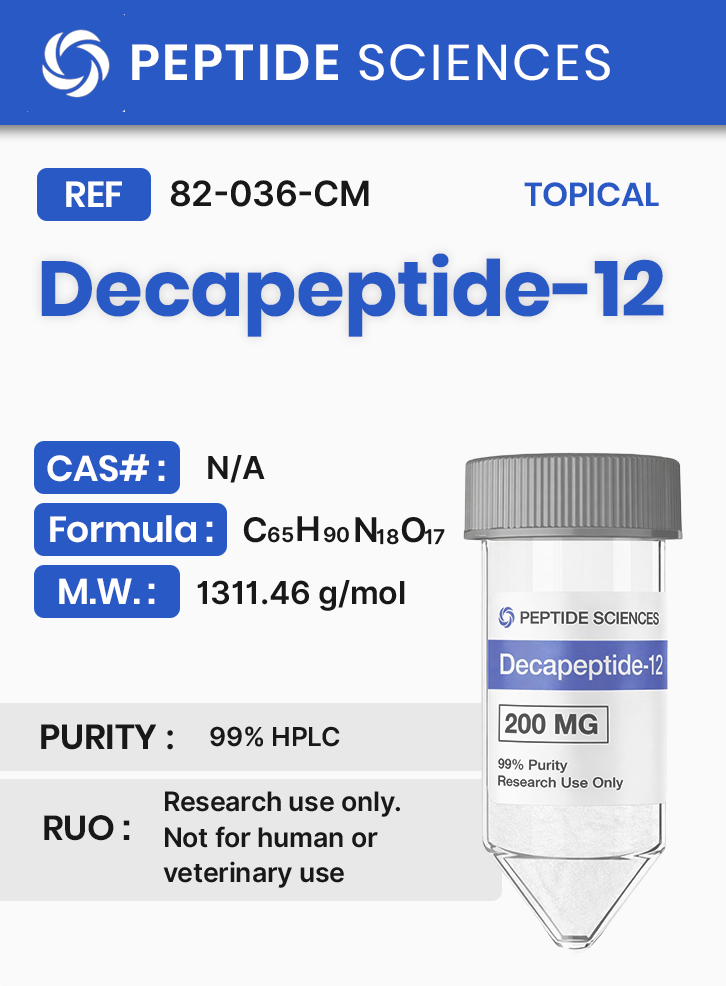
Sequence (Three-Letter Code): Tyr-Arg-Ser-Aar-Lysd-Tyr-Ser-Ser-Trp-Tyr
Molecular formula: C65H90N18O17
Molecular weight: 1311.46 g/mol
Decapeptide-12 is a short, sequence-specific peptide suitable for mechanistic enzyme studies, including binding analyses and oxidation rate measurements in tyrosinase-centered biochemical assays.
Research Applications
Decapeptide-12 is primarily utilized in pigmentation research to study inhibition of tyrosinase activity and downstream melanin synthesis. Experimental models assess enzyme kinetics, melanin content quantification in cultured melanocytes, oxidative phenol conversion assays, and modulation of pigmentation markers in controlled settings. These applications support mechanistic investigations into hyperpigmentation pathways and photodamage-associated pigment changes.
Beyond dermatologic research, tyrosinase inhibition has broader investigational relevance. In food science models, the peptide has been evaluated for its capacity to reduce enzymatic browning caused by phenolic oxidation in plant tissues. In entomological research, tyrosinase-related pathways involved in exoskeleton formation and wound repair are also studied using enzyme inhibitors. All applications of Decapeptide-12 are limited to laboratory, in-vitro, and preclinical research purposes only.
Pathway / Mechanistic Context
Tyrosinase is a binuclear copper oxidase that catalyzes rate-limiting oxidation steps in pigment biosynthesis and related phenolic oxidation pathways. Its catalytic activity generates reactive intermediates that subsequently polymerize into higher-order pigment structures.
Decapeptide-12 has been described in preclinical literature as a reversible modulator of tyrosinase activity. Mechanistic investigations focus on peptide–enzyme interactions, copper coordination effects, and alterations in substrate oxidation kinetics without permanent enzyme inactivation.
Molecular studies frequently integrate tyrosinase gene expression data (TYR) with enzymatic activity readouts to contextualize pathway flux and biochemical outcomes in controlled experimental systems.
Preclinical Research Summary
Preclinical investigations have evaluated decapeptide-12 in isolated enzyme assays and pigment-related cellular models. In vitro studies using cultured pigment-producing cells have reported measurable reductions in melanin-associated biochemical markers consistent with upstream tyrosinase modulation under defined experimental conditions.
Comparative assay designs often include reference tyrosinase inhibitors to contextualize activity modulation. Such benchmarking is limited to analytical comparison within laboratory systems and does not imply applicability beyond research use.
Form & Analytical Testing
Decapeptide-12 is supplied as a research-grade peptide intended for laboratory experimentation. Standard analytical characterization typically includes high-performance liquid chromatography (HPLC) and mass spectrometry (MS) to confirm identity and purity. Handling and storage should follow established peptide reagent laboratory protocols.
Referenced Citations
- Iozumi, K., Hoganson, G. E., Pennella, R., Everett, M. A. & Fuller, B. B. Role of tyrosinase as the determinant of pigmentation in cultured human melanocytes. J. Invest. Dermatol. 100, 806–811 (1993).
- TYR tyrosinase [Homo sapiens (human)] – Gene – NCBI. Available at: http://www.ncbi.nlm.nih.gov/gene/7299
- Abu Ubeid, A., Zhao, L., Wang, Y. & Hantash, B. M. Short-sequence oligopeptides with inhibitory activity against mushroom and human tyrosinase. J. Invest. Dermatol. 129, 2242–2249 (2009).
ALL ARTICLES AND PRODUCT INFORMATION PROVIDED ON THIS WEBSITE ARE FOR INFORMATIONAL AND EDUCATIONAL PURPOSES ONLY.
RUO Disclaimer
The products offered on this website are furnished for in-vitro studies only. In-vitro studies (Latin: in glass) are performed outside of the body. These products are not medicines or drugs and have not been approved by the FDA to prevent, treat, or cure any disease or condition. Bodily introduction of any kind into humans or animals is strictly forbidden by law.
For Laboratory Research Only. Not for human use, medical use, diagnostic use, or veterinary use.