Matrixyl 200mg (Topical)
$200.00
Matrixyl is a palmitoylated pentapeptide (Pal-Lys-Thr-Thr-Lys-Ser) investigated for its regulatory effects on extracellular matrix synthesis and dermal signaling. It enhances collagen and fibronectin gene expression in cultured fibroblasts through TGF-β and integrin-mediated pathways. Matrixyl serves as a topical research model for studying peptide-driven cellular communication, matrix remodeling, and fibroblast activation mechanisms.
For research use only. Not for human consumption.
References:
Katayama K et al., J Biochem, 1991 110(4):575–580
Masaki H et al., J Cosmet Sci, 2009 60(6):751–760
Schagen SK, Clin Interv Aging, 2017 12:1609–1624
Overview
Matrixyl is commonly referenced as palmitoyl pentapeptide-4 (often written as Pal-KTTKS), a lipidated peptide motif used as a laboratory tool compound for investigating extracellular matrix (ECM) biology and peptide–lipid conjugate behavior in controlled experimental systems. In research workflows, lipidation (e.g., palmitoylation) is frequently leveraged to alter peptide hydrophobicity, membrane association, and local microenvironment interactions, enabling mechanistic exploration of structure–function relationships in peptide-based modulators.
Biochemical Characteristics
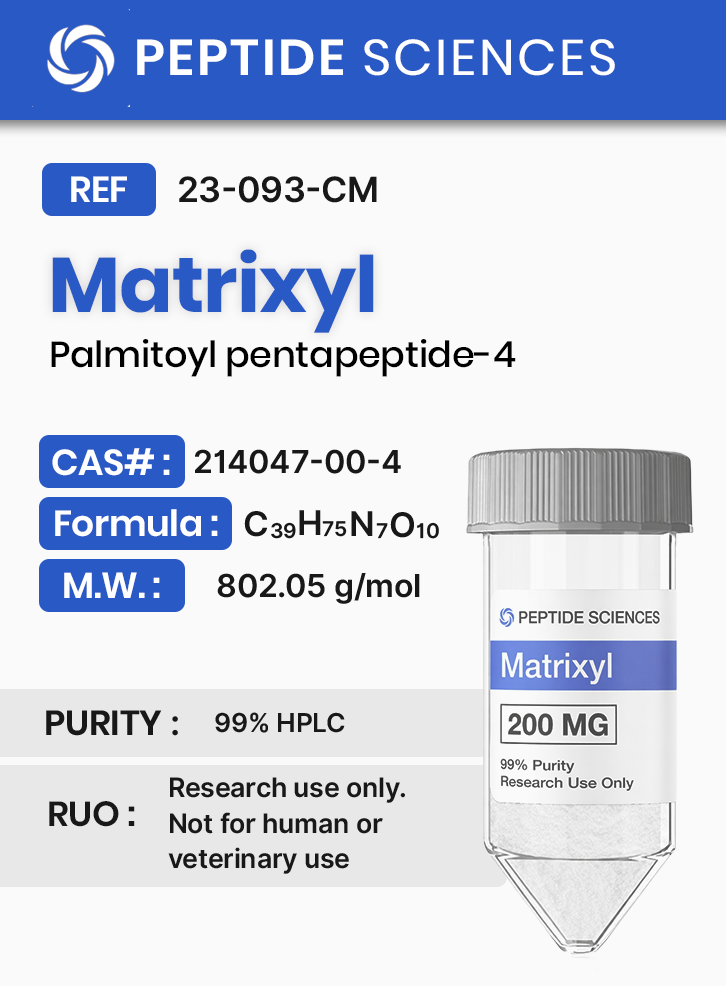
Molecular Formula: C39H75N7O10
Molecular Weight: 802.05 g/mol
Sequence (Three-Letter Code): Pal-Lys-Thr-Thr-Ser-OH or Pal-KTTS-OH
Common Literature Name: Palmitoyl Pentapeptide-4 (often written as Pal-KTTKS)
Matrixyl is a lipidated peptide composed of a palmitoyl (C16) fatty-acid chain covalently linked to a short amino-acid sequence. In peptide research, lipidation is commonly used to influence properties such as hydrophobicity, adsorption to laboratory plastics/glass, aggregation propensity, and interaction with hydrophobic interfaces (including model membranes). These properties can be relevant when designing reproducible cell-based assays and standardizing handling variables in peptide studies.
Research Applications
Matrixyl is supplied for laboratory research workflows that may include (non-exhaustive):
- Fibroblast-based experiments evaluating ECM-associated transcriptional programs (e.g., collagen-related markers, matrix organization panels)
- Structure–activity comparisons of lipidated vs. non-lipidated peptide motifs in controlled assay systems
- Assays examining peptide–interface behavior (e.g., adsorption, aggregation, membrane-association models) that can influence apparent potency and exposure
- Exploratory matrix remodeling studies measuring MMP/TIMP panels, cytokine/chemokine profiles, and ECM deposition endpoints (immunostaining/biochemical extraction)
- Analytical method development for lipopeptides (identity confirmation, purity profiling, stability checks across buffers/containers)
Pathway / Mechanistic Context
In ECM research, fibroblast signaling environments are commonly characterized by coordinated regulation of matrix synthesis, processing, crosslinking, and degradation. Experimental readouts often focus on:
- Collagen-related markers and ECM structural proteins (transcripts and protein abundance)
- Matrix turnover signatures (e.g., MMP/TIMP expression, ECM degradation products)
- Adhesion and mechano-signaling nodes (integrin-linked pathways, kinase/transcription factor activation patterns)
As a lipidated peptide tool compound, Matrixyl may be used to interrogate how peptide–interface behavior (membrane association, local concentration effects, adsorption to labware) can modulate stimulus–response relationships and contribute to observed changes in ECM-related endpoints in controlled in-vitro systems.
Preclinical Research Summary
1) Fibroblast / ECM Marker Studies (In Vitro)
Published laboratory work has evaluated palmitoylated peptide motifs such as C16-linked KTTKS sequences in fibroblast systems, using ECM-relevant endpoints (e.g., collagen-associated readouts) as part of controlled mechanistic study designs. These studies are frequently used to guide assay optimization and hypothesis generation for ECM signaling investigations in vitro [2].
2) Translational Cosmetic-Science Literature (Human Skin Appearance Endpoints)
Cosmetic-science and dermatology-adjacent literature has discussed topical palmitoyl pentapeptide findings in photoaged skin appearance contexts (e.g., elasticity / fine lines) as observational outcomes reported in the cosmetic literature. These summaries are provided for background only and should be interpreted within the limitations of formulation differences, study design variability, and endpoint selection [3].
3) Future Research Directions (Method Standardization & Advanced Models)
Ongoing research interest in lipidated peptide motifs like palmitoyl pentapeptides includes expanded structure–activity analyses, comparative evaluation across related lipopeptides, and improved standardization for quantifying ECM deposition and organization. Additional directions include evaluation in complex culture systems (e.g., 3D matrices and organotypic models) and deeper pathway mapping of matrix-associated transcriptional responses in controlled preclinical settings.
Important: All research summaries above reflect non-clinical observations and are provided solely to support experimental planning and mechanistic discussion.
Form & Analytical Testing
This peptide is supplied for laboratory handling and downstream analytical verification. Product identity and purity are commonly confirmed using chromatographic and mass spectrometric methods. Batch-specific analytical documentation is provided below.
Referenced Citations
- PubChem. Palmitoyl Pentapeptide-4 / related palmitoyl pentapeptide entries (compound data and identifiers). PubChem
- Jones RR, Castelletto V, Connon CJ, Hamley IW. “Collagen Stimulating Effect of Peptide Amphiphile C-16-KTTKS on Human Fibroblasts.” Mol Pharmaceutics. 2013. ACS (DOI)
- Aruan RR, et al. “Double-blind, Randomized Trial on the Effectiveness of Topical Acetyl Hexapeptide-8 Cream…” (article includes citation to Robinson LR, Fitzgerald NC, Doughty DG, et al., 2005, regarding topical palmitoyl pentapeptide in photoaged facial skin). J Clin Aesthet Dermatol (JCAD Online). 2023. Full Text
ALL ARTICLES AND PRODUCT INFORMATION PROVIDED ON THIS WEBSITE ARE FOR INFORMATIONAL AND EDUCATIONAL PURPOSES ONLY.
RUO Disclaimer
The products offered on this website are furnished for in-vitro studies only. In-vitro studies (Latin: in glass) are performed outside of the body. These products are not medicines or drugs and have not been approved by the FDA to prevent, treat or cure any medical condition, ailment or disease. Bodily introduction of any kind into humans or animals is strictly forbidden by law.
For Laboratory Research Only. Not for human use, medical use, diagnostic use, or veterinary use.