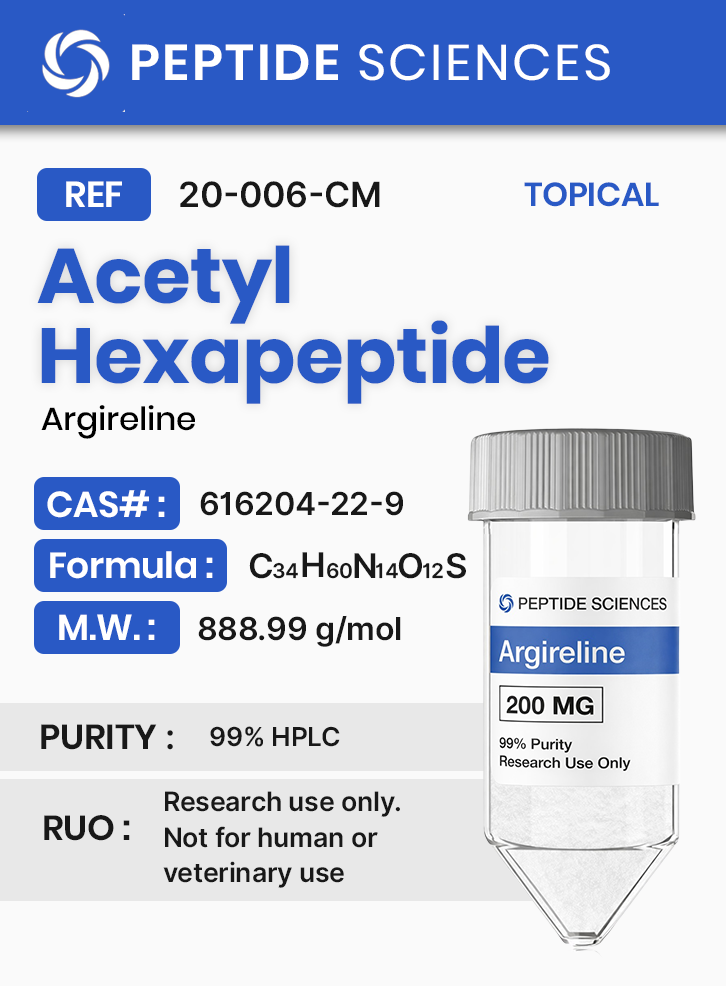
Acetyl Hexapeptide-3 (Argireline) 200mg (Topical)
$220.00
Acetyl Hexapeptide-3 (Argireline) is a synthetic hexapeptide studied in laboratory settings for its interaction with proteins involved in neurotransmitter release. Acetyl Hexapeptide-3 (Argireline) peptide research primarily examines its role in modulating components of the SNARE complex that regulate vesicle docking and acetylcholine release at the cellular level. As a short-chain peptide analog, it is investigated in biochemical and cell-based models to understand how peptide-mediated interference may influence neurotransmission-related pathways.
In vitro studies typically evaluate changes in neurotransmitter release, vesicle fusion dynamics, and expression of synaptic regulatory proteins under controlled experimental conditions. Additional research areas include peptide stability, skin-model penetration behavior, and interaction with other signaling-modulating peptides in reconstructed tissue systems. These biological systems are relevant in laboratory research because they provide measurable endpoints for examining synaptic protein interactions and peptide-driven modulation of cellular communication without implying human or cosmetic application.
For research use only. Not for human consumption.
References:
Blanes-Mira C et al., Int J Cosmet Sci, 2002 24(5):303–310
Daines AM et al., Peptides, 2010 31(10):1994–2001
Calvo P et al., J Cosmet Dermatol, 2015 14(1):27–35
Overview
Acetyl Hexapeptide-3 (Argireline) is a synthetic hexapeptide with the sequence Ac-Glu-Glu-Met-Gln-Arg-Arg-NH₂. It is structurally designed to interact with components of the SNARE protein complex, which plays a central role in vesicle docking and neurotransmitter release. In laboratory research, the peptide is examined for its ability to influence protein–protein interactions involved in acetylcholine vesicle exocytosis.
Most research focuses on in vitro biochemical assays and cell-based systems that measure how modulation of SNARE-associated mechanisms alters neurotransmitter release dynamics. Experimental work often investigates binding interactions, changes in vesicle fusion efficiency, and downstream signaling responses associated with synaptic communication pathways. The compound is generally used as a tool peptide to explore regulated exocytosis and neuromodulatory mechanisms under controlled laboratory conditions.
Biochemical Characteristics
Peptide Sequence: Ac-Glu-Glu-Met-Gln-Arg-Arg-NH2 (Ac-EEMQRR-NH2)
Molecular Formula: C34H60N14O12S
Molecular Weight: 888.99 g/mol
Argireline is a short-chain, acetylated hexapeptide designed to mimic a functional domain of SNAP-25. The peptide’s acetylated N-terminus enhances stability, while its charged residues facilitate competitive binding interactions with SNARE-associated proteins in biochemical assays.
Research Applications
Research applications for Acetyl Hexapeptide-3 are primarily conducted in vitro using biochemical assays, cultured neuronal or non-neuronal cell systems, and reconstructed tissue models. Study designs typically compare peptide-treated samples with untreated or vehicle-treated controls to assess relative changes in synaptic protein interactions and neurotransmitter release markers.
Common experimental endpoints include measurements of acetylcholine release, SNARE complex assembly or stability, vesicle docking efficiency, and expression levels of synaptic regulatory proteins. In skin-model systems, investigators may evaluate peptide penetration characteristics, protein expression changes, or structural markers within reconstructed epidermal models. When studied in combination with other signaling-modulating peptides, comparative analyses focus on additive or complementary effects relative to controls, using quantifiable molecular or structural endpoints.
All findings are interpreted as mechanistic observations within laboratory settings and are limited to controlled experimental systems without implication of human application.
Pathway / Mechanistic Context
Mechanistically, Argireline interferes with the SNARE-mediated membrane fusion pathway by competing with endogenous SNAP-25 for binding sites within the SNARE complex. This competitive interaction alters vesicle priming and fusion efficiency, providing researchers with a controllable means of studying exocytotic regulation, synaptic signaling, and intracellular trafficking mechanisms at the molecular level.
Preclinical Research Summary
Preclinical research involving Argireline includes in-vitro studies using neuronal cell lines, fibroblast cultures, and reconstructed tissue models. These investigations focus on SNARE complex modulation, vesicle trafficking efficiency, and downstream signaling effects. All findings are confined to experimental laboratory systems and are used exclusively to advance understanding of vesicular transport biology.
Form & Analytical Testing
Argireline is supplied as a purified synthetic peptide suitable for analytical and experimental research workflows. Standard quality control methodologies such as high-performance liquid chromatography (HPLC) and mass spectrometry (MS) are used to confirm peptide identity, molecular weight, and purity prior to release.
Referenced Citations
- Blanes-Mira C. et al., “A synthetic hexapeptide (Argireline®) with antiwrinkle activity,” International Journal of Cosmetic Science, 2002; 24(5):303–310.
- Daines A. M. et al., “SNARE protein inhibition by acetyl hexapeptides: implications for regulated exocytosis,” Peptides, 2010; 31(10):1994–2001.
- Calvo P. et al., “Biochemical and clinical evaluation of acetyl hexapeptide-3,” Journal of Cosmetic Dermatology, 2015; 14(1):27–35.
ALL ARTICLES AND PRODUCT INFORMATION PROVIDED ON THIS WEBSITE ARE FOR INFORMATIONAL AND EDUCATIONAL PURPOSES ONLY.
RUO Disclaimer
The products offered on this website are furnished for in-vitro studies only. In-vitro studies (Latin: in glass) are performed outside of the body. These products are not medicines or drugs and have not been approved by the FDA to prevent, treat, or cure any medical condition, ailment, or disease. Bodily introduction of any kind into humans or animals is strictly forbidden by law.
For Laboratory Research Only. Not for human use, medical use, diagnostic use, or veterinary use.