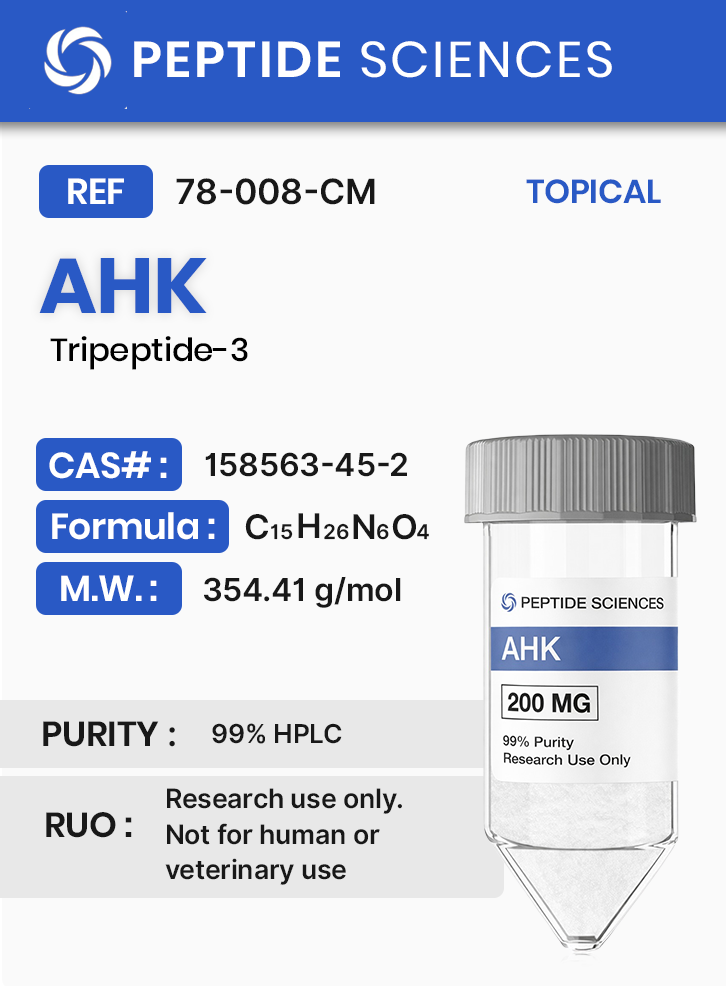
AHK (Tripeptide-3) 200mg (Topical)
$200.00
AHK (Tripeptide-3) is a synthetic tripeptide composed of the amino acids alanine, histidine, and lysine (Ala-His-Lys). AHK tripeptide research investigates its interaction with cellular pathways involved in extracellular matrix regulation, angiogenesis-associated signaling, and tissue remodeling processes. In laboratory studies, AHK is frequently examined alone or in copper-complexed form (AHK-Cu) to evaluate how short peptides influence fibroblast and endothelial cell activity under controlled conditions.
In vitro and animal models commonly assess changes in collagen-associated gene expression, growth factor signaling, and markers of vascular development. Major research areas include dermal fibroblast activation, endothelial cell proliferation dynamics, and hair follicle–related cellular signaling pathways. These biological systems are important in laboratory research because they provide measurable endpoints for studying peptide-mediated modulation of tissue remodeling and vascular signaling without implying cosmetic, therapeutic, or human application.
For research use only. Not for human consumption.
References:
Katayama K et al., J Biochem, 2010 147(1):61–69
Pickart L et al., Biochim Biophys Acta, 2015 1850(8):1863–1885
Siméon A et al., J Invest Dermatol, 2000 115(6):961–968
Overview
AHK-Cu is a short tripeptide (alanine-histidine-lysine) complexed with a copper ion. The copper atom is coordinated through nitrogen-containing residues within the peptide, forming a stable metallopeptide structure. In laboratory research, AHK-Cu is studied for its interaction with cellular pathways involved in extracellular matrix regulation, endothelial cell signaling, and growth factor modulation.
Most published work utilizes in vitro cell culture systems and animal models to evaluate how AHK-Cu influences fibroblast activity, endothelial cell behavior, and transcriptional regulation of structural proteins. Research often focuses on signaling pathways associated with collagen production, angiogenic markers, and cytokine modulation. Within experimental settings, AHK-Cu functions as a research tool to explore copper-dependent peptide signaling and tissue remodeling mechanisms under controlled conditions.
Biochemical Characteristics
Sequence: (Three-Letter Code): Ala-His-Lys-Cu
Molecular formula: C15H25CuN6O4
Molecular weight: 416.9 g/mol
The histidine residue provides a key coordination site for copper binding, enabling formation of a stable metal–peptide complex. This complex is frequently leveraged in mechanistic experiments examining how copper coordination can influence peptide conformation, redox behavior, and interactions with biomolecular targets under controlled in vitro conditions.
Research Applications
Research applications for AHK-Cu are primarily conducted in vitro using cultured dermal fibroblasts, endothelial cells, and hair follicle–associated cell systems, as well as in animal models designed to assess tissue remodeling and vascular development. Study designs typically compare peptide-treated samples with untreated or vehicle-treated controls to quantify changes in gene expression, protein synthesis, and cellular proliferation markers.
Common endpoints include collagen type I expression levels, extracellular matrix protein production, VEGF-associated signaling measurements, endothelial cell migration or proliferation assays, and evaluation of TGF-β1 pathway markers. In hair follicle–focused models, investigators may measure dermal papilla cell activity, vascular density indicators, and follicular structural parameters relative to controls.
Across all systems, findings are interpreted as mechanistic observations within laboratory and preclinical contexts. Results are limited to in vitro and animal research settings and do not imply cosmetic, clinical, or human use.
Pathway / Mechanistic Context
Fibroblasts contribute to ECM homeostasis through production of structural proteins (including collagen and elastin) and secretion of signaling mediators that influence adjacent cell types. Endothelial cells, which form the inner lining of blood vessels, are regulated by growth factors that coordinate angiogenic programs and vascular maintenance.
In mechanistic research, AHK-Cu has been examined for its ability to influence signaling pathways associated with vascular endothelial growth factor (VEGF) and transforming growth factor beta-1 (TGF-β1). These pathways are frequently studied in vitro due to their roles in ECM remodeling, fibroblast phenotype regulation, and endothelial responses in controlled experimental settings.
Copper complexation may further impact the physicochemical behavior of the peptide (e.g., coordination geometry and stability), which can be relevant when designing structure–function experiments involving copper-dependent peptide interactions and downstream molecular readouts.
Preclinical Research Summary
Preclinical laboratory studies (including in vitro cellular systems and animal-model research) have evaluated AHK-Cu–associated changes in fibroblast behavior and ECM-related protein expression. In cultured skin-derived cells, AHK-Cu exposure has been associated with increased collagen type I production under specific experimental conditions, supporting continued use as a probe for collagen-linked transcriptional and translational pathways [1].
Additional benchtop and preclinical investigations have explored AHK-Cu in experimental designs evaluating follicle-associated cell populations and angiogenesis-related signaling (including VEGF-linked responses) [2]. These studies are commonly referenced for mechanistic context when modeling peptide-driven effects on vascular and connective tissue cell systems in vitro.
Form & Analytical Testing
AHK-Cu is supplied as a purified research reagent intended for laboratory experimentation. Analytical verification typically includes high-performance liquid chromatography (HPLC) and mass spectrometry (MS) to confirm identity and purity. Standard laboratory handling practices for peptides and metal–peptide complexes are recommended.
Referenced Citations
- neova-dna-nourishing-study.pdf. Available at: http://www.dermacaredirect.co.uk/skin/frontend/default/dermacare/pdf/neova-dna-nourishing-study.pdf. (Accessed: 25th July 2016)
- Pyo, H. K. et al. The effect of tripeptide-copper complex on human hair growth in vitro. Arch. Pharm. Res. 30, 834–839 (2007).
ALL ARTICLES AND PRODUCT INFORMATION PROVIDED ON THIS WEBSITE ARE FOR INFORMATIONAL AND EDUCATIONAL PURPOSES ONLY.
RUO Disclaimer
The products offered on this website are furnished for in-vitro studies only. In-vitro studies (Latin: in glass) are performed outside of the body. These products are not medicines or drugs and have not been approved by the FDA to prevent, treat or cure any medical condition, ailment or disease. Bodily introduction of any kind into humans or animals is strictly forbidden by law.
For Laboratory Research Only. Not for human use, medical use, diagnostic use, or veterinary use.