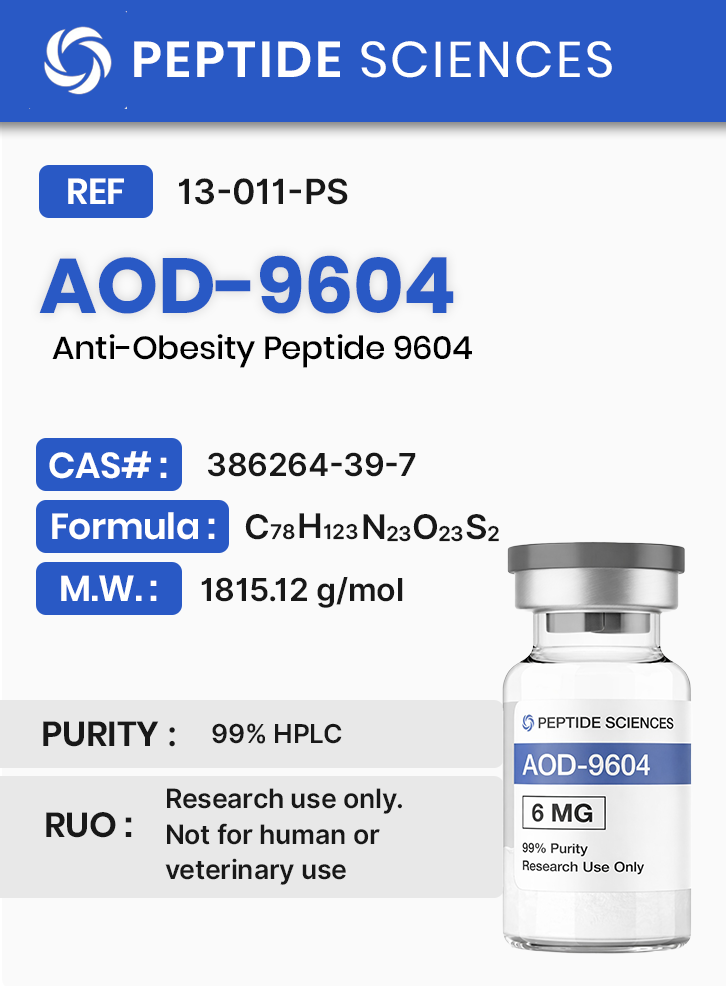
AOD9604 6mg
$65.00
AOD-9604 is a synthetic peptide derived from a modified fragment of human growth hormone (hGH), corresponding to the hGH 176–191 region and containing a disulfide bridge. AOD9604 peptide research examines how this hexadecapeptide influences lipid metabolism–associated signaling in controlled laboratory systems. In preclinical settings, AOD9604 is commonly investigated for its effects on pathways associated with lipolysis and lipogenesis in adipose tissue models.
In vitro experiments and animal studies often evaluate changes in lipid handling markers, adipocyte metabolic activity, and downstream signaling events related to energy balance. Major research areas include adipose tissue metabolism, metabolic pathway regulation in models of altered nutrient handling, and exploratory studies in joint and cardiovascular biology using preclinical endpoints. These systems are important in laboratory research because they provide quantifiable readouts for studying peptide-mediated modulation of metabolic signaling without implying clinical efficacy or human use.
For research use only. Not for human consumption.
References:
Heffernan MA et al., Eur J Endocrinol, 2001 144:511-517
Ng FM et al., Drug Dev Res, 2000 51:63-71
Ng FM et al., Metabolism, 2002 51(12):1739-1743
Overview
AOD9604 is a synthetic hexadecapeptide based on a modified fragment of human growth hormone (hGH), corresponding to amino acids 176–191, and includes a disulfide bridge that contributes to its structural stability. It is studied as a research peptide to explore how specific hGH-derived sequences may influence cellular pathways associated with lipid metabolism. Unlike full-length hGH, AOD9604 is investigated primarily for mechanistic effects on adipocyte lipid handling pathways in controlled experimental systems.
Most published research uses in vitro adipocyte models and animal studies to assess whether AOD9604 modulates biochemical markers linked to lipolysis and lipogenesis. Investigations typically focus on pathway-level changes in lipid mobilization, intracellular lipid accumulation, and gene or protein expression patterns associated with metabolic regulation. Within laboratory contexts, AOD9604 is used as a tool peptide to examine metabolic signaling mechanisms under defined conditions.
Biochemical Characteristics
Sequence: Tyr-Leu-Arg-Ile-Val-Gln-Cys-Arg-Ser-Val-Glu-Gly-Ser-Cys-Gly-Phe
Disulfide bridge: Cys7–Cys15
Molecular Formula: C78H123N23O23S2
Molecular Weight: 1815.12 g/mol
PubChem CID: 16131447
CAS Number: 386264-39-7
AOD9604 is a 16-amino-acid peptide containing an intramolecular disulfide linkage (Cys7–Cys15), a structural feature that can influence conformational constraints and stability in assay matrices. In research workflows, identity and integrity are commonly verified via chromatographic purity profiling and mass-based confirmation prior to use in pathway interrogation experiments.
Research Applications
Research applications for AOD9604 are primarily conducted in vitro and in animal models to evaluate lipid metabolism–related signaling and downstream metabolic endpoints. Experimental designs commonly compare AOD9604-treated groups with untreated or vehicle-treated controls to quantify changes relative to baseline and to distinguish peptide-associated effects from background variation.
Commonly measured endpoints include markers of lipolysis and lipogenesis, changes in adipocyte lipid content, circulating lipid parameters in animal studies, and transcriptional or protein-level changes in pathways involved in energy balance. In preclinical metabolic models, investigators may also assess glucose and insulin-related biomarkers as observational endpoints alongside lipid metrics, interpreted relative to control groups.
Some studies explore AOD9604 in additional preclinical contexts such as joint biology or cardiovascular-related models, using standard laboratory endpoints (e.g., histologic scoring, structural markers, or inflammation-associated biomarkers) where applicable. Across all systems, findings are interpreted as mechanistic observations from in vitro and animal research and do not imply therapeutic, preventive, or clinical use.
Pathway / Mechanistic Context
AOD9604 is used in mechanistic study designs to map signaling and biochemical endpoints associated with lipid metabolism and adipose tissue function. Experimental readouts may include changes in lipid turnover markers, adipocyte-associated transcriptional programs, and pathway-proximal signals linked to nutrient handling. Comparative designs may include full-length hGH as a reference ligand to contextualize fragment-derived effects within broader somatotropic signaling networks, while avoiding confounding interpretation from pleiotropic endocrine pathways.
In vivo studies may incorporate time-course sampling to evaluate exposure–response relationships for selected molecular markers, as well as tissue-level measurements in adipose depots and metabolically relevant organs to characterize pathway distribution and downstream signaling signatures.
Preclinical Research Summary
Preclinical investigations have assessed AOD9604 in obese mouse models and in β3-adrenergic receptor knock-out mice, using lipid-metabolism endpoints and body composition–adjacent measurements to support mechanistic hypothesis testing regarding adipose biology pathways.[5]
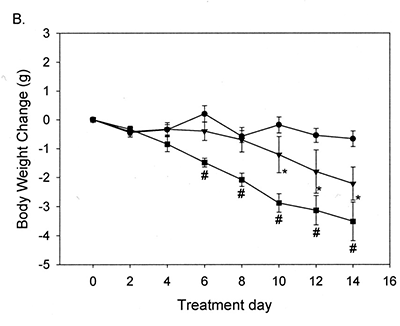 Body weight change in obese mice over 14-day treatment period with AOD9604 (squares), HGH (triangles), and placebo (circles).
Source: Oxford Academic
Additional animal model work has examined joint-tissue response endpoints in rabbit osteoarthritis paradigms following intra-articular experimental dosing designs with AOD9604 (with or without hyaluronic acid), supporting continued investigation of cartilage and matrix-associated biology in controlled preclinical systems.[6]
Form & Analytical Testing
AOD9604 is supplied as a synthetic peptide suitable for controlled laboratory research workflows. Quality control in RUO settings commonly includes chromatographic purity assessment (e.g., HPLC) and identity confirmation by mass spectrometry (MS), along with batch documentation to support experimental reproducibility.
Article Author
The above literature was researched, edited and organized by Dr. Logan, M.D. Dr. Logan holds a doctorate degree from Case Western Reserve University School of Medicine and a B.S. in molecular biology.
Scientific Journal Author
Stier Heike studied biology and holds a PhD in Neurobiology (NMIReutlingen/ University of Hohenheim) and a Master in Bioinformatics (University of Applied Sciences-TFH-Berlin). She worked as a Post-Doc in several national and international Labs in Developmental Neurobiology (NMI-Reutlingen, School of Medicine – University of Utah) and in Bioinformatics (Institute of Bioinformatics – Charité, Berlin). Dr. Heike pioneered a study on the safety and tolerability of the Hexadecapeptide AOD9604 in Humans. In 2007, she joined A&R where she was responsible for the field of regulatory affairs of herbal medicinal products, with a broad knowledge of the adjacent product categories medical device and supplements. Dr. Heike Stier currently works in the field of regulatory affairs for herbal medicinal products at analyze & realize GmbH.
Stier Heike is being referenced as one of the leading scientists involved in the research and development of AOD9604. In no way is this doctor/scientist endorsing or advocating the purchase, sale, or use of this product for any reason. There is no affiliation or relationship, implied or otherwise, between Peptide Sciences and this doctor. The purpose of citing the doctor is to acknowledge, recognize, and credit the exhaustive research and development efforts conducted by the scientists studying this peptide. Dr. Heike is listed in [8] under the referenced citations.
Referenced Citations
- F. M. Ng, J. Sun, L. Sharma, R. Libinaka, W. J. Jiang, and R. Gianello, “Metabolic studies of a synthetic lipolytic domain (AOD9604) of human growth hormone,” Horm. Res., vol. 53, no. 6, pp. 274–278, 2000.
- H. Stier, E. Vos, and D. Kenley, “Safety and Tolerability of the Hexadecapeptide AOD9604 in Humans,” J. Endocrinol. Metab., vol. 3, no. 1–2, pp. 7–15, Apr. 2013. [Journal of Endocrinology & Metabolism]
- “Obesity drug codenamed AOD9604 highly successful in trials,” News-Medical.net, 16-Dec-2004.
- R. Zieba, “[Obesity: a review of currently used antiobesity drugs and new compounds in clinical development],” Postepy Hig. Med. Doswiadczalnej Online, vol. 61, pp. 612–626, Oct. 2007.
- M. Heffernan et al., “The Effects of Human GH and Its Lipolytic Fragment (AOD9604) on Lipid Metabolism Following Chronic Treatment in Obese Mice and β3-AR Knock-Out Mice,” Endocrinology, vol. 142, no. 12, pp. 5182–5189, Dec. 2001.
- D. R. Kwon and G. Y. Park, “Effect of Intra-articular Injection of AOD9604 with or without Hyaluronic Acid in Rabbit Osteoarthritis Model,” Ann. Clin. Lab. Sci., vol. 45, no. 4, pp. 426–432, Jul. 2015.
- M. D. Jensen, “Potential role of new therapies in modifying cardiovascular risk in overweight patients with metabolic risk factors,” Obes. Silver Spring Md, vol. 14 Suppl 3, pp. 143S–149S, Jun. 2006.
- Stier, H., Vos, E., Kenley, D. “Safety and Tolerability of the Hexadecapeptide AOD9604 in Humans.” Journal of Endocrinology and Metabolism, 3, Apr. 2013.
ALL ARTICLES AND PRODUCT INFORMATION PROVIDED ON THIS WEBSITE ARE FOR INFORMATONAL AND EDUCATIONAL PURPOSES ONLY.
RUO Disclaimer
The products offered on this website are furnished for in-vitro studies only. In-vitro studies (Latin: in glass) are performed outside of the body. These products are not medicines or drugs and have not been approved by the FDA to prevent, treat, or cure any medical condition, ailment, or disease. Bodily introduction of any kind into humans or animals is strictly forbidden by law.
For Laboratory Research Only. Not for human use, medical use, diagnostic use, or veterinary use.