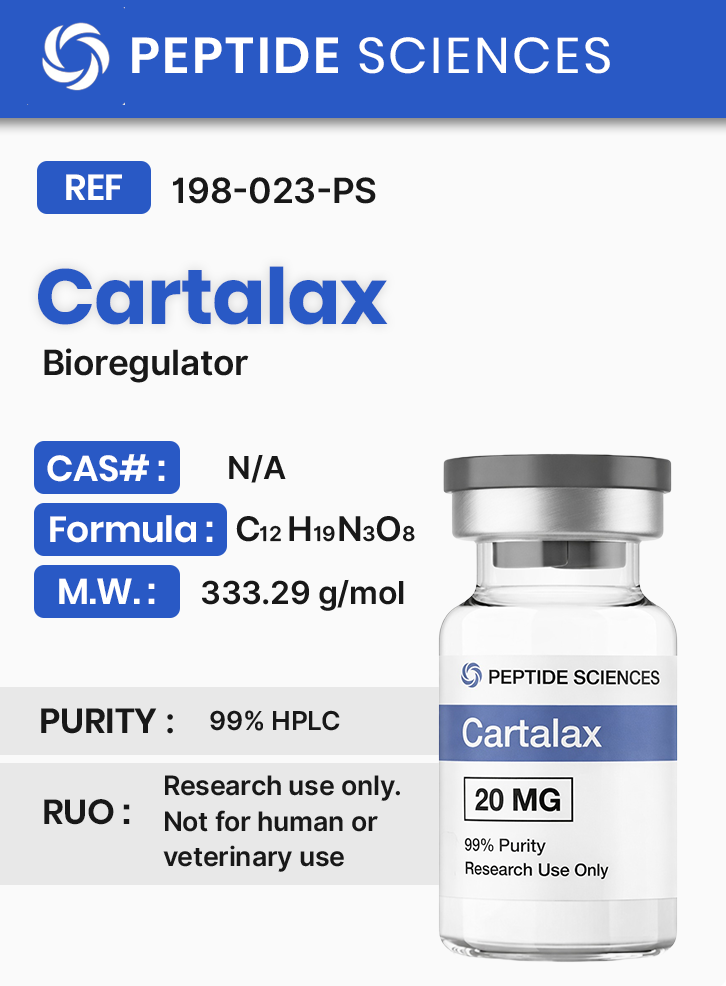
Cartalax 20mg (Bioregulator)
$70.00
Cartalax is a short bioregulatory tripeptide studied in laboratory and preclinical models for its influence on fibroblast-associated signaling and tissue maintenance pathways. Fibroblasts are central regulators of extracellular matrix turnover and connective tissue integrity across systems including skin, cartilage, vasculature, and renal tissue. Cartalax is therefore investigated as a research tool for examining how short peptides may modulate proliferation, apoptosis balance, and senescence-linked molecular markers.
In controlled in vitro and animal studies, Cartalax has been evaluated using endpoints such as proliferation markers (e.g., Ki-67), apoptosis-related proteins (including p53-associated signaling), cytokine expression profiles, and matrix-remodeling enzymes. Additional aging-focused research examines how the peptide may influence gene-expression programs associated with cellular senescence and tissue renewal. All findings are investigational and limited to mechanistic laboratory research contexts.
For research use only. Not for human consumption.
References:
Khavinson VK et al., Bull Exp Biol Med, 2002 134(4):356–359
Anisimov VN et al., Mech Ageing Dev, 1997 96(1–3):123–132
Linkova NS et al., Biogerontology, 2014;15(2):161–170
Overview
Cartalax is a synthetic tripeptide categorized within short bioregulatory peptides investigated for effects on fibroblast function and extracellular matrix dynamics. Fibroblasts are widely distributed cells responsible for collagen production, matrix remodeling, and structural tissue homeostasis. In experimental systems, Cartalax is studied for its potential to influence signaling pathways involved in cell proliferation, apoptosis regulation, and transcriptional modulation linked to aging-related cellular changes.
Research frameworks commonly examine molecular markers such as Ki-67 (cell proliferation index), p53 and related apoptosis-associated pathways, NF-κB signaling components, and matrix metalloproteinases (MMPs). Studies also assess expression patterns of senescence-associated proteins and gene targets implicated in longevity pathways. Observations remain model-dependent and are interpreted strictly within preclinical and mechanistic research settings.
Biochemical Characteristics
Amino Acid Sequence: Ala-Glu-Asp (AED)
Molecular Formula: C12H19N3O8
Molecular Weight: 333.29 g/mol
PubChem CID: 87815447
Synonyms: T-31, AED, SCHEMBL5324601, Alanyl-glutamyl-aspartic acid
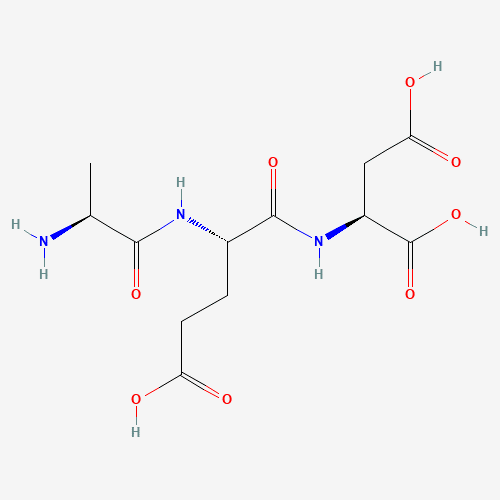 Source: PubChem
Research Applications
Cartalax is utilized in connective tissue and fibroblast biology research to investigate extracellular matrix remodeling and cellular aging mechanisms. In skin and cartilage-derived cell cultures, experimental endpoints include proliferation rates, apoptosis markers (including caspase-associated pathways), MMP expression levels, cytokine signaling profiles, and transcription-factor activity (e.g., AP-1, NF-κB, c-Jun, TGF-β–related pathways). These studies aim to characterize how peptide-mediated modulation may influence balance between matrix deposition and matrix degradation under controlled conditions.
In renal and aging-focused models, Cartalax has been examined for effects on cell-renewal indices and senescence-associated markers such as p16, p21, p53, and SIRT-related proteins. Gene-expression analyses in mesenchymal or fibroblast-derived cultures further explore modulation of pathways including IGF1, FOXO1, TERT, and other longevity-associated targets. These applications are exploratory and intended solely for laboratory investigation, without established clinical translation.
Pathway / Mechanistic Context
Mechanistic studies of Cartalax emphasize its interaction with intracellular regulatory pathways common to fibroblast biology. Reported experimental observations include modulation of proliferation-associated markers such as Ki-67, altered signaling through transcription factors including NF-κB and AP-1, and changes in apoptosis-related proteins such as p53 and caspase-associated pathways. These effects are evaluated in the context of transcriptional regulation, chromatin accessibility, and downstream gene-expression programs.
Additional studies examine the influence of Cartalax on extracellular matrix remodeling through regulation of matrix metalloproteinases (including MMP-1, MMP-3, MMP-8, and MMP-9) and associated signaling mediators (e.g., TGF-β, TNF-α, CCN1). In these models, peptide-associated effects are interpreted as shifts in the balance of matrix synthesis and degradation within defined experimental systems rather than as outcome-driven biological responses.
Renal cell culture investigations further describe Cartalax-associated modulation of senescence-linked molecular markers, including altered expression of p16, p21, p53, and sirtuin-family proteins such as SIRT-6. These pathways are analyzed in vitro to characterize peptide-associated changes in transcriptional and epigenetic regulation during cellular aging models.
Preclinical Research Summary
Preclinical research on Cartalax includes fibroblast-based in-vitro studies and animal-derived tissue culture models. Skin-associated fibroblast experiments report peptide-associated changes in proliferation indices, apoptosis markers, and extracellular matrix–related gene expression under controlled laboratory conditions. These studies are frequently conducted using aging or stress-induced cellular models to evaluate transcriptional and biochemical responses.
Additional preclinical investigations involve renal tissue cultures from young and aged animals, where Cartalax is evaluated alongside other short peptides for its influence on cell renewal markers and senescence-associated proteins. Across these studies, findings are reported as experimental observations within defined model systems and are used to support mechanistic hypotheses related to peptide-mediated regulation of fibroblast and renal cell biology.
Form & Analytical Testing
This product is provided strictly as a laboratory research reagent. Standard analytical characterization for short peptides may include chromatographic purity analysis (e.g., HPLC or UPLC) and molecular mass confirmation by mass spectrometry. Researchers should consult lot-specific certificates of analysis (COA) for identity, purity, and analytical data relevant to experimental documentation and quality assurance.
Article Author
The above literature was researched, edited and organized by Dr. E. Logan, M.D. Dr. E. Logan holds a doctorate degree from Case Western Reserve University School of Medicine and a B.S. in molecular biology.
Scientific Journal Author
 Vladimir Khavinson is a Professor, President of the European region of the International Association of Gerontology and Geriatrics; Member of the Russian and Ukrainian Academies of Medical Sciences; Main gerontologist of the Health Committee of the Government of Saint Petersburg, Russia; Director of the Saint Petersburg Institute of Bioregulation and Gerontology; Vice-president of Gerontological Society of the Russian Academy of Sciences; Head of the Chair of Gerontology and Geriatrics of the North-Western State Medical University, St-Petersburg; Colonel of medical service (USSR, Russia), retired. Vladimir Khavinson is known for the discovery, experimental and clinical studies of new classes of peptide bioregulators as well as for the development of bioregulating peptide therapy. He is engaged in studying of the role of peptides in regulation of the mechanisms of ageing. His main field of actions is design, pre-clinical and clinical studies of new peptide geroprotectors. A 40-year-long investigation resulted in a multitude of methods of application of peptide bioregulators to slow down the process of ageing and increase human life span. Six peptide-based pharmaceuticals and 64 peptide food supplements have been introduced into clinical practice by V. Khavinson. He is an author of 196 patents (Russian and international) as well as of 775 scientific publications. His major achievements are presented in two books: “Peptides and Ageing” (NEL, 2002) and “Gerontological aspects of genome peptide regulation” (Karger AG, 2005). Vladimir Khavinson introduced scientific specialty “Gerontology and Geriatrics” in the Russian Federation on the governmental level. Academic Council headed by V. Khavinson has oversighted over 200 Ph.D. and Doctorate theses from many different countries.
Prof. Vladimir Khavinson is being referenced as one of the leading scientists involved in the research and development of Cartalax. In no way is this doctor/scientist endorsing or advocating the purchase, sale, or use of this product for any reason. There is no affiliation or relationship, implied or otherwise, between Peptide Sciences and this doctor. The purpose of citing the doctor is to acknowledge, recognize, and credit the exhaustive research and development efforts conducted by the scientists studying this peptide.
Referenced Citations
- N. S. Lin’kova et al., “Peptide Regulation of Skin Fibroblast Functions during Their Aging In Vitro,” Bull. Exp. Biol. Med., vol. 161, no. 1, pp. 175–178, May 2016, doi: 10.1007/s10517-016-3370-x.
- V. K. Khavinson, N. S. Linkova, A. S. Diatlova, E. O. Gutop, and O. A. Orlova, “[Short peptides: regulation of skin function during aging.],” Adv. Gerontol. Uspekhi Gerontol., vol. 33, no. 1, pp. 46–54, 2020.
- E. O. Gutop, A. S. Diatlova, N. S. Linkova, O. A. Orlova, S. V. Trofimova, and V. K. Khavinson, “[Aging of skin fibroblasts: genetic and epigenetic factors.],” Adv. Gerontol. Uspekhi Gerontol., vol. 32, no. 6, pp. 908–914, 2019.
- M. B. Ellman, D. Yan, K. Ahmadinia, D. Chen, H. S. An, and H. J. Im, “Fibroblast growth factor control of cartilage homeostasis,” J. Cell. Biochem., vol. 114, no. 4, pp. 735–742, Apr. 2013, doi: 10.1002/jcb.24418.
- N. I. Chalisova, N. S. Lin’kova, T. E. Nichik, A. P. Ryzhak, A. V. Dudkov, and G. A. Ryzhak, “Peptide Regulation of Cells Renewal Processes in Kidney Tissue Cultures from Young and Old Animals,” Bull. Exp. Biol. Med., vol. 159, no. 1, pp. 124–127, May 2015, doi: 10.1007/s10517-015-2906-9.
- V. K. Khavinson et al., “[Tripeptides slow down aging process in renal cell culture],” Adv. Gerontol. Uspekhi Gerontol., vol. 27, no. 4, pp. 651–656, 2014.
- V. Ashapkin, V. Khavinson, G. Shilovsky, N. Linkova, and B. Vanuyshin, “Gene expression in human mesenchymal stem cell aging cultures: modulation by short peptides,” Mol. Biol. Rep., vol. 47, no. 6, pp. 4323–4329, Jun. 2020, doi: 10.1007/s11033-020-05506-3.
ALL ARTICLES AND PRODUCT INFORMATION PROVIDED ON THIS WEBSITE ARE FOR INFORMATIONAL AND EDUCATIONAL PURPOSES ONLY.
RUO Disclaimer
The products offered on this website are furnished for in-vitro studies only. In-vitro studies (Latin: in glass) are performed outside of the body. These products are not medicines or drugs and have not been approved by the FDA to prevent, treat or cure any medical condition, ailment or disease. Bodily introduction of any kind into humans or animals is strictly forbidden by law.
For Laboratory Research Only. Not for human use, medical use, diagnostic use, or veterinary use.