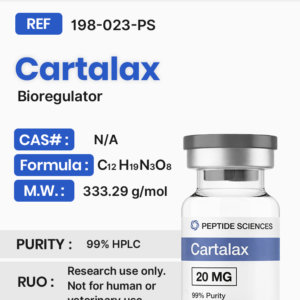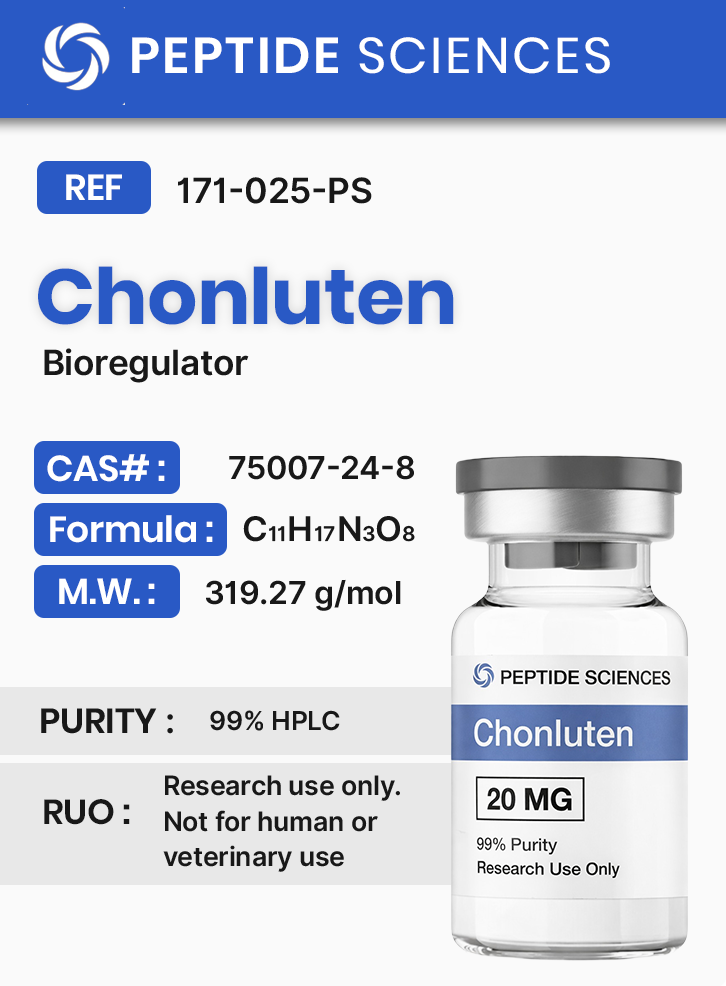
Chonluten 20mg (Bioregulator)
$65.00
Chonluten is a short bioregulatory peptide studied for its potential to influence gene-expression programs associated with inflammation control, antioxidant defenses, and tissue responses to injury. Experimental research suggests the peptide shows its strongest activity in lung tissue, with secondary activity observed in gastrointestinal models, making it a useful laboratory tool for exploring mucosal biology and inflammatory signaling.
In preclinical and mechanistic studies, Chonluten has been evaluated for effects on transcriptional regulation involving oxidative-stress pathways and inflammatory mediators, along with genes linked to proliferation and remodeling during chronic irritation. Because airway mucosal dysfunction is a hallmark feature of chronic inflammatory lung conditions, Chonluten continues to be investigated as a research probe for studying processes relevant to disorders such as asthma and COPD. All findings are investigational and intended for in-vitro and preclinical research contexts only.
For research use only. Not for human consumption.
References:
Khavinson VK et al., Bull Exp Biol Med, 2004 137(5):597–600
Trofimova SV et al., Adv Gerontol, 2015 28(3):432–439
Linkova NS et al., Biochemistry (Moscow), 2012 77(7):874–881
Overview
Chonluten is a synthetic tripeptide bioregulator (T-34) investigated for its capacity to modulate gene expression patterns involved in antioxidant activity and inflammation regulation. Available research describes tissue-preferential activity in pulmonary models, with additional effects reported in gastrointestinal settings. Mechanistic work focuses on how short peptides may interact with regulatory regions that influence transcription and downstream inflammatory and oxidative-stress responses.
Within airway research models, Chonluten is studied in the context of bronchial mucosal homeostasis—processes that include epithelial barrier behavior, inflammatory cytokine signaling, and oxidative-stress handling. These areas are relevant to chronic airway pathology because sustained inflammation can drive mucus dysregulation, mucosal thickening, remodeling, and progressive functional decline. Evidence remains limited to experimental research and is not a basis for clinical use.
Biochemical Characteristics
Molecular Formula: C11H17N3O8
Molecular Weight: 319.27 g/mol
PubChem CID: 194641
CAS No: 75007-24-8
Alternative Names: T-34 tripeptide, EDG
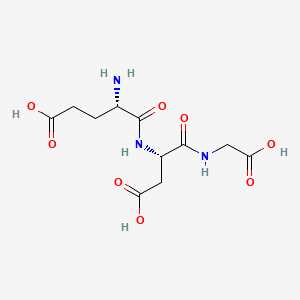 Source: PubChem
Research Applications
Chonluten is used in laboratory research as a tool to probe transcriptional regulation in airway and mucosal inflammation models. Studies commonly evaluate gene-expression endpoints related to oxidative stress and inflammatory signaling (including antioxidant-system genes and inflammatory mediators), as well as transcription factors associated with proliferation and remodeling responses to chronic irritation. In pulmonary settings, research interest centers on whether modulation of these targets can help characterize mechanisms that influence bronchial mucosal stability under inflammatory stress (e.g., models relevant to asthma or COPD).
Secondary applications involve gastrointestinal inflammation research, where Chonluten is explored for its potential to modulate inflammatory and vascular-response pathways in experimental models of mucosal injury. Broader gerontology-oriented work on short peptides also examines how tripeptides may affect age-associated shifts in transcriptional control, including epigenetic-associated mechanisms and cellular stress-response programs. These applications are investigational, model-dependent, and intended exclusively for scientific and educational research use.
Article Author
The above literature was researched, edited and organized by Dr. E. Logan, M.D. Dr. E. Logan holds a doctorate degree from Case Western Reserve University School of Medicine and a B.S. in molecular biology.
Scientific Journal Author
 Vladimir Khavinson is a Professor, President of the European region of the International Association of Gerontology and Geriatrics; Member of the Russian and Ukrainian Academies of Medical Sciences; Main gerontologist of the Health Committee of the Government of Saint Petersburg, Russia; Director of the Saint Petersburg Institute of Bioregulation and Gerontology; Vice-president of Gerontological Society of the Russian Academy of Sciences; Head of the Chair of Gerontology and Geriatrics of the North-Western State Medical University, St-Petersburg; Colonel of medical service (USSR, Russia), retired. Vladimir Khavinson is known for the discovery, experimental and clinical studies of new classes of peptide bioregulators as well as for the development of bioregulating peptide therapy. He is engaged in studying of the role of peptides in regulation of the mechanisms of ageing. His main field of actions is design, pre-clinical and clinical studies of new peptide geroprotectors. A 40-year-long investigation resulted in a multitude of methods of application of peptide bioregulators to slow down the process of ageing and increase human life span. Six peptide-based pharmaceuticals and 64 peptide food supplements have been introduced into clinical practice by V. Khavinson. He is an author of 196 patents (Russian and international) as well as of 775 scientific publications. His major achievements are presented in two books: “Peptides and Ageing” (NEL, 2002) and “Gerontological aspects of genome peptide regulation” (Karger AG, 2005). Vladimir Khavinson introduced scientific specialty “Gerontology and Geriatrics” in the Russian Federation on the governmental level. Academic Council headed by V. Khavinson has oversighted over 200 Ph.D. and Doctorate theses from many different countries.
Prof. Vladimir Khavinson is being referenced as one of the leading scientists involved in the research and development of Chonluten. In no way is this doctor/scientist endorsing or advocating the purchase, sale, or use of this product for any reason. There is no affiliation or relationship, implied or otherwise, between Peptide Sciences and this doctor. The purpose of citing the doctor is to acknowledge, recognize, and credit the exhaustive research and development efforts conducted by the scientists studying this peptide. Prof. Vladimir Khavinson is listed in [1] [2] [4] [5] [6] and [7] under the referenced citations.
Referenced Citations
- V. K. Khavinson, N. S. Lin’kova, A. V. Dudkov, V. O. Polyakova, and I. M. Kvetnoi, “Peptidergic regulation of expression of genes encoding antioxidant and anti-inflammatory proteins,” Bull. Exp. Biol. Med., vol. 152, no. 5, pp. 615–618, Mar. 2012, doi: 10.1007/s10517-012-1590-2.
- V. N. Anisimov and V. K. Khavinson, “Peptide bioregulation of aging: results and prospects,” Biogerontology, vol. 11, no. 2, pp. 139–149, Apr. 2010, doi: 10.1007/s10522-009-9249-8.
- M. A. Voicekhovskaya, N. I. Chalisova, E. A. Kontsevaya, and G. A. Ryzhak, “Effect of bioregulatory tripeptides on the culture of skin cells from young and old rats,” Bull. Exp. Biol. Med., vol. 152, no. 3, pp. 357–359, Jan. 2012, doi: 10.1007/s10517-012-1527-9.
- V. K. Khavinson, I. G. Popovich, N. S. Linkova, E. S. Mironova, and A. R. Ilina, “Peptide Regulation of Gene Expression: A Systematic Review,” Molecules, vol. 26, no. 22, p. 7053, Nov. 2021, doi: 10.3390/molecules26227053.
- V. K. Khavinson, N. S. Lin’kova, and S. I. Tarnovskaya, “Short Peptides Regulate Gene Expression,” Bull. Exp. Biol. Med., vol. 162, no. 2, pp. 288–292, Dec. 2016, doi: 10.1007/s10517-016-3596-7.
- L. I. Fedoreyeva, I. I. Kireev, V. K. Khavinson, and B. F. Vanyushin, “Penetration of short fluorescence-labeled peptides into the nucleus in HeLa cells and in vitro specific interaction of the peptides with deoxyribooligonucleotides and DNA,” Biochem. Biokhimii͡a, vol. 76, no. 11, Art. no. 11, Nov. 2011, doi: 10.1134/S0006297911110022.
- V. Khavinson, N. Linkova, A. Dyatlova, B. Kuznik, and R. Umnov, “Peptides: Prospects for Use in the Treatment of COVID-19,” Molecules, vol. 25, no. 19, p. 4389, Sep. 2020, doi: 10.3390/molecules25194389.
ALL ARTICLES AND PRODUCT INFORMATION PROVIDED ON THIS WEBSITE ARE FOR INFORMATIONAL AND EDUCATIONAL PURPOSES ONLY.
RUO Disclaimer
The products offered on this website are furnished for in-vitro studies only. In-vitro studies (Latin: in glass) are performed outside of the body. These products are not medicines or drugs and have not been approved by the FDA to prevent, treat or cure any medical condition, ailment or disease. Bodily introduction of any kind into humans or animals is strictly forbidden by law.
For Laboratory Research Only. Not for human use, medical use, diagnostic use, or veterinary use.