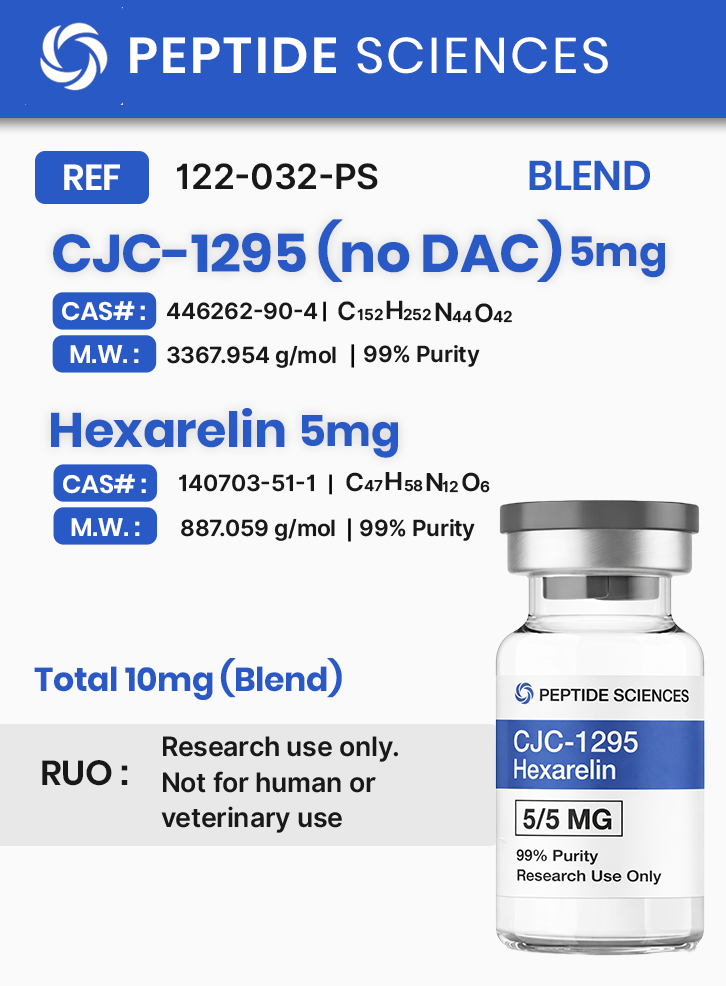
CJC-1295 (no DAC), Hexarelin 10mg (Blend)
$95.00
CJC-1295 (no DAC) and Hexarelin is a research peptide blend combining GHRH receptor and ghrelin receptor agonists to model growth hormone signaling. CJC-1295 (Mod GRF 1–29) stimulates cAMP/PKA activity through GHRH receptor binding, while Hexarelin activates GHS-R1a to induce phospholipase C–mediated calcium release. This blend is used in studies of pituitary activation, peptide stability, and somatotropic regulation.
For research use only. Not for human consumption.
References:
Bowers CY et al., Endocrinology, 1990 126(2):1165–1171
Ghigo E et al., Eur J Endocrinol, 2001 145(1):1–10
Teichman SL et al., J Clin Endocrinol Metab, 2006 91(2):479–487
Overview
Hexarelin is a synthetic growth hormone secretagogue studied as an agonist of the growth hormone secretagogue receptor (GHSR-1a). When evaluated in combination with CJC-1295, a growth hormone releasing hormone (GHRH) receptor agonist, the pairing is used in preclinical research to examine coordinated activation of GHSR-1a and GHRH receptor (GHRHR) signaling in pituitary-derived and whole-animal experimental models.
Biochemical Characteristics
Hexarelin is commonly used in laboratory settings to probe ghrelin receptor pharmacology, including ligand-dependent signaling bias, intracellular calcium mobilization, and downstream second-messenger responses. CJC-1295 is a synthetic GHRH analog used to evaluate GHRHR-mediated cAMP signaling and regulated endocrine pulsatility. In combined paradigms, these ligands enable comparative assessment of Ca2+-dependent (GHSR-1a) and cAMP-dependent (GHRHR) pathway engagement.
Research Applications
Experimental applications for Hexarelin + CJC-1295 co-administration designs include:
- Characterization of pituitary receptor cross-talk and endocrine pulsatility under dual-receptor stimulation
- Signal transduction profiling in cell-based assays (e.g., cAMP readouts, Ca2+ flux, MAPK/ERK pathway activation)
- Preclinical evaluation of tissue-specific receptor expression and downstream molecular responses in cardiovascular and metabolic research models.
Pathway / Mechanistic Context
GHSR-1a activation by hexarelin is associated with phospholipase C (PLC) activation and intracellular Ca2+ mobilization, with reported downstream effects on kinase signaling pathways and calcium-handling proteins in selected preclinical systems. GHRHR activation by CJC-1295 primarily signals via Gs-mediated adenylate cyclase activation, increasing intracellular cAMP and engaging protein kinase A (PKA)–linked transcriptional mechanisms. Dual-ligand experimental designs are used to examine how these distinct signaling modules interact to shape temporal endocrine output and tissue-specific molecular endpoints.
Preclinical Research Summary
Non-clinical studies have investigated hexarelin in cardiovascular research models, including rodent and murine ischemia/reperfusion paradigms and diabetic model systems, with emphasis on cardiomyocyte signaling, inflammatory mediator pathways, and intracellular calcium regulation[1]–[3]. Additional animal studies have examined hexarelin-associated alterations in lipid metabolism markers within insulin-resistant model systems[4]. Separate preclinical investigations have explored growth hormone secretagogues, including hexarelin, in skeletal muscle models evaluating mitochondrial integrity and calcium homeostasis under chemotherapy-associated stress paradigms in rodents[5], [6]. All referenced findings are derived from laboratory and animal research settings and are used to inform mechanistic hypotheses.
Form & Analytical Testing
Peptides are supplied as lyophilized research materials. Standard analytical characterization typically includes high-performance liquid chromatography (HPLC) and mass spectrometry for identity and purity verification. Where applicable, additional quality controls may include peptide content confirmation and batch-to-batch consistency testing to support experimental reproducibility.
About The Author
The above literature was researched, edited and organized by Dr. E. Logan, M.D. Dr. E. Logan holds a doctorate degree from Case Western Reserve University School of Medicine and a B.S. in molecular biology.
Scientific Journal Author
Aline Moulin’s research contributions include studies involving ghrelin receptor pharmacology and evaluation of compounds for their capacity to modulate hexarelin-associated signaling readouts in experimental systems. Her work spans development and characterization efforts relevant to receptor ligand profiling, quality frameworks, and research operations across multiple scientific settings.
Aline Moulin is referenced solely to acknowledge scientific contributions in this field. No endorsement, affiliation, or advocacy is implied. Aline Moulin is listed in [8] under the referenced citations.
Referenced Citations
- X. Zhang, L. Qu, L. Chen, and C. Chen, “Improvement of cardiomyocyte function by in vivo hexarelin treatment in streptozotocin-induced diabetic rats,” Physiol. Rep., vol. 6, no. 4, 2018. [PubMed]
- J. Huang, Y. Li, J. Zhang, Y. Liu, and Q. Lu, “The Growth Hormone Secretagogue Hexarelin Protects Rat Cardiomyocytes From in vivo Ischemia/Reperfusion Injury Through Interleukin-1 Signaling Pathway,” Int. Heart. J., vol. 58, no. 2, pp. 257–263, Apr. 2017. [PubMed]
- Y. Ma, L. Zhang, J. N. Edwards, B. S. Launikonis, and C. Chen, “Growth hormone secretagogues protect mouse cardiomyocytes from in vitro ischemia/reperfusion injury through regulation of intracellular calcium,” PloS One, vol. 7, no. 4, p. e35265, 2012.
- R. Mosa et al., “Hexarelin, a Growth Hormone Secretagogue, Improves Lipid Metabolic Aberrations in Nonobese Insulin-Resistant Male MKR Mice,” Endocrinology, vol. 158, no. 10, pp. 3174–3187, 01 2017. [PubMed]
- E. Conte et al., “Growth hormone secretagogues prevent dysregulation of skeletal muscle calcium homeostasis in a rat model of cisplatin-induced cachexia,” J. Cachexia Sarcopenia Muscle, vol. 8, no. 3, pp. 386–404, Jun. 2017. [PubMed]
- G. Sirago et al., “Growth hormone secretagogues hexarelin and JMV2894 protect skeletal muscle from mitochondrial damages in a rat model of cisplatin-induced cachexia,” Sci. Rep., vol. 7, Oct. 2017. [Nature]
- X. Zhang, L. Qu, L. Chen, and C. Chen, “Improvement of cardiomyocyte function by in vivo hexarelin treatment in streptozotocin-induced diabetic rats,” Physiol. Rep., vol. 6, no. 4, 2018. [PubMed]
- Torsello, Antonio & Bresciani, Elena & Tamiazzo, Laura & Bulgarelli, Ilaria & Caporali, Simona & Moulin, Aline & Fehrentz, jean-alain & Martinez, Jean & Perissoud, Daniel & Locatelli, Vittorio. (2008). Novel potent and selective non-peptide ligands of ghrelin receptor : characterization of endocrine and extraendocrine actions. [Research Gate]
ALL ARTICLES AND PRODUCT INFORMATION PROVIDED ON THIS WEBSITE ARE FOR INFORMATIONAL AND EDUCATIONAL PURPOSES ONLY.
RUO Disclaimer
The products offered on this website are furnished for in-vitro studies only. In-vitro studies (Latin: in glass) are performed outside of the body. These products are not medicines or drugs and have not been approved by the FDA to prevent, treat or cure any medical condition, ailment or disease. Bodily introduction of any kind into humans or animals is strictly forbidden by law.
For Laboratory Research Only. Not for human use, medical use, diagnostic use, or veterinary use.