IGF-1 LR3 (Receptor Grade) 1mg
$250.00
IGF1-LR3 (Receptor Grade) is a research peptide analog of human insulin-like growth factor 1 engineered with a 13–amino acid N-terminal extension to improve receptor affinity and resistance to binding proteins. It activates IGF-1 receptor–mediated PI3K/Akt and MAPK/ERK signaling pathways that regulate cellular proliferation, differentiation, and anabolic activity. IGF-1 LR3 (Receptor Grade) is used in controlled studies examining growth factor kinetics, peptide–receptor interactions, and metabolic signaling mechanisms.
For research use only. Not for human consumption.
References:
Yakar S et al., Endocr Rev, 2001 22(6):803–817
Bach LA et al., Mol Cell Endocrinol, 2018 473:1–9
Humbel RE et al., Eur J Biochem, 1990 190(3):445–462
Overview
IGF1-LR3 (insulin-like growth factor-1 long arginine-3) is a synthetic analog of insulin-like growth factor-1 engineered for use in laboratory research. Structural modifications include N-terminal amino acid extension and substitution of glutamic acid with arginine at position three, resulting in reduced affinity for IGF-binding proteins. These modifications extend molecular persistence in experimental systems, enabling prolonged interaction with IGF-associated receptors in controlled in-vitro and in-vivo animal models.
Preclinical research utilizes IGF1-LR3 as a tool compound to investigate growth factor–mediated signaling, cellular proliferation pathways, differentiation programs, and metabolic signaling cascades. All discussion herein is limited to experimental research contexts and does not imply applied, therapeutic, or physiological use.
Biochemical Characteristics
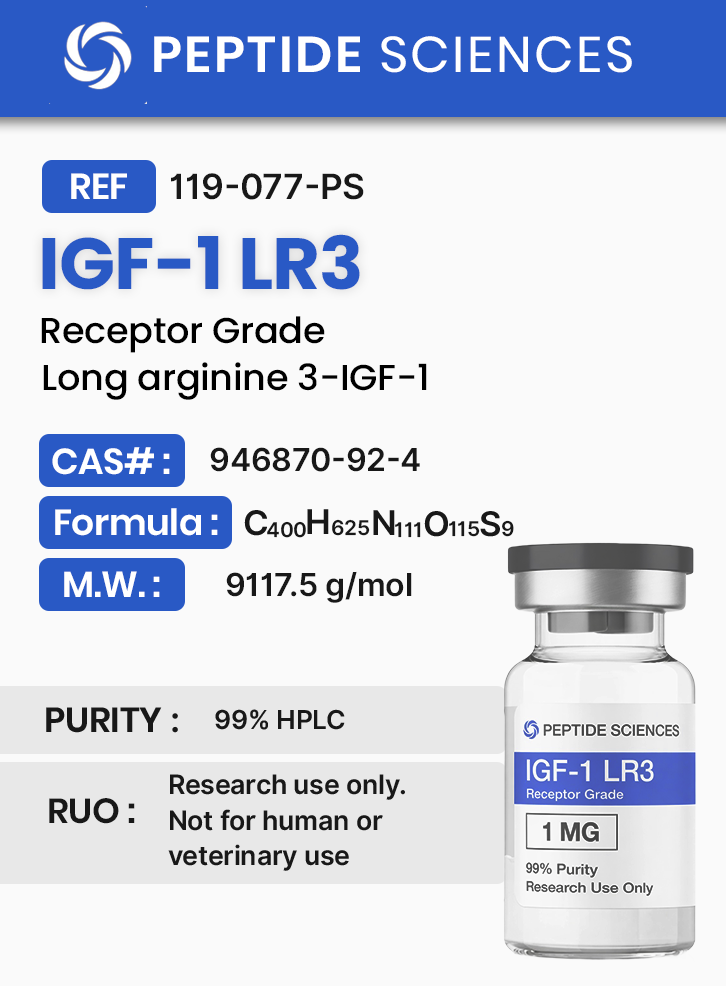
Sequence: MFPAMPLSSL FVNGPRTLCG AELVDALQFV CGDRGFYFNK PTGYGSSSRR APQTGIVDEC CFRSCDLRRL EMYCAPLKPA KSA
Molecular Formula: C400H625N111O115S9
Molecular Weight: 9117.5 g/mol
CAS Number: 946870-92-4
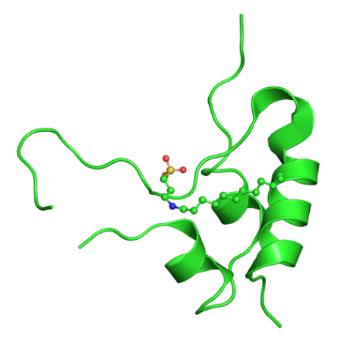
Source: PubChem
IGF1-LR3 retains the core tertiary fold of native IGF-1 while exhibiting altered receptor-binding kinetics due to its modified N-terminal region. The peptide interacts primarily with the IGF-1 receptor (IGF-1R) and, to a lesser extent, insulin receptor isoforms. Reduced interaction with IGF-binding proteins alters distribution and degradation dynamics in experimental models.
Research Applications
IGF1-LR3 is employed in laboratory research to study mitogenic and differentiative signaling mediated by IGF-1R activation. Common applications include cell-culture assays assessing proliferation kinetics, lineage differentiation, and survival signaling in connective tissue, epithelial, neural, hepatic, and renal model systems.
Additional experimental use includes investigation of metabolic signaling interactions between IGF-1R and insulin receptor pathways, particularly in studies examining glucose transport, lipid metabolism regulation, and energy-balance signaling in animal and cellular models.
Pathway / Mechanistic Context
Mechanistically, IGF1-LR3 activates IGF-1R–dependent signaling cascades, including the PI3K–Akt and MAPK/ERK pathways. These pathways regulate transcriptional programs governing cell-cycle progression, apoptosis suppression, and differentiation signaling. Due to extended receptor engagement, IGF1-LR3 enables prolonged pathway interrogation compared to native IGF-1 in experimental settings.
Preclinical literature also describes interaction between IGF-1 signaling and myostatin-regulated pathways, with downstream effects on MyoD-associated transcription. These interactions are investigated to understand regulatory balance between growth-promoting and growth-inhibitory signaling networks in skeletal muscle models.
Preclinical Research Summary
Preclinical investigations of IGF1-LR3 include in-vitro cell-culture studies and in-vivo animal models evaluating cellular proliferation, differentiation capacity, metabolic signaling, and tissue-maintenance markers. Reported findings include increased proliferative indices, modulation of glucose uptake pathways, and altered expression of genes involved in growth regulation.
Animal studies further explore interactions between IGF-1 signaling and aging-associated pathways, glucocorticoid-responsive signaling, and metabolic adaptation under experimental conditions. All findings are interpreted strictly within the context of laboratory research models.
Form & Analytical Testing
IGF1-LR3 is supplied as a synthetic research-grade peptide. Identity and purity are confirmed through analytical methodologies including high-performance liquid chromatography (HPLC) and mass spectrometry (MS). Batch-specific documentation may include certificate of analysis data supporting molecular identity and purity metrics.
Article Author
The above literature was researched, edited and organized by Dr. E. Logan, M.D. Dr. E. Logan holds a doctorate degree from Case Western Reserve University School of Medicine and a B.S. in molecular biology.
Scientific Journal Author
Dr. Anastasios Philippou, Ph.D. focused on Experimental Physiology at the National & Kapodistrian University of Athens Medical School. He is now a National Center Manager and Assistant Professor, however his extensive studying and documented research pertaining to the effects of muscle regeneration, the role of IGF-1 in skeletal muscle physiology, the expression of IGF-1 isoforms after exercise induced muscle damage in humans, characterization of the MGF E peptide actions in vitro, and epigenetic regulation on gene expression induced by physical exercise are most impressive.
Dr. Anastasios Philippou, Ph.D. is being referenced as one of the leading scientists involved in the research and development of IGF1-LR3. In no way is this doctor/scientist endorsing or advocating the purchase, sale, or use of this product for any reason. There is no affiliation or relationship, implied or otherwise, between Peptide Sciences and this doctor. The purpose of citing the doctor is to acknowledge, recognize, and credit the exhaustive research and development efforts conducted by the scientists studying this peptide. Dr. Anastasios Philippou, Ph.D. is listed in [7] and [8] under the referenced citations.
Referenced Citations
- “Adipose Tissue-Derived Stem Cell Secreted IGF-1 Protects Myoblasts from the Negative Effect of Myostatin.” [Online]. Available: https://www.hindawi.com/journals/bmri/2014/129048/. [Accessed: 16-May-2019].
- N. Li, Q. Yang, R. G. Walker, T. B. Thompson, M. Du, and B. D. Rodgers, “Myostatin Attenuation In Vivo Reduces Adiposity, but Activates Adipogenesis,” Endocrinology, vol. 157, no. 1, pp. 282–291, Jan. 2016.
- E. Corpas, S. M. Harman, and M. R. Blackman, “Human growth hormone and human aging,” Endocr. Rev., vol. 14, no. 1, pp. 20–39, Feb. 1993.
- W. E. Sonntag, A. Csiszar, R. deCabo, L. Ferrucci, and Z. Ungvari, “Diverse roles of growth hormone and insulin-like growth factor-1 in mammalian aging: progress and controversies,” J. Gerontol. A. Biol. Sci. Med. Sci., vol. 67, no. 6, pp. 587–598, Jun. 2012.
- “IGF-I/IGFBP system: metabolism outline and physical exercise. – PubMed – NCBI.” [Online]. Available: https://www.ncbi.nlm.nih.gov/pubmed/22714057. [Accessed: 16-May-2019].
- B. Y. Hanaoka, C. A. Peterson, C. Horbinski, and L. J. Crofford, “Implications of glucocorticoid therapy in idiopathic inflammatory myopathies,” Nat. Rev. Rheumatol., vol. 8, no. 8, pp. 448–457, Aug. 2012.
- A Philippou, A Halapas, M Maridaki, M Koutsilieris – J Musculoskelet Neuronal Interact, 2007 [Semantic Scholar]
- A Philippou, E Papageorgiou, G Bogdanis, A Halapas… – In vivo, 2009 [Iiar Journals]
ALL ARTICLES AND PRODUCT INFORMATION PROVIDED ON THIS WEBSITE ARE FOR INFORMATIONAL AND EDUCATIONAL PURPOSES ONLY.
RUO Disclaimer
The products offered on this website are furnished for in-vitro studies only. In-vitro studies (Latin: in glass) are performed outside of the body. These products are not medicines or drugs and have not been approved by the FDA to prevent, treat or cure any medical condition, ailment or disease. Bodily introduction of any kind into humans or animals is strictly forbidden by law.
For Laboratory Research Only. Not for human use, medical use, diagnostic use, or veterinary use.