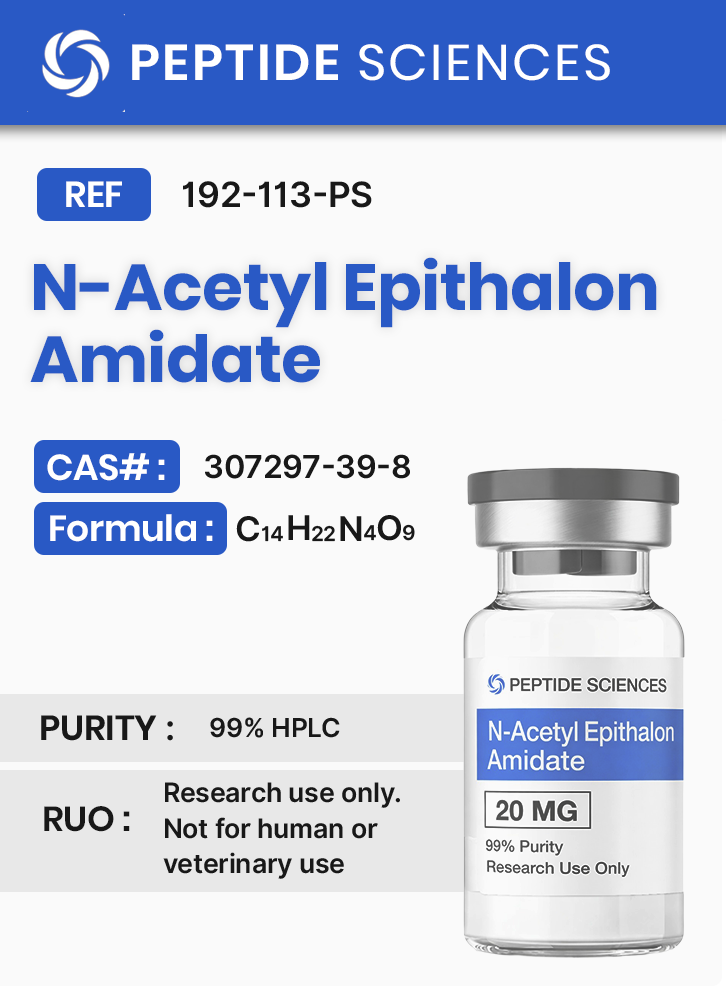
N-Acetyl Epithalon Amidate 20mg
$100.00
N-Acetyl Epithalon Amidate is a stabilized analog of the pineal-derived tetrapeptide Epitalon (Ala-Glu-Asp-Gly) modified for enhanced bioavailability. It is studied for its influence on telomerase activation, circadian gene regulation, and oxidative stress response. N-Acetyl Epithalon Amidate is used in molecular biology research exploring genomic stability and epigenetic longevity pathways.
For research use only. Not for human consumption.
References:
Khavinson VK et al., Bull Exp Biol Med, 2003 135(4):429–432
Arutyunyan AV et al., Adv Gerontol, 2005 15(3):28–36
Anisimov VN et al., Neuro Endocrinol Lett, 2003 24(3–4):233–240
Overview
N-Acetyl Epithalon Amidate is an N-terminally acetylated and C-terminally amidated derivative of the synthetic tetrapeptide commonly referenced in the literature as Epithalon (Epitalon; Ala-Glu-Asp-Gly). The parent tetrapeptide was originally characterized in the context of peptide bioregulator research and has been investigated across preclinical models for its capacity to modulate transcriptional programs, redox-associated biochemical readouts, and telomere/telomerase-related parameters under defined experimental conditions.
Current research attention has focused on mechanistic hypotheses that include epigenetic regulation of gene accessibility and downstream effects on protein synthesis during lineage specification in cellular models, as well as systems-level effects measured in animal studies under controlled experimental illumination conditions.
Biochemical Characteristics
Amino Acid Sequence: Ala-Glu-Asp-Gly
Chemical Formula: C14H22N4O9
Molecular Mass: 446.45 g/mol
PubChem CID: 219042
CAS Number: 307297-39-8
Synonyms: Epitalon, Epithalone, Epithalamin, Epithalamine
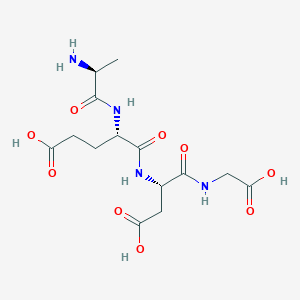 Source: PubChem
In peptide nomenclature, Ac- denotes N-terminal acetylation and -NH2 denotes C-terminal amidation. These end-capping modifications are commonly employed in peptide chemistry to reduce susceptibility to exopeptidase-mediated degradation and to modify physicochemical properties such as charge distribution, which can influence stability and persistence in experimental biological matrices.
Research Applications
N-Acetyl Epithalon Amidate is supplied exclusively as a research reagent for use in non-clinical laboratory investigations focused on short-peptide signaling and genome-associated regulatory mechanisms. Published preclinical and in-vitro literature has utilized the parent peptide (Ala-Glu-Asp-Gly) in experimental contexts including:
- Cellular differentiation models: analysis of transcriptional and translational changes during neurogenesis and lineage specification in controlled cell culture systems.
- Gene expression profiling: evaluation of cytoskeletal and developmental marker expression (e.g., Nestin, GAP43, βIII-tubulin, Doublecortin).
- Redox biochemistry assays: assessment of lipid peroxidation-associated products and oxidative protein modification markers in animal-based experimental models.
- Telomere and telomerase studies: in-vitro evaluation of telomerase activity and telomere-associated molecular readouts in somatic cell systems.
- Systems-level animal investigations: longitudinal evaluation of survival curves and spontaneous tumor incidence under defined illumination and housing conditions.
- Circadian-associated molecular pathways: investigation of clock gene–linked regulation (e.g., PER1) and pineal-associated biochemical rhythms in preclinical settings.
Experimental design, control selection, and analytical endpoints should be determined by the investigator and aligned with the specific mechanistic hypothesis under investigation.
Pathway / Mechanistic Context
Mechanistic frameworks described in the cited literature propose that the Epithalon (Ala-Glu-Asp-Gly) peptide scaffold modulates genome accessibility through interactions with chromatin-associated proteins, resulting in altered transcriptional availability of specific genomic loci during cellular differentiation processes.
Additional investigations have examined the role of this peptide scaffold in circadian-associated molecular pathways, including clock gene networks such as PER1 and pineal-associated enzymatic systems that regulate rhythmic biochemical outputs in animal models. Independent lines of preclinical research have also evaluated redox-related biochemical markers consistent with oxidative stress–associated molecular processes.
N-terminal acetylation and C-terminal amidation are considered relevant to mechanistic studies due to their effects on proteolytic stability and peptide behavior within experimental biological environments.
Preclinical Research Summary
Neurogenesis-associated molecular programs: Cell culture studies have reported modulation of gene expression and protein synthesis markers associated with neuronal lineage specification following exposure to the Ala-Glu-Asp-Gly peptide scaffold, with proposed involvement of epigenetic regulatory mechanisms [1], [2].
Skin-derived cellular systems: In-vitro investigations utilizing skin-derived cell cultures have documented changes in proliferation and functional activity of fibroblast-associated cell populations in animal-derived models [3], [4].
Immune-related gene expression: Experimental studies have reported altered expression of immune-associated signaling molecules, including CD5, IL-2, and interferon gamma–linked pathways, under controlled exposure conditions in preclinical models [5].
Oncology-associated animal models: Rodent studies have evaluated spontaneous tumor development and tumor-associated parameters under defined experimental conditions, including illumination-controlled environments [6], [13].
Circadian and pineal-associated outputs: Preclinical investigations have examined modulation of circadian-associated molecular rhythms and pineal-derived biochemical outputs in animal systems [8].
Redox-associated molecular endpoints: Animal studies have reported changes in free-radical processes and oxidative modification markers following exposure to bioactive tetrapeptides [10].
Telomerase and telomere-associated readouts: In-vitro studies in human somatic cell models have documented induction of telomerase activity and telomere elongation-associated molecular readouts under controlled experimental conditions [11].
Form & Analytical Testing
N-Acetyl Epithalon Amidate is supplied as a synthetic research peptide intended solely for laboratory use. Analytical characterization may include identity verification and purity assessment using methods such as high-performance liquid chromatography (HPLC) and mass spectrometry (MS), consistent with standard research reagent quality practices.
Investigators are responsible for validating peptide integrity and stability under their specific experimental conditions, including buffer composition, temperature, exposure duration, and protease presence.
Article Author
The above literature was researched, edited and organized by Dr. E. Logan, M.D. Dr. E. Logan holds a doctorate degree from Case Western Reserve University School of Medicine and a B.S. in molecular biology.
Scientific Journal Author
 Vladimir Khavinson is a Professor, President of the European region of the International Association of Gerontology and Geriatrics; Member of the Russian and Ukrainian Academies of Medical Sciences; Main gerontologist of the Health Committee of the Government of Saint Petersburg, Russia; Director of the Saint Petersburg Institute of Bioregulation and Gerontology; Vice-president of Gerontological Society of the Russian Academy of Sciences; Head of the Chair of Gerontology and Geriatrics of the North-Western State Medical University, St-Petersburg; Colonel of medical service (USSR, Russia), retired. Vladimir Khavinson is known for the discovery, experimental and clinical studies of new classes of peptide bioregulators as well as for the development of bioregulating peptide therapy. He is engaged in studying of the role of peptides in regulation of the mechanisms of ageing. His main field of actions is design, pre-clinical and clinical studies of new peptide geroprotectors. A 40-year-long investigation resulted in a multitude of methods of application of peptide bioregulators to slow down the process of ageing and increase human life span. Six peptide-based pharmaceuticals and 64 peptide food supplements have been introduced into clinical practice by V. Khavinson. He is an author of 196 patents (Russian and international) as well as of 775 scientific publications. His major achievements are presented in two books: “Peptides and Ageing” (NEL, 2002) and “Gerontological aspects of genome peptide regulation” (Karger AG, 2005). Vladimir Khavinson introduced scientific specialty “Gerontology and Geriatrics” in the Russian Federation on the governmental level. Academic Council headed by V. Khavinson has oversighted over 200 Ph.D. and Doctorate theses from many different countries.
Prof. Vladimir Khavinson is being referenced as one of the leading scientists involved in the research and development of N-Acetyl Epithalon Amidate. In no way is this doctor/scientist endorsing or advocating the purchase, sale, or use of this product for any reason. There is no affiliation or relationship, implied or otherwise, between Peptide Sciences and this doctor. The purpose of citing the doctor is to acknowledge, recognize, and credit the exhaustive research and development efforts conducted by the scientists studying this peptide.
Referenced Citations
- V. Khavinson et al.,AEDG Peptide (Epitalon) Stimulates Gene Expression and Protein Synthesis during Neurogenesis: Possible Epigenetic Mechanism ,” Mol. Basel Switz., vol. 25, no. 3, p. E609, Jan. 2020, doi: 10.3390/molecules25030609.
- S. Caputi et al., “Effect of short peptides on neuronal differentiation of stem cells,” Int. J. Immunopathol. Pharmacol. , vol. 33, p. 2058738419828613, Feb. 2019, doi: 10.1177/2058738419828613.
- N. I. Chalisova, N. S. Lin’kova, A. N. Zhekalov, A. O. Orlova, G. A. Ryzhak, and V. K. Khavinson, “[Short peptides stimulate skin cell regeneration during ageing],” Adv. Gerontol. Uspekhi Gerontol, , vol. 27, no. 4, pp. 699–703, 2014.
- V. K. Khavinson, N. S. Linkova, A. S. Diatlova, E. O. Gutop, and O. A. Orlova, “[Short peptides: regulation of skin function during aging.],” Adv. Gerontol. Uspekhi Gerontol. , vol. 33, no. 1, Art. no. 1, 2020.
- N. Lin’kova, B. Kuznik, and V. Khavinson, “The peptide Ala-Glu-Asp-Gly and interferon gamma: Their role in immune response during aging,” Adv. Gerontol., vol. 3, Apr. 2013, doi: 10.1134/S2079057013020100.
- I. A. Vinogradova, A. V. Bukalev, M. A. Zabezhinski, A. V. Semenchenko, V. K. Khavinson, and V. N. Anisimov, “Effect of Ala-Glu-Asp-Gly peptide on life span and development of spontaneous tumors in female rats exposed to different illumination regimes,” Bull. Exp. Biol. Med., vol. 144, no. 6, pp. 825–830, Dec. 2007, doi: 10.1007/s10517-007-0441-z.
- S. Gery, N. Komatsu, L. Baldjyan, A. Yu, D. Koo, and H. P. Koeffler, “The circadian gene per1 plays an important role in cell growth and DNA damage control in human cancer cells,” Mol. Cell, vol. 22, no. 3, pp. 375–382, May 2006, doi: 10.1016/j.molcel.2006.03.038.
- O. Korkushko et al., “[Normalizing effect of the pineal gland peptides on the daily melatonin rhythm in old monkeys and elderly people],” Adv. Gerontol. Uspekhi Gerontol. Ross. Akad. Nauk Gerontol. Obshchestvo, vol. 20, pp. 74–85, Feb. 2007.
- V. N. Anisimov, S. V. Mylnikov, and V. K. Khavinson, “Pineal peptide preparation epithalamin increases the lifespan of fruit flies, mice and rats,” Mech. Ageing Dev., vol. 103, no. 2, pp. 123–132, Jun. 1998, doi: 10.1016/S0047-6374(98)00034-7.
- L. S. Kozina, “Effects of bioactive tetrapeptides on free-radical processes,” Bull. Exp. Biol. Med. , vol. 143, no. 6, Art. no. 6, Jun. 2007, doi: 10.1007/s10517-007-0230-8.
- V. Kh. Khavinson, I. E. Bondarev, and A. A. Butyugov, “Epithalon Peptide Induces Telomerase Activity and Telomere Elongation in Human Somatic Cells,” Bull. Exp. Biol. Med., vol. 135, no. 6, Art. no. 6, Jun. 2003, doi: 10.1023/A:1025493705728.
- T. A. Dzhokhadze, T. Z. Buadze, M. N. GaÄozishvili, M. A. Rogava, and T. A. Lazhava, “[Functional regulation of genome with peptide bioregulators by hypertrophic cardiomyopathy (by patients and relatives)],” Georgian Med. News , no. 225, Art. no. 225, Dec. 2013.
- V. N. Anisimov, “Effect of Epitalon on biomarkers of aging, life span and spontaneous tumor incidence in female Swiss-derived SHR mice,” Biogerontology, vol. 4, no. 4, pp. 193–202, 2003, doi: 10.1023/a:1025114230714.
ALL ARTICLES AND PRODUCT INFORMATION PROVIDED ON THIS WEBSITE ARE FOR INFORMATIONAL AND EDUCATIONAL PURPOSES ONLY.
RUO Disclaimer
The products offered on this website are furnished for in-vitro studies only. In-vitro studies (Latin: in glass) are performed outside of the body. These products are not medicines or drugs and have not been approved by the FDA to prevent, treat or cure any medical condition, ailment or disease. Bodily introduction of any kind into humans or animals is strictly forbidden by law.
For Laboratory Research Only. Not for human use, medical use, diagnostic use, or veterinary use.