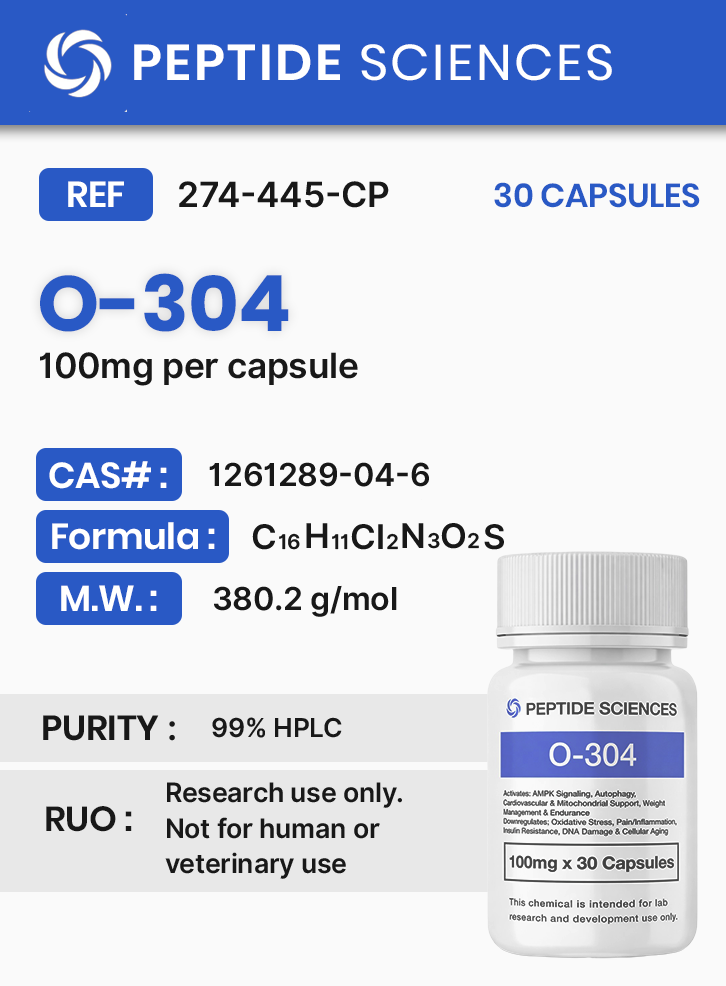
O-304 (100mg x 30 Capsules)
$265.00
O-304 is a synthetic small-molecule research compound developed to modulate cellular senescence-associated pathways. It acts by influencing DNA damage response, SIRT1 signaling, and collagen synthesis in experimental models of aging. O-304 is used in preclinical studies investigating epigenetic regulation, extracellular matrix remodeling, and molecular mechanisms of cellular longevity.
References:
Di Micco R et al., Cell Biol, 2021
Alves-Fernandes DK et al., DNA Repair (Amst), 2019
Shreeya T et al., Ageing Res Rev, 2024
These capsules are provided exclusively as inert containers for the dry transport, storage, and handling of laboratory research materials. They are not dosage forms and are not intended for ingestion or administration. They must not be used as drug delivery systems, consumed, or administered in any form. For Research Use Only: Not for use in humans or animals. Not for diagnostic or therapeutic purposes.
Peptide Sciences has changed the name of its peptide, but you may receive product labeled with the old name, OS-01. Any existing stock displaying OS-01 is not affiliated with, endorsed by, approved by, or otherwise associated with OneSkin’s OS-01 products and registered OS-01® trademark
Overview
O-304 is a synthetic small-molecule AMPK (5′ AMP-activated protein kinase) activator developed for laboratory investigation of cellular energy-sensing pathways. AMPK functions as a conserved metabolic regulator that coordinates cellular responses to energetic stress by modulating mitochondrial activity, substrate utilization, and autophagic processes.
In research settings, O-304 is utilized as a biochemical probe to examine AMPK-dependent regulation of mitochondrial turnover, redox balance, and metabolic signaling under controlled experimental conditions.
Biochemical Characteristics
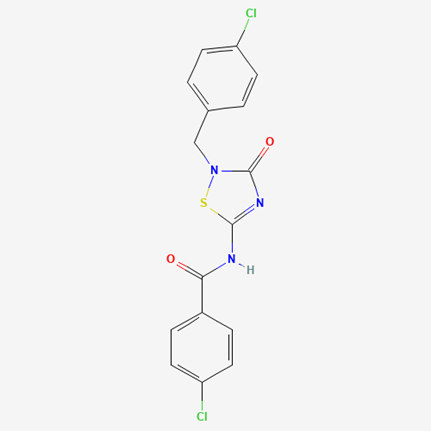 Source: PubChem
Chemical Formula: C16H11Cl2N3O2S
Molecular Weight: 380.2 g/mol
PubChem CID: 50923806
CAS No.: 1261289-04-6
Synonyms: O-304
O-304 demonstrates physicochemical properties compatible with intracellular access and sustained AMPK phosphorylation in experimental model systems.
Research Applications
- AMPK-regulated metabolic signaling studies
- Mitochondrial biogenesis and mitophagy analysis
- Oxidative stress and redox homeostasis modeling
- Autophagy-linked transcriptional regulation
- Energy-sensing pathway interrogation in cellular and animal models
All applications are restricted to non-clinical laboratory research environments.
Pathway / Mechanistic Context
AMPK acts as a heterotrimeric kinase complex that responds to cellular energy depletion by promoting ATP-generating catabolic pathways while suppressing energy-consuming anabolic processes. O-304 enhances AMPK signaling by stabilizing phosphorylation of the catalytic α-subunit, thereby extending the active signaling state.
Downstream effects observed in experimental systems include modulation of fatty acid oxidation, glucose transporter trafficking, mitochondrial quality control, and transcriptional regulation of autophagy-associated genes.
Preclinical Research Summary
Preclinical investigations utilizing cellular assays and rodent models have examined O-304-mediated AMPK activation in the context of mitochondrial metabolism, glucose handling, lipid utilization, and oxidative stress regulation. These studies document alterations in mitochondrial enzyme expression, respiratory capacity, and autophagic flux.
Additional experimental work has evaluated AMPK-dependent signaling in tissues characterized by high energetic demand, including skeletal muscle, renal epithelium, cardiac tissue, and neuronal systems.
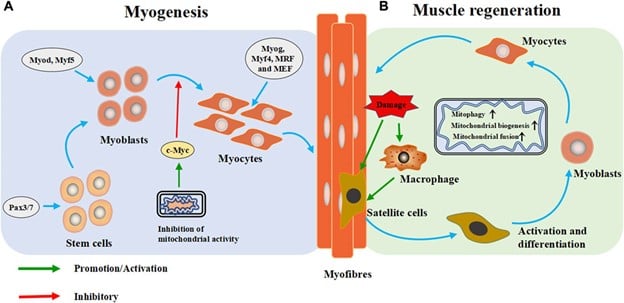 AMPK-mediated regulation of mitochondrial and metabolic pathways
Source: Frontiers
Form & Analytical Testing
O-304 is supplied as a research-grade small-molecule compound. Identity and purity are verified using standard analytical methodologies, including chromatographic separation and mass-based characterization, to ensure suitability for laboratory research applications.
About The Author
The above literature was researched, edited, and organized by Dr. Logan, M.D. Dr. Logan holds a doctorate degree from Case Western Reserve University School of Medicine and a B.S. in molecular biology.
Scientific Journal Author
Vaskar Das, PhD., is currently working on National Institutes of Health-funded pain research as a co-investigator. His research has focused on new non-opioid treatments for acute and chronic pain by following the key energy sensor AMPK (adenosine mono-phosphate activated kinase) and the pain-relieving effect of the ketamine metabolite (2R,6R)-hydroxynorketamine.
Vaskar Das, Ph.D., is referenced as one of the leading scientists involved in the research and development of O-304. In no way is this doctor/scientist endorsing or advocating the purchase, sale, or use of this product for any reason. There is no affiliation or relationship, implied or otherwise, between Peptide Sciences and this doctor. The purpose of citing the doctor is to acknowledge, recognize, and credit the exhaustive research and development efforts conducted by the scientists studying this peptide. Vaskar Das, Ph.D., is listed in [1] and [9] under the referenced citations.
Referenced Citations
- V. Das, J. S. Kroin, M. Moric, R. J. McCarthy, and A. Buvanendran, “AMP-activated protein kinase (AMPK) activator drugs reduce mechanical allodynia in a mouse model of low back pain,” Reg Anesth Pain Med, p. rapm-2019-100839, Sep. 2019, doi: 10.1136/rapm-2019-100839.
- P. Steneberg et al., “PAN-AMPK activator O304 improves glucose homeostasis and microvascular perfusion in mice and type 2 diabetes patients,” JCI Insight, vol. 3, no. 12, pp. e99114, 99114, Jun. 2018, doi: 10.1172/jci.insight.99114.
- K. Partridge, “The impact of novel AMP-activated protein kinase (AMPK) activators and glucose variability on pancreatic α-cell function,” Aug. 2023, Accessed: Jan. 31, 2025. [Online]. Available: https://ore.exeter.ac.uk/repository/handle/10871/133834
- M. Ericsson, P. Steneberg, R. Nyrén, and H. Edlund, “AMPK activator O304 improves metabolic and cardiac function, and exercise capacity in aged mice,” Commun Biol, vol. 4, no. 1, pp. 1–8, Nov. 2021, doi: 10.1038/s42003-021-02837-0.
- E. O. Ojuka, “Role of calcium and AMP kinase in the regulation of mitochondrial biogenesis and GLUT4 levels in muscle,” Proc Nutr Soc, vol. 63, no. 2, pp. 275–278, May 2004, doi: 10.1079/PNS2004339.
- W. W. Winder, B. F. Holmes, D. S. Rubink, E. B. Jensen, M. Chen, and J. O. Holloszy, “Activation of AMP-activated protein kinase increases mitochondrial enzymes in skeletal muscle,” J Appl Physiol (1985), vol. 88, no. 6, pp. 2219–2226, Jun. 2000, doi: 10.1152/jappl.2000.88.6.2219.
- Y. Yan et al., “Adenosine monophosphate activated protein kinase contributes to skeletal muscle health through the control of mitochondrial function,” Front. Pharmacol., vol. 13, Oct. 2022, doi: 10.3389/fphar.2022.947387.
- N. Ouchi, R. Shibata, and K. Walsh, “AMP-activated protein kinase signaling stimulates VEGF expression and angiogenesis in skeletal muscle,” Circ Res, vol. 96, no. 8, pp. 838–846, Apr. 2005, doi: 10.1161/01.RES.0000163633.10240.3b.
- V. Das, J. S. Kroin, M. Moric, R. J. McCarthy, and A. Buvanendran, “Antihyperalgesia effect of AMP-activated protein kinase (AMPK) activators in a mouse model of postoperative pain,” Reg Anesth Pain Med, p. rapm-2019-100651, Jun. 2019, doi: 10.1136/rapm-2019-100651.
- Z. Wang, J. Shen, E. Feng, and Y. Jiao, “AMPK as a Potential Therapeutic Target for Intervertebral Disc Degeneration,” Front Mol Biosci, vol. 8, p. 789087, Dec. 2021, doi: 10.3389/fmolb.2021.789087.
- M. K. S. Lee et al., “Defective AMPK regulation of cholesterol metabolism accelerates atherosclerosis by promoting HSPC mobilization and myelopoiesis,” Mol Metab, vol. 61, p. 101514, May 2022, doi: 10.1016/j.molmet.2022.101514.
- Y. Li, Q. Wang, J. Li, B. Shi, Y. Liu, and P. Wang, “SIRT3 affects mitochondrial metabolic reprogramming via the AMPK–PGC-1α axis in the development of benign prostatic hyperplasia,” The Prostate, vol. 81, no. 15, pp. 1135–1148, 2021, doi: 10.1002/pros.24208.
- M. Zhu et al., “AMPK Activator O304 Protects Against Kidney Aging Through Promoting Energy Metabolism and Autophagy,” Front. Pharmacol., vol. 13, Mar. 2022, doi: 10.3389/fphar.2022.836496.
- M. Katerelos et al., “The AMPK activator ATX-304 alters cellular metabolism to protect against cisplatin-induced acute kidney injury,” Biomedicine & Pharmacotherapy, vol. 175, p. 116730, Jun. 2024, doi: 10.1016/j.biopha.2024.116730.
- X. Ge et al., “Electroacupuncture improves cognitive impairment in diabetic cognitive dysfunction rats by regulating the mitochondrial autophagy pathway,” The Journal of Physiological Sciences, vol. 72, no. 1, p. 29, Nov. 2022, doi: 10.1186/s12576-022-00854-0.
- K. Yang et al., “NTRK1 knockdown induces mouse cognitive impairment and hippocampal neuronal damage through mitophagy suppression via inactivating the AMPK/ULK1/FUNDC1 pathway,” Cell Death Discov, vol. 9, no. 1, p. 404, Oct. 2023, doi: 10.1038/s41420-023-01685-7.
- D. Sun and Y. Du, “O304 alleviates abdominal aortic aneurysm formation via AMPK/mTOR/MMP pathway activation,” Front Pharmacol, vol. 15, p. 1457817, Nov. 2024, doi: 10.3389/fphar.2024.1457817.
- Y. Zhang et al., “FUNDC1 Mediated Mitophagy in Epileptic Hippocampal Neuronal Injury Induced by Magnesium-Free Fluid,” Neurochem Res, vol. 48, no. 1, pp. 284–294, Jan. 2023, doi: 10.1007/s11064-022-03749-z.
ALL ARTICLES AND PRODUCT INFORMATION PROVIDED ON THIS WEBSITE ARE FOR INFORMATIONAL AND EDUCATIONAL PURPOSES ONLY.
RUO Disclaimer
The products offered on this website are furnished for in-vitro studies only. In-vitro studies (Latin: in glass) are performed outside of the body. These products are not medicines or drugs and have not been approved by the FDA to prevent, treat or cure any medical condition, ailment or disease. Bodily introduction of any kind into humans or animals is strictly forbidden by law.
For Laboratory Research Only. Not for human use, medical use, diagnostic use, or veterinary use.