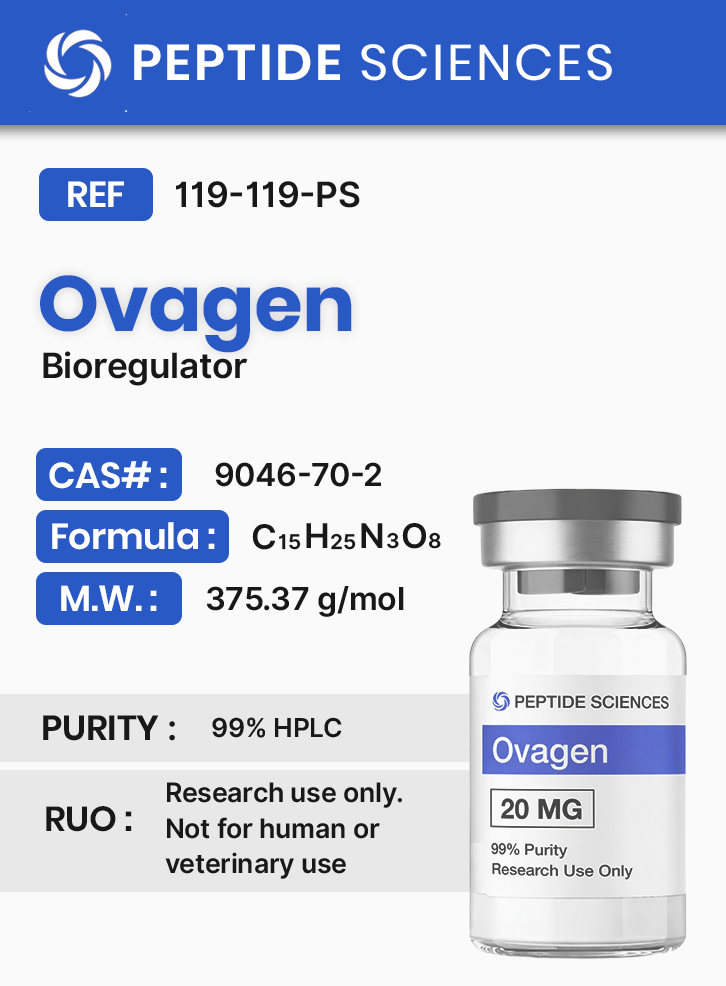
Ovagen 20mg (Bioregulator)
$65.00
Ovagen is a peptide bioregulator derived from liver tissue extracts used in studies of detoxification and cellular regeneration. It modulates gene expression related to protein synthesis, antioxidant defense, and hepatocellular repair. Ovagen is employed in molecular and biochemical research examining peptide-based control of hepatic metabolism and cytoprotection.
For research use only. Not for human consumption.
References:
Khavinson VK et al., Biochemistry (Moscow), 2000 65(8):853–858
Popovich IG et al., Bull Exp Biol Med, 2003 136(1):28–31
Anisimov VN et al., Biogerontology, 2010;11(2):139–149
Overview
Ovagen is a short-chain tripeptide (Glu-Asp-Leu; EDL) described in the scientific literature as a tissue-associated peptide bioregulator. It is distinct from similarly named preparations containing peptide hormones and should not be conflated with those materials. In laboratory research contexts, Ovagen is investigated as a low–molecular weight regulatory peptide with reported activity in hepatic and gastrointestinal experimental systems. Studies focus on peptide-associated modulation of transcriptional activity, chromatin organization, and biochemical signaling pathways within controlled preclinical models.
Biochemical Characteristics
Amino Acid Sequence: Glu-Asp-Leu (EDL)
Molecular Formula: C15H25N3O8
Molecular Weight: 375.37 g/mol
PubChem CID: 444128
Synonyms: EDL, glutamyl-aspartyl-leucine, SCHEMBL5329396, 1a30, CHEBI:137252
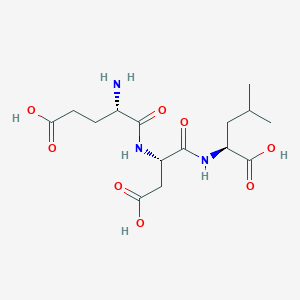 Source: PubChem
Research Applications
Ovagen is supplied exclusively for laboratory research use. Reported research applications include in-vitro and in-vivo experimental designs examining peptide-mediated regulation of hepatic and gastrointestinal cellular systems. Typical use cases include: (i) studies of transcriptional regulation and chromatin accessibility in liver-derived cells; (ii) evaluation of extracellular matrix and fibrotic-marker expression in animal models; (iii) gastrointestinal epithelial barrier and mucosal signaling assays; and (iv) enzymatic interaction studies in virological or biochemical assay systems where peptide–enzyme binding is investigated under controlled conditions.
Pathway / Mechanistic Context
Mechanistic descriptions of Ovagen in the literature emphasize its classification as a short peptide capable of interacting with intracellular regulatory systems. Experimental findings are commonly framed around modulation of chromatin structure, transcription-factor accessibility, and downstream gene-expression patterns in tissue-specific models. In hepatic and gastrointestinal systems, these mechanisms are evaluated through changes in markers associated with cellular proliferation, extracellular matrix organization, and mucosal signaling pathways within defined experimental time courses.
Separate biochemical studies describe Ovagen as a low–molecular weight peptide capable of interacting with viral protease enzymes in vitro. In this context, enzymatic inhibition is assessed using purified enzyme systems and substrate-cleavage assays, providing mechanistic insight into peptide–protease binding and inhibition dynamics without implication of clinical or translational application.
Preclinical Research Summary
Preclinical investigations cited for Ovagen include in-vitro biochemical assays and animal-based experimental models. In hepatic systems, studies examine peptide-associated changes in fibrotic markers, cellular proliferation indices, and transcriptional activity under experimentally induced stress or injury paradigms. Gastrointestinal research focuses on epithelial and mucosal signaling readouts relevant to barrier integrity and cellular turnover within controlled animal models.
Additional biochemical research evaluates Ovagen in enzyme-inhibition assays involving viral proteases. These studies are conducted using isolated enzymes and synthetic substrates, with outcomes reported as concentration-dependent effects on enzymatic activity. All findings are presented within the scope of exploratory, non-clinical laboratory research.
Form & Analytical Testing
This product is provided strictly as a research reagent. Standard analytical characterization for short peptides may include chromatographic purity analysis (e.g., HPLC or UPLC) and molecular mass confirmation by mass spectrometry. Lot-specific certificates of analysis (COA) should be consulted for identity and purity data relevant to experimental documentation and quality control.
Article Author
The above literature was researched, edited and organized by Dr. E. Logan, M.D. Dr. E. Logan holds a doctorate degree from Case Western Reserve University School of Medicine and a B.S. in molecular biology.
Scientific Journal Author
 Vladimir Khavinson is a Professor, President of the European region of the International Association of Gerontology and Geriatrics; Member of the Russian and Ukrainian Academies of Medical Sciences; Main gerontologist of the Health Committee of the Government of Saint Petersburg, Russia; Director of the Saint Petersburg Institute of Bioregulation and Gerontology; Vice-president of Gerontological Society of the Russian Academy of Sciences; Head of the Chair of Gerontology and Geriatrics of the North-Western State Medical University, St-Petersburg; Colonel of medical service (USSR, Russia), retired. Vladimir Khavinson is known for the discovery, experimental and clinical studies of new classes of peptide bioregulators as well as for the development of bioregulating peptide therapy. He is engaged in studying of the role of peptides in regulation of the mechanisms of ageing. His main field of actions is design, pre-clinical and clinical studies of new peptide geroprotectors. A 40-year-long investigation resulted in a multitude of methods of application of peptide bioregulators to slow down the process of ageing and increase human life span. Six peptide-based pharmaceuticals and 64 peptide food supplements have been introduced into clinical practice by V. Khavinson. He is an author of 196 patents (Russian and international) as well as of 775 scientific publications. His major achievements are presented in two books: “Peptides and Ageing” (NEL, 2002) and “Gerontological aspects of genome peptide regulation” (Karger AG, 2005). Vladimir Khavinson introduced scientific specialty “Gerontology and Geriatrics” in the Russian Federation on the governmental level. Academic Council headed by V. Khavinson has oversighted over 200 Ph.D. and Doctorate theses from many different countries.
Prof. Vladimir Khavinson is being referenced as one of the leading scientists involved in the research and development of Ovagen. In no way is this doctor/scientist endorsing or advocating the purchase, sale, or use of this product for any reason. There is no affiliation or relationship, implied or otherwise, between Peptide Sciences and this doctor. The purpose of citing the doctor is to acknowledge, recognize, and credit the exhaustive research and development efforts conducted by the scientists studying this peptide.
Referenced Citations
ALL ARTICLES AND PRODUCT INFORMATION PROVIDED ON THIS WEBSITE ARE FOR INFORMATIONAL AND EDUCATIONAL PURPOSES ONLY.
RUO Disclaimer
The products offered on this website are furnished for in-vitro studies only. In-vitro studies (Latin: in glass) are performed outside of the body. These products are not medicines or drugs and have not been approved by the FDA to prevent, treat or cure any medical condition, ailment or disease. Bodily introduction of any kind into humans or animals is strictly forbidden by law.
For Laboratory Research Only. Not for human use, medical use, diagnostic use, or veterinary use.