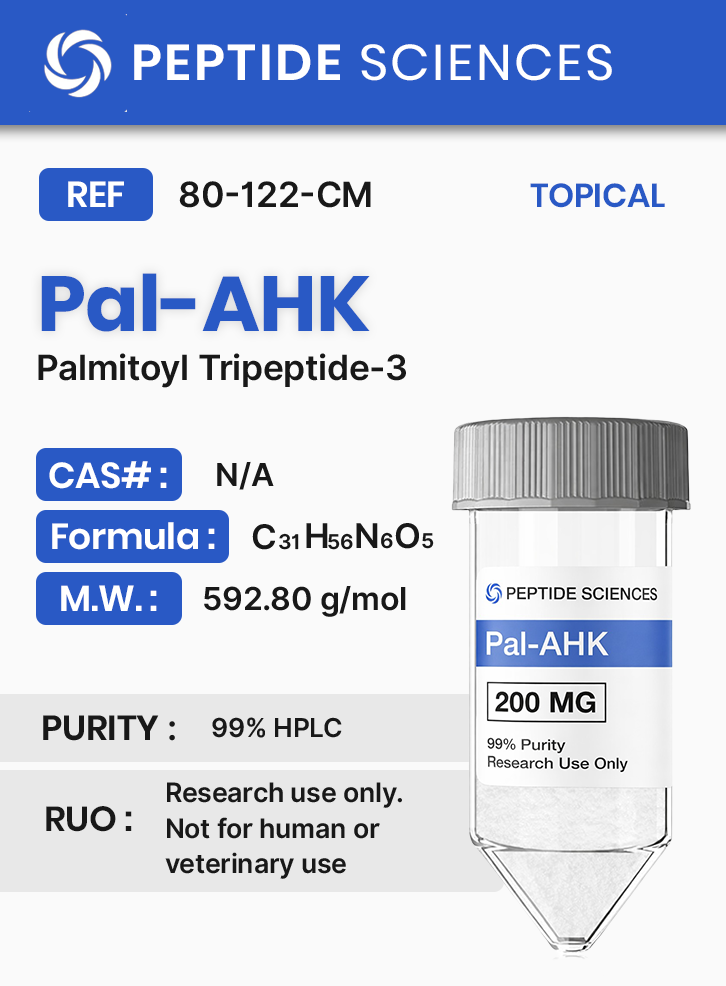
Pal-AHK 200mg (Topical)
$200.00
Pal-AHK is a research peptide consisting of the tripeptide Ala-His-Lys conjugated with palmitic acid to enhance skin absorption and bioavailability. Studies indicate that it stimulates fibroblast activity and extracellular matrix synthesis through copper-dependent redox signaling and TGF-β modulation. Pal-AHK is utilized in dermal biology research exploring peptide-induced tissue regeneration and protein remodeling mechanisms.
For research use only. Not for human consumption.
References:
Pickart L et al., Biochim Biophys Acta, 2015 1850(8):1863–1885
Katayama K et al., J Biochem, 2010 147(1):61–69
Siméon A et al., J Invest Dermatol, 2000 115(6):961–968
Overview
Pal-AHK, also known as Palmitoyl Tripeptide-3, is a synthetic lipidated peptide composed of the tripeptide alanine–histidine–lysine (AHK) covalently linked to a palmitoyl fatty acid moiety. In laboratory research settings, Pal-AHK is utilized as a molecular probe to study fibroblast-associated signaling, extracellular matrix (ECM) protein regulation, and lipid-enhanced peptide transport across biological membranes.
Biochemical Characteristics
Sequence (Three-Letter Code): Palmitoyl-Ala-His-Lys
Molecular formula: C31H56N6O5
Molecular weight: 592.80 g/mol
The palmitoyl group confers increased hydrophobicity relative to non-lipidated AHK, facilitating membrane interaction and cellular uptake in experimental model systems. This structural modification makes Pal-AHK suitable for mechanistic studies involving peptide–membrane interactions and intracellular signaling engagement.
Research Applications
-
Fibroblast signaling research: Investigation of peptide-mediated activation and transcriptional regulation within fibroblast cell populations.
-
Extracellular matrix dynamics: Analysis of collagen and elastin synthesis pathways in cellular and tissue-level experimental models.
-
TGF-β pathway studies: Evaluation of transforming growth factor-β–associated signaling cascades and downstream gene expression.
-
Angiogenic signaling research: Examination of VEGF-related molecular responses in preclinical in vitro and in vivo models.
-
Lipidated peptide transport: Study of fatty acid–conjugated peptide uptake and intracellular distribution.
Pathway / Mechanistic Context
Fibroblasts are central regulators of extracellular matrix composition through the synthesis and remodeling of structural proteins such as collagen and elastin. Pal-AHK has been examined in mechanistic studies for its ability to influence fibroblast-associated signaling networks, particularly those involving transforming growth factor-β (TGF-β).
The palmitoyl modification enhances interaction with lipid bilayers, increasing peptide access to intracellular targets. This facilitates downstream signaling analyses related to ECM assembly, matrix turnover, and growth factor-mediated transcriptional programs.
Additional mechanistic investigations have explored the relationship between Pal-AHK exposure and vascular endothelial growth factor (VEGF) signaling, providing insight into peptide-driven modulation of angiogenesis-related molecular pathways.
Preclinical Research Summary
Preclinical studies employing cellular systems and animal models have evaluated Pal-AHK for its influence on fibroblast activity and ECM-associated protein expression. Experimental findings describe increased transcriptional activity linked to collagen and elastin synthesis pathways under controlled laboratory conditions.
Comparative studies between lipidated and non-lipidated AHK variants highlight the role of palmitoylation in enhancing membrane permeability and intracellular engagement, supporting its use as a research tool for peptide delivery and signaling investigations.
Form & Analytical Testing
Pal-AHK is supplied as a purified research reagent intended for laboratory experimentation. Analytical verification typically includes high-performance liquid chromatography (HPLC) and mass spectrometry (MS) to confirm molecular identity and purity. Proper storage and handling should follow standard peptide reagent protocols.
Referenced Citations
- Łubkowska, B., Grobelna, B. & Maćkiewicz, Z. The use of synthetic polypeptides in cosmetics. Copernic. Lett. 1, 75 (2010).
- Gorouhi, F. & Maibach, H. I. Role of topical peptides in preventing or treating aged skin. Int. J. Cosmet. Sci. 31, 327–345 (2009).
- Lourith, N. & Kanlayavattanakul, M. Biopolymeric agents for skin wrinkle treatment. J. Cosmet. Laser Ther. 18, 301–310 (2016).
ALL ARTICLES AND PRODUCT INFORMATION PROVIDED ON THIS WEBSITE ARE FOR INFORMATIONAL AND EDUCATIONAL PURPOSES ONLY.
RUO Disclaimer
The products offered on this website are furnished for in-vitro studies only. In-vitro studies (Latin: in glass) are performed outside of the body. These products are not medicines or drugs and have not been approved by the FDA to prevent, treat, or cure any disease or condition. Bodily introduction of any kind into humans or animals is strictly forbidden by law.
For Laboratory Research Only. Not for human use, medical use, diagnostic use, or veterinary use.