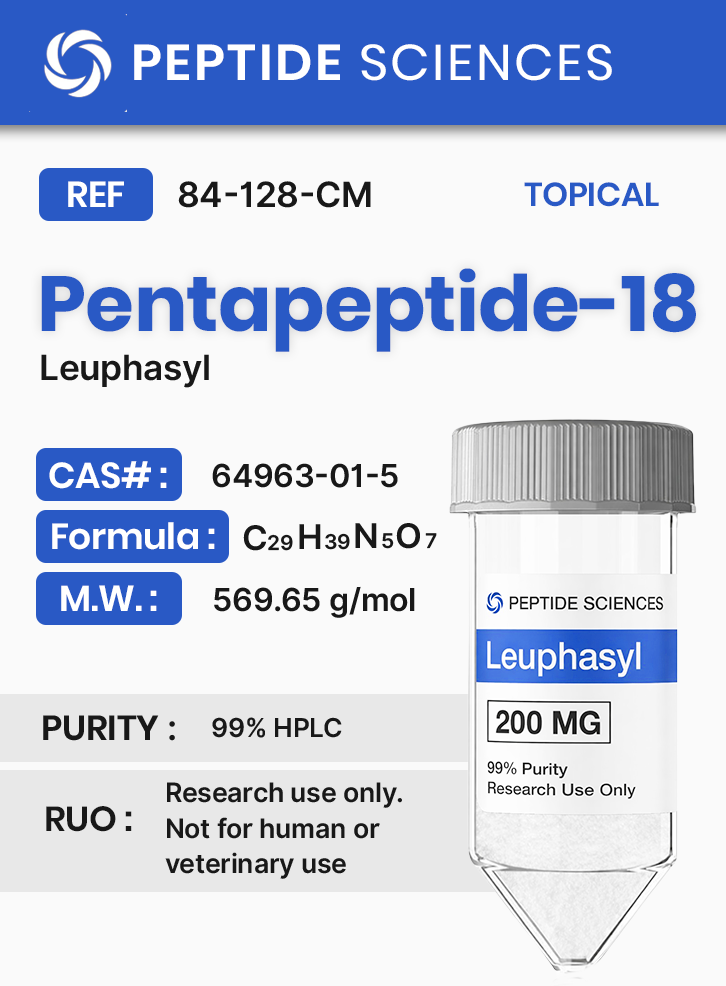
Pentapeptide-18 (Leuphasyl) 200mg (Topical)
$95.00
Pentapeptide-18 (Leuphasyl) is a research peptide derived from the enkephalin sequence Tyr-D-Ala-Gly-Phe-Leu, designed to study neuromodulatory mechanisms in peptide–receptor communication. It acts on enkephalin receptors to modulate catecholamine release and synaptic signaling in vitro. Pentapeptide-18 is utilized in neuropeptide and dermatological research to explore peptide-based modulation of signal transduction and muscle innervation pathways.
For research use only. Not for human consumption.
References:
Wakamatsu K et al., Peptides, 1991 12(5):1043–1048
Blanchfield JT et al., Neuropeptides, 2003 37(3):151–159
Tsetlin V et al., Front Mol Neurosci, 2018 11:459
verview
Pentapeptide-18 (Leuphasyl) is a synthetic pentapeptide supplied exclusively for laboratory research applications. The peptide is derived from enkephalin-related sequences and is investigated in preclinical and in vitro experimental systems for its interaction with neuromuscular signaling pathways. Research focuses on characterization of peptide-mediated modulation of synaptic communication under controlled laboratory conditions.
Sequence: (Three-Letter Code): Tyr-D-Ala-Gly-Phe-Leu
Molecular formula: C29H39N5O7
Molecular weight: 569.65 g/mol
Biochemical Characteristics
Pentapeptide-18 is composed of five amino acids arranged to replicate functional motifs found in endogenous enkephalins. The inclusion of D-amino acid residues contributes to enhanced stability in experimental environments. Structural analyses describe the peptide as capable of interacting with synaptic receptor systems involved in neuromuscular signal transmission.
Research Applications
Pentapeptide-18 is utilized in laboratory research to investigate modulation of neuromuscular junction activity. Experimental applications include in vitro neuronal–muscle co-culture assays and in vivo animal models assessing peptide effects on synaptic signaling dynamics and muscle fiber activation parameters.
Pathway / Mechanistic Context
Pentapeptide-18 is studied for its ability to modulate neuromuscular signal transmission through interaction with receptor systems associated with enkephalin-mediated pathways. By influencing neurotransmitter release and receptor responsiveness at the synaptic interface, the peptide enables investigation of downstream effects on muscle activation signaling without permanent receptor inactivation.
Preclinical Research Summary
Preclinical studies involving Pentapeptide-18 include animal models and in vitro neuromuscular assays evaluating changes in synaptic transmission and muscle contractile signaling following peptide exposure. Experimental observations report reversible modulation of neuromuscular activity, supporting investigation of enkephalin-derived peptide structure–function relationships in controlled research settings.
Form & Analytical Testing
Pentapeptide-18 is supplied as a synthetic research-grade peptide. Identity and purity are typically confirmed using analytical techniques such as high-performance liquid chromatography (HPLC) and mass spectrometry (MS). Storage and handling should follow standard laboratory protocols appropriate for peptide-based research reagents.
Referenced Citations
- Dragomirescu, A. O., Andoni, M., Ionescu, D. & Andrei, F. The Efficiency and Safety of Leuphasyl—A Botox-Like Peptide. Cosmetics 1, 75–81 (2014).
- Puig, A., Garcia-Anton, J., Perez, R. & Mangues, M. Eyeseryl and Leuphasyl: Synthetic Peptides as Advanced Cosmetic Actives. Available at: http://www.cosmeticsciencetechnology.com/companies/articles/821.pdf. (Accessed: 28th July 2016)
- Montiel, A. V. F., Puche, J. C. & Montiel, A. P. Cosmetic or dermopharmaceutical composition comprising enkephalin-derived peptides for reducing and/or eliminating facial wrinkles. (2015).
- Wilson, A. J., Chin, B. C., Hsu, V. M., Mirzabeigi, M. N. & Percec, I. Digital Image Correlation: A Novel Dynamic Three-Dimensional Imaging Technique for Precise Quantification of the Dynamic Rhytid and Botulinum Toxin Type A Efficacy. Plast. Reconstr. Surg. 135, 869e–876e (2015).
ALL ARTICLES AND PRODUCT INFORMATION PROVIDED ON THIS WEBSITE ARE FOR INFORMATIONAL AND EDUCATIONAL PURPOSES ONLY.
RUO Disclaimer
The products offered on this website are furnished for in-vitro studies only. In-vitro studies (Latin: in glass) are performed outside of the body. These products are not medicines or drugs and have not been approved by the FDA to prevent, treat or cure any medical condition, ailment or disease. Bodily introduction of any kind into humans or animals is strictly forbidden by law.
For Laboratory Research Only. Not for human use, medical use, diagnostic use, or veterinary use.