PNC-27 5mg
$150.00
PNC-27 is a research peptide composed of a p53–MDM2 binding domain linked to a membrane-targeting sequence (residues 12–26 of the p53 protein). It has been shown in preclinical studies to interact with cancer cell membranes through HDM-2–associated mechanisms, leading to selective pore formation and membrane destabilization. PNC-27 is utilized in experimental oncology research to investigate peptide–membrane interactions, apoptotic signaling, and tumor-selective cytolytic activity in vitro.
For research use only. Not for human consumption.
References:
Sotomayor EM et al., Int J Cancer, 2005 115(5):701–709
Arora V et al., J Cell Biochem, 2013 114(3):664–671
Hu W et al., Oncotarget, 2017 8(29):47425–47436
Overview
PNC-27 is a synthetic peptide supplied exclusively for laboratory research use. In published preclinical literature, PNC-27 is used as a mechanistic probe in experimental systems evaluating peptide–protein binding behavior and membrane-associated localization phenomena involving HDM-2/MDM2-related targets under controlled conditions.
This material is provided for in-vitro and other non-clinical experimental applications only. No statements regarding safety, efficacy, or outcomes are made or implied.
Biochemical Characteristics
PNC-27 is described in the research literature as incorporating an HDM-2/MDM2-binding motif corresponding to residues 12–26 of p53, coupled to a membrane-interacting domain. Experimental work typically evaluates binding, localization, and membrane interaction using biochemical and cell-based assay formats.
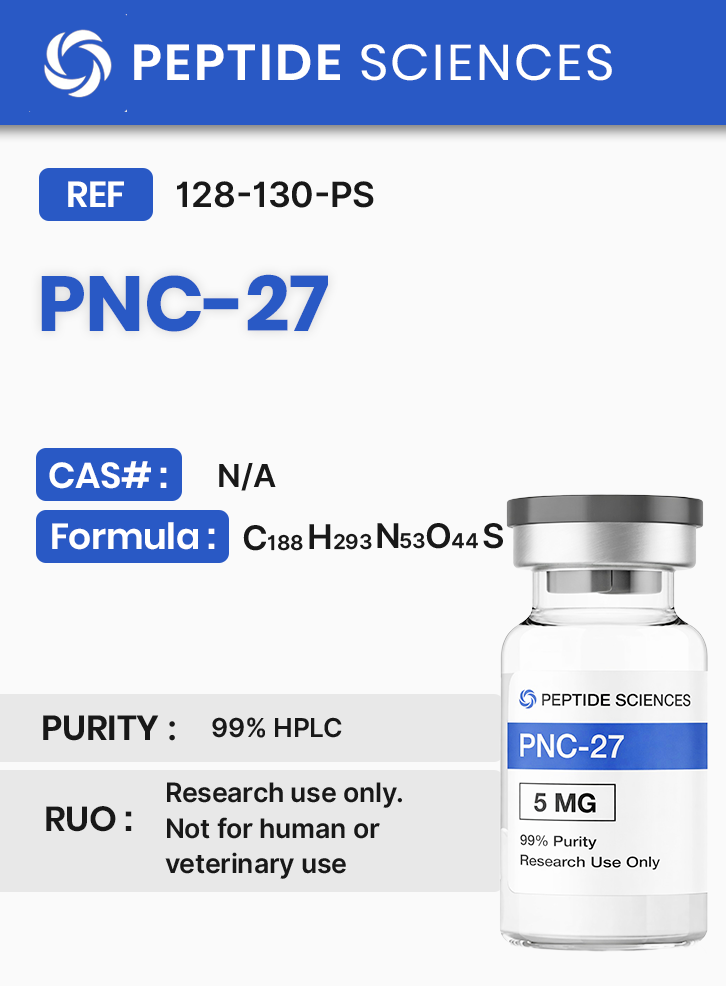
Molecular formula: C188H293N53O44S
Molar Mass: 4031.7
Research Applications
PNC-27 is used in preclinical research settings as a tool compound for investigations such as:
- Peptide–protein binding studies involving HDM-2/MDM2-associated interaction motifs
- Assessment of peptide localization to membrane compartments in engineered or model systems
- Structure–function exploration of p53-derived binding regions in controlled experimental formats
- Method development for membrane interaction assays (e.g., microscopy-based localization, biochemical fractionation)
Observations are specific to the experimental systems used (e.g., in-vitro cell models, isolated membranes, or preclinical model designs) and should be interpreted only within the scope of those systems.
Pathway / Mechanistic Context
Mechanistic discussions of PNC-27 in the scientific literature commonly center on its ability to associate with HDM-2/MDM2-related targets and its behavior in membrane-associated contexts. Experimental endpoints may include binding readouts, localization signals, and membrane interaction signatures measured by established laboratory assays.
This section is provided as biochemical context for researchers and does not imply therapeutic intent, clinical translation, or biological outcome claims.
Preclinical Research Summary
In preclinical publications, PNC-27 has been used in experimental oncology research models to study the relationship between MDM2/HDM2 membrane-associated localization and peptide interaction behavior. Reported experiments include in-vitro and other non-clinical models designed to characterize mechanistic features (e.g., binding dependence and cellular localization patterns).
Citations are provided below exactly as listed in the original content to document the historical research context.
Form & Analytical Testing
Form: Synthetic peptide (lyophilized or otherwise specified by accompanying documentation, if provided).
Identity / Purity Confirmation: Analytical methods commonly used for peptide verification include HPLC and mass spectrometry (MS), where available from lot-specific documentation.
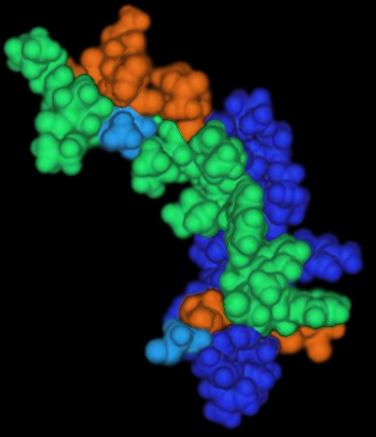
Image shown for molecular reference and product identification only.
Article Author
The above literature was researched, edited and organized by Dr. Logan, M.D. Dr. Logan holds a doctorate degree from Case Western Reserve University School of Medicine and a B.S. in molecular biology..
Scientific Journal Author
Wilbur B. Bowne, M.D., FACS, is an Associate Professor of Surgical Oncology and Cellular/Molecular Biology at Drexel University College of Medicine (DUCOM). He is a recipient of The American Association of Cancer Research (AACR) Young Investigator and The American College of Surgeons Faculty Fellowship Research Awards for his research in pancreatic cancer. Dr. Bowne’s laboratory research is focused on developing novel anticancer targeted therapies against oncoprotein and cell cycle regulation in pancreatic cancer. He is extensively published with over 130 peer-reviewed articles, abstracts, and book chapters. He has received numerous awards for outstanding service, teaching excellence and outstanding skills and commitment in the clinical care of patients. Dr. Bowne and colleagues developed a scoring system to improve patient safety for pancreatic surgery developed from the American College of Surgeons National Surgical Quality Improvement Program (ACS NSQIP). Dr. Bowne takes great pride in being a member of DUCOM multidisciplinary cancer team that treats the most complex patient situations whatever the circumstances or nature of the condition.
Dr. Wilbur B. Bowne, M.D. is being referenced as one of the leading scientists involved in the research and development of FOXO4-DRI. In no way is this doctor/scientist endorsing or advocating the purchase, sale, or use of this product for any reason. There is no affiliation or relationship, implied or otherwise, between Peptide Sciences and this doctor. The purpose of citing the doctor is to acknowledge, recognize, and credit the exhaustive research and development efforts conducted by the scientists studying this peptide. Dr. Peter de Keizer is listed in [2] under the referenced citations.
.
Referenced Citations
- http://www.pnas.org/content/107/5/1918.full
- Cancer Chemother Pharmacol. 2010 Jul;66(2):325-31. doi: 10.1007/s00280-009-1166-7. Epub 2010 Feb 25. https://www.ncbi.nlm.nih.gov/pubmed/20182728
- Ann Clin Lab Sci. 2014 Summer;44(3):241-8. https://www.ncbi.nlm.nih.gov/pubmed/25117093
- Int. J. Cancer: 119, 1577–1585 (2006)
- AACR Publications. 10.1158/1538-7445.AM10-5770 Published April 2010
ALL ARTICLES AND PRODUCT INFORMATION PROVIDED ON THIS WEBSITE ARE FOR INFORMATIONAL AND EDUCATIONAL PURPOSES ONLY.
RUO Disclaimer
The products offered on this website are furnished for in-vitro studies only. In-vitro studies (Latin: in glass) are performed outside of the body. These products are not medicines or drugs and have not been approved by the FDA to prevent, treat or cure any medical condition, ailment or disease. Bodily introduction of any kind into humans or animals is strictly forbidden by law.
For Laboratory Research Only. Not for human use, medical use, diagnostic use, or veterinary use.