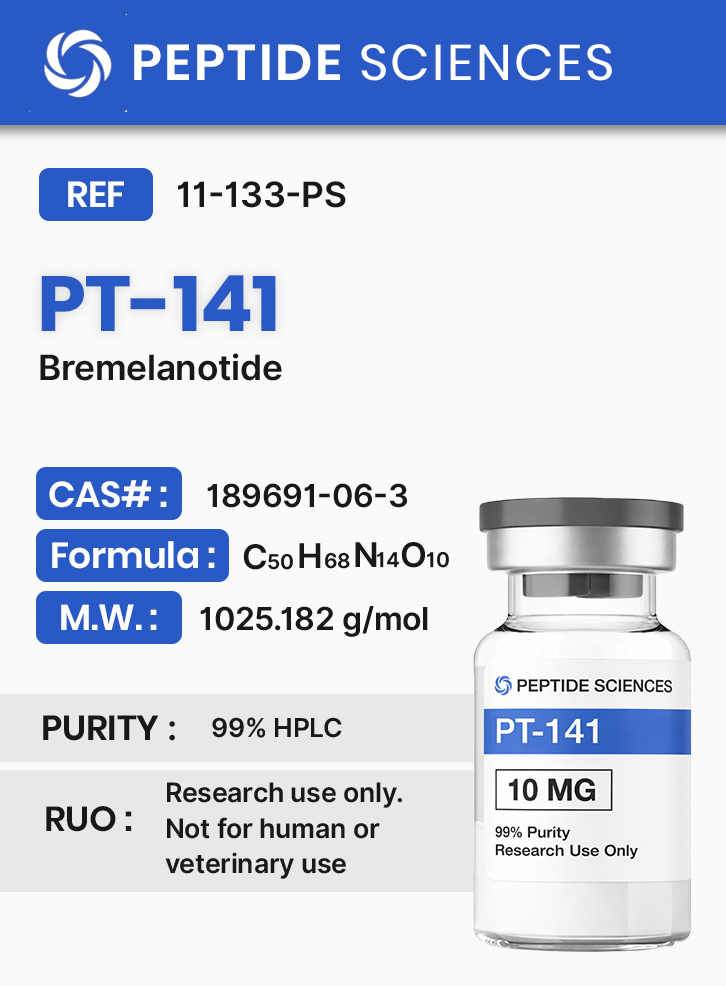
PT-141 10mg
$55.00
PT-141 is a synthetic melanocortin receptor agonist structurally derived from the analog Melanotan II. It binds selectively to MC3R and MC4R, modulating neuropeptide signaling pathways involved in hypothalamic control mechanisms. PT-141 is commonly employed in research focusing on GPCR activation, neuronal signaling, and neuroendocrine modulation.
For research use only. Not for human consumption.
References:
Wessells H et al., J Urol, 2003 170(2 Pt 1):627–632
Shadiack AM et al., J Sex Med, 2007 4(1):95–104
Hadley ME, Ann NY Acad Sci, 2006 994:419–430
Overview
PT-141, also known as bremelanotide, is a synthetic melanocortin peptide used in research to interrogate melanocortin receptor (MCR) signaling. In mechanistic systems, PT-141 is commonly discussed as an agonist probe for melanocortin receptor subtypes, with pathway mapping frequently emphasizing melanocortin-4 receptor (MC4R) and melanocortin-1 receptor (MC1R) in receptor pharmacology workflows.
PT-141 is structurally related to other synthetic melanocortin ligands (including melanotan-class sequences) and is used in laboratory settings to evaluate receptor activation, ligand–receptor selectivity, and downstream second-messenger signaling in controlled in-vitro assays and in-vivo animal models.
Biochemical Characteristics
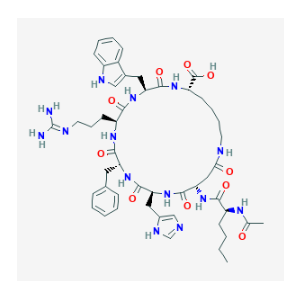 Source: PubChem
Sequence: Ac-Nle-Asp(1)-His-D-Phe-Arg-Trp-Lys(1)
Molecular Formula: C50H68N14O10
Molecular Weight: 1025.182 g/mol
PubChem CID: 9941379
CAS Number: 189691-06-3
PT-141 is a synthetic peptide engineered for receptor-binding studies in melanocortin receptor assays. In research workflows, peptide identity and integrity are typically confirmed using chromatographic purity profiling and mass-based analysis prior to use as a receptor agonist probe in cellular signaling experiments.
Research Applications
1. Melanocortin Receptor Pharmacology & Ligand–Receptor Selectivity
PT-141 is used as an agonist probe in receptor pharmacology to measure melanocortin receptor activation and to compare signaling behavior across receptor subtypes under controlled assay conditions. Common endpoints include concentration–response profiling, receptor desensitization/internalization studies, and pathway bias assessment using second-messenger and phospho-protein readouts.
2. CNS-Relevant Signaling Networks in Animal Models
Melanocortin receptor agonism is frequently examined in rodent models to map receptor-linked signaling across CNS-associated circuits. Experimental designs may quantify downstream molecular endpoints (e.g., cAMP-regulated transcriptional signatures, ERK phosphorylation, immediate-early gene expression) and incorporate receptor subtype attribution strategies using pharmacologic blockade or genetic models.[1]
3. Inflammation & Host-Response Pathway Interrogation
MC1R-associated signaling is studied in immune-adjacent models to characterize how melanocortin pathway activation intersects with inflammatory mediator regulation and macrophage-associated phenotypes. In preclinical infection and inflammation paradigms, melanocortin ligands have been used to quantify cytokine-linked endpoints, leukocyte signaling markers, and tissue-level inflammatory signatures in controlled animal systems.[4]
4. Pigmentation-Linked Signaling & Photobiology Mechanisms
In melanocyte-focused experimental systems, melanocortin signaling is used to study cAMP/PKA-driven transcriptional control of pigmentation-associated enzymes and melanosome biology. MC1R pathway mapping may include evaluation of signaling cross-talk with MAPK cascades and DNA damage-response markers in mechanistic photobiology workflows.
Pathway / Mechanistic Context
Melanocortin receptors are G protein-coupled receptors (GPCRs) that commonly couple to Gs signaling, increasing intracellular cAMP and activating PKA-dependent transcriptional programs. In cell-based assays, PT-141–driven pathway interrogation may include cAMP accumulation, CREB-linked transcriptional activity, and downstream modulation of phospho-signaling nodes (including MAPK/ERK) measured under standardized exposure windows and receptor expression contexts.
Because multiple melanocortin receptor subtypes can be expressed across tissues and experimental model systems, mechanistic studies frequently incorporate subtype attribution methods (e.g., selective antagonists, receptor knockdown/knockout strategies, or receptor expression controls) to associate observed biochemical outputs with specific receptor populations.
Preclinical Research Summary
Preclinical research involving melanocortin receptor agonism includes rodent behavioral and neuroendocrine models used to map MC4R-linked signaling networks and downstream transcriptional responses. Genetic MC4R-deficient mouse models have been used to evaluate pathway consequences of disrupted melanocortin signaling, supporting mechanistic interpretation of receptor involvement across measured endpoints.[1]
Additional animal studies using melanocortin agonist frameworks have examined receptor-linked effects on neurobehavioral signaling and related molecular markers in controlled preclinical contexts.[2], [3]
In immune-adjacent models, melanocortin signaling has been evaluated for its relationship to inflammatory mediator regulation and macrophage-associated pathways in controlled animal infection paradigms.[4]
Form & Analytical Testing
PT-141 is supplied as a synthetic peptide suitable for controlled laboratory research workflows. Standard analytical verification commonly includes chromatographic purity assessment (HPLC) and identity confirmation by mass spectrometry (MS), supported by batch documentation for reproducibility in RUO study designs.
Article Author
The above literature was researched, edited and organized by Dr. Logan, M.D. Dr. Logan holds a doctorate degree from Case Western Reserve University School of Medicine and a B.S. in molecular biology.
Scientific Journal Author
Dr. Sheryl A. Kingsberg is the chief of behavioral medicine at University Hospitals Case Medical Center and a professor in Reproductive Biology and Psychiatry at Case Western Reserve University. Her research includes neurobehavioral and psychophysiological frameworks relevant to sexual medicine, with published work that included evaluation of melanocortin agonist pharmacology endpoints in controlled research settings.
Dr. Sheryl A. Kingsberg is referenced here to acknowledge published research related to PT-141. This reference does not imply endorsement or advocacy of purchase, sale, or use of this product. No affiliation or relationship is implied between Peptide Sciences and this scientist. Dr. Kingsberg is listed in the citations below.
Referenced Citations
- M. Sandrock, A. Schulz, C. Merkwitz, T. Schöneberg, K. Spanel-Borowski, and A. Ricken, “Reduction in corpora lutea number in obese melanocortin-4-receptor-deficient mice,” Reprod. Biol. Endocrinol., vol. 7, p. 24, Mar. 2009.
- H. Wessells, V. J. Hruby, J. Hackett, G. Han, P. Balse-Srinivasan, and T. W. Vanderah, “Ac-Nle-c[Asp-His-DPhe-Arg-Trp-Lys]-NH2 induces penile erection…,” Neuroscience, vol. 118, no. 3, pp. 755–762, 2003.
- A.-S. Rössler, J. G. Pfaus, H. K. Kia, J. Bernabé, L. Alexandre, and F. Giuliano, “The melanocortin agonist, melanotan II, enhances proceptive sexual behaviors…,” Pharmacol. Biochem. Behav., vol. 85, no. 3, pp. 514–521, Nov. 2006.
- H. Ji et al., “The Synthetic Melanocortin (CKPV)2 Exerts Anti-Fungal and Anti-Inflammatory Effects…,” PLOS ONE, vol. 8, no. 2, Feb. 2013.
ALL ARTICLES AND PRODUCT INFORMATION PROVIDED ON THIS WEBSITE ARE FOR INFORMATIONAL AND EDUCATIONAL PURPOSES ONLY.
RUO Disclaimer
The products offered on this website are furnished for in-vitro studies only. In-vitro studies (Latin: in glass) are performed outside of the body. These products are not medicines or drugs and have not been approved by the FDA to prevent, treat or cure any medical condition, ailment or disease. Bodily introduction of any kind into humans or animals is strictly forbidden by law.
For Laboratory Research Only. Not for human use, medical use, diagnostic use, or veterinary use.