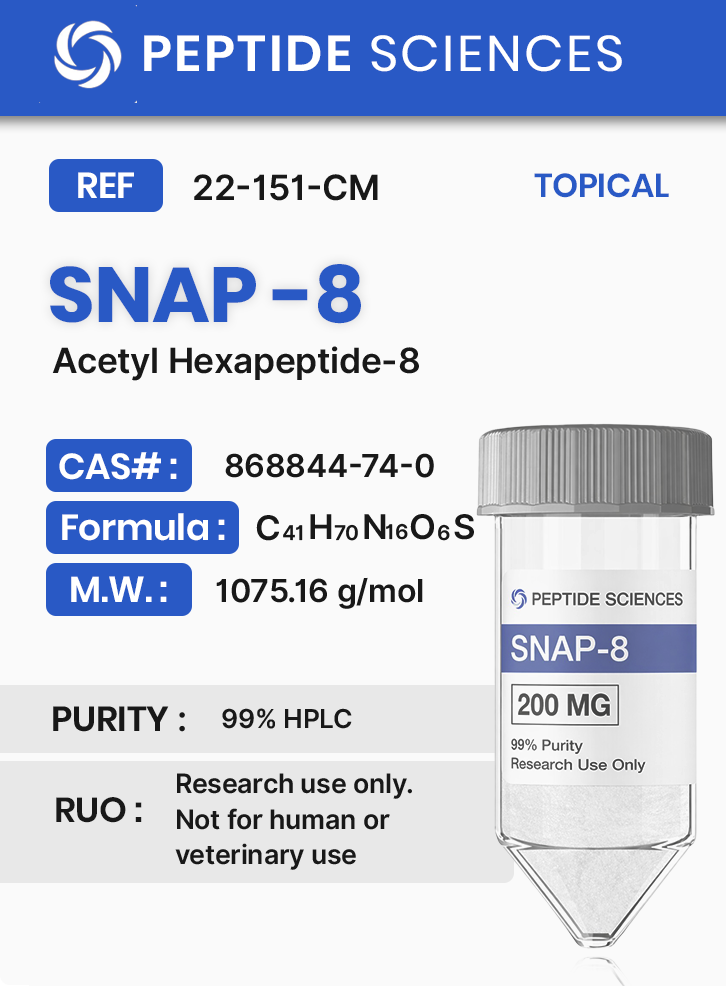
SNAP-8 200mg (Topical)
$180.00
SNAP-8 is a synthetic octapeptide (Ac-Glu-Glu-Met-Gln-Arg-Arg-Ala-Asp-NH₂) derived from SNAP-25, designed to modulate vesicle exocytosis-associated protein interactions. It inhibits catecholamine release by competing with SNAP-25 for SNARE complex assembly, providing a model for studying neuropeptide-mediated vesicular fusion and neurotransmission regulation. SNAP-8 is widely used in topical peptide research focused on neuromodulation and cell–membrane interaction mechanisms.
For research use only. Not for human consumption.
References:
Blanes-Mira C et al., Int J Cosmet Sci, 2002 24(5):303–310
Monteiro R et al., Neuroscience, 2006 138(4):1209–1217
López O et al., Peptides, 2015 64:25–32
Overview
SNAP-8 is a synthetic peptide used in research to study SNARE-complex–mediated vesicle docking and membrane fusion, a core process in regulated exocytosis (e.g., neurotransmitter and hormone release). As a short SNAP-25–related mimetic sequence, SNAP-8 is commonly used as a peptide tool to probe how partial interference within multi-protein fusion assemblies can modulate vesicle fusion efficiency and release dynamics in controlled experimental systems.
Biochemical Characteristics
Sequence: Acetyl-Glu-Glu-Met-Gln-Arg-Arg-Ala-Asp-NH2
Molecular Formula: C41H70N16O16S
Molecular Weight: 1075.16 g/mol
INCI Name: Acetyl Glutamyl Heptapeptide-1
Common Name: SNAP-8 [1]
SNAP-8 is typically manufactured with an N-terminal acetyl group and a C-terminal amide (amidation). These end-cap modifications are commonly used in peptide engineering to help reduce terminal charge, improve handling stability, and support consistent behavior in biochemical assays. Because SNAP-25 itself is subject to N-terminal processing/acetylation in biological contexts, N-terminus chemistry is frequently discussed in SNARE-related protein regulation studies. [4]
Research Applications
SNAP-8 is used in research environments to investigate mechanisms underlying regulated exocytosis and SNARE-dependent vesicle fusion. Common experimental applications include:
- SNARE assembly / disassembly studies (protein–protein interaction and complex stability assays)
- Vesicle fusion kinetics assays (fluorescence dequenching, lipid-mixing, content-mixing readouts)
- Cell-based exocytosis modulation models (neurosecretory or endocrine-derived cell systems)
- Competitive peptide-interference designs to probe domain-specific contributions in fusion machinery
Peptide-based competition approaches are widely used to map SNARE interface requirements and define which interaction surfaces are rate-limiting for complex formation and membrane fusion. [3]
Pathway / Mechanistic Context
The SNARE fusion core is commonly described as a set of proteins (classically including a vesicle SNARE and target-membrane SNAREs) that “zipper” into a stable helical bundle, generating mechanical force that draws membranes together to support fusion. This core machinery is embedded in broader regulatory networks that control timing, calcium coupling (in synapses), and specificity. [2]
In mechanistic models, a SNAP-25–derived mimetic peptide can be used to test how partial disruption of interface formation changes:
- complex nucleation and propagation (“zippering”) kinetics,
- fusion probability and threshold behavior,
- release dynamics (graded modulation versus full blockade), and
- downstream readouts such as neurotransmitter or vesicle-cargo release.
Foundational biochemical work has shown that specific SNARE interaction surfaces can be probed using defined peptides, helping delineate the interface rules that govern complex formation. [3]
Preclinical Research Summary
Preclinical SNARE research frameworks frequently combine purified-protein reconstitution assays and cell-based secretion models to quantify how perturbations in SNARE interactions influence membrane fusion outcomes. Review literature describes SNARE/SM proteins as central, complementary components of the fusion machinery, with SNARE zippering providing force generation and SM proteins supporting productive fusogenic action. [2]
In RUO experimental designs, SNAP-8 may be used as a peptide-interference tool to support:
- structure–function mapping of SNARE interface contributions,
- comparative studies across SNARE-derived peptide motifs, and
- hypothesis generation for how partial SNARE disruption modulates regulated exocytosis phenotypes.
All findings described in published SNARE-mechanism literature are context-dependent and model-dependent; SNAP-8 is supplied strictly for controlled laboratory research.
Form & Analytical Testing
This peptide is commonly supplied as a lyophilized solid to support stability during storage and transport prior to experimental use. Identity and purity are typically confirmed using standard analytical workflows such as HPLC (purity profiling) and mass spectrometry (molecular weight confirmation). These tests help support batch consistency and reproducibility in research settings.
Referenced Citations
- Omizzur. “SNAP-8 (Acetyl Glutamyl Heptapeptide-1)” (ingredient/peptide listing; sequence and basic properties).
- T. C. Südhof & J. E. Rothman. “Membrane fusion: grappling with SNARE and SM proteins.” Science. 2009;323(5913):474–477. doi:10.1126/science.1161748.
- D. Fasshauer, M. Margittai, “A transient N-terminal interaction of SNAP-25 and syntaxin nucleates SNARE assembly.” PNAS. 2004. (Peptide/protein interface mapping relevant to SNARE assembly rules).
- L. Wang et al. “N-Terminal Acetylation of SNAP-25 Regulates SNARE Complex Assembly.” ACS Chemical Neuroscience. 2016.
ALL ARTICLES AND PRODUCT INFORMATION PROVIDED ON THIS WEBSITE ARE FOR INFORMATIONAL AND EDUCATIONAL PURPOSES ONLY.
RUO Disclaimer
The products offered on this website are furnished for in-vitro studies only. In-vitro studies (Latin: in glass) are performed outside of the body. These products are not medicines or drugs and have not been approved by the FDA to prevent, treat or cure any medical condition, ailment or disease. Bodily introduction of any kind into humans or animals is strictly forbidden by law.
For Laboratory Research Only. Not for human use, medical use, diagnostic use, or veterinary use.