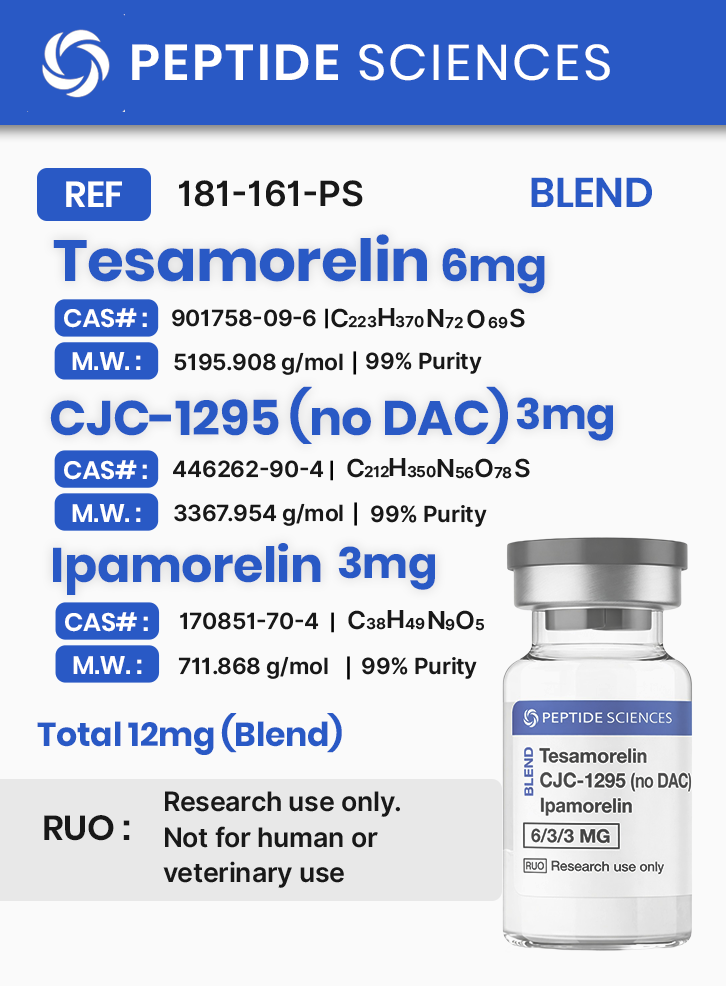
Tesamorelin, CJC-1295 (no DAC), Ipamorelin 12mg (Blend)
$125.00
Tesamorelin, CJC-1295 (no DAC), and Ipamorelin is a research peptide blend formulated to investigate growth hormone axis modulation through combined GHRH and ghrelin receptor pathways. Tesamorelin and CJC-1295 (Mod GRF 1–29) activate GHRH receptor signaling via cAMP/PKA cascades, while Ipamorelin targets the GHS-R1a receptor, promoting calcium mobilization. This blend is used in endocrine and receptor biology studies exploring synergistic GH pulsatility and hypothalamic–pituitary coordination.
For research use only. Not for human consumption.
References:
Teichman SL et al., J Clin Endocrinol Metab, 2006 91(2):479–487
Frohman LA et al., Front Neuroendocrinol, 2002 23(3):257–291
Kojima M et al., Nature, 1999 402(6762):656–660
CJC-1295 (no DAC)
Overview
CJC-1295 (no DAC), also known as Modified GRF (1–29), is a synthetic peptide analog of growth hormone–releasing hormone (GHRH). It is utilized in laboratory research to examine GHRH receptor–dependent signaling and endocrine axis modulation in experimental systems.
Biochemical Characteristics
CJC-1295 (no DAC) consists of 29 amino acids with targeted substitutions that enhance resistance to enzymatic degradation compared to native GHRH. These structural modifications prolong peptide stability in biological matrices used in preclinical research models.
Research Applications
This peptide is employed in cellular assays and in-vivo animal studies to investigate pulsatile growth hormone release, insulin-like growth factor signaling, and feedback regulation within the hypothalamic–pituitary axis.
Pathway / Mechanistic Context
CJC-1295 activates the GHRH receptor, a class B G protein–coupled receptor, leading to stimulation of adenylate cyclase, increased intracellular cAMP, and downstream protein kinase A–mediated transcriptional activity. These pathways are studied to elucidate endocrine rhythm regulation in preclinical models.
Preclinical Research Summary
Preclinical investigations have examined sustained growth hormone signaling patterns and serum protein profile changes following GHRH analog exposure. All reported findings originate from controlled laboratory or translational research environments.
Form & Analytical Testing
CJC-1295 (no DAC) is supplied in lyophilized form for laboratory research use. Analytical validation typically includes high-performance liquid chromatography (HPLC) and mass spectrometry to confirm molecular identity and purity.
Ipamorelin
Overview
Ipamorelin is a synthetic pentapeptide functioning as a selective agonist of the growth hormone secretagogue receptor (GHS-R1a). It is widely studied in laboratory research for its receptor specificity and signaling behavior.
Biochemical Characteristics
Ipamorelin demonstrates high selectivity for ghrelin receptor activation with minimal off-target interaction in comparative in-vitro assays. Its peptide sequence contributes to focused receptor engagement without broad pituitary hormone pathway activation in experimental models.
Research Applications
Research applications include analysis of ghrelin-mediated intracellular signaling, calcium flux dynamics, and comparative secretagogue activity in rodent and cellular systems.
Pathway / Mechanistic Context
Upon receptor binding, ipamorelin activates phospholipase C signaling, resulting in intracellular calcium mobilization. These signaling events are studied to characterize growth hormone secretagogue receptor pathway specificity under controlled laboratory conditions.
Preclinical Research Summary
Animal-based studies have explored ipamorelin-associated signaling effects on skeletal development parameters and gastrointestinal motility models. All data are derived exclusively from non-clinical research settings.
Form & Analytical Testing
Ipamorelin is provided as a lyophilized peptide for research use only. Standard analytical testing includes HPLC and mass spectrometry to ensure batch consistency and structural verification.
Tesamorelin
Overview
Tesamorelin is a synthetic growth hormone–releasing hormone analog used in laboratory research to study GHRH receptor signaling and downstream endocrine pathway modulation.
Biochemical Characteristics
Tesamorelin is engineered with amino acid substitutions that enhance stability while preserving high affinity for the GHRH receptor. Its biochemical profile closely mirrors endogenous GHRH in receptor-binding assays.
Research Applications
The peptide is utilized in preclinical studies examining insulin-like growth factor signaling, lipid metabolism markers, and vascular-associated biochemical endpoints in cellular and animal models.
Pathway / Mechanistic Context
Tesamorelin binding to GHRH receptors activates cAMP-dependent signaling cascades, influencing transcriptional regulation associated with growth hormone synthesis in pituitary-derived tissues studied ex vivo and in vivo.
Preclinical Research Summary
Published studies have explored tesamorelin-associated changes in adipose distribution markers, inflammatory signaling indicators, and endocrine feedback mechanisms. These findings are limited to experimental research contexts.
Form & Analytical Testing
Tesamorelin is supplied as a lyophilized research peptide. Analytical confirmation typically includes HPLC and mass spectrometry prior to laboratory use.
Summary
CJC-1295 (no DAC), Ipamorelin, and Tesamorelin are frequently studied in parallel within preclinical research frameworks due to their distinct yet convergent mechanisms of growth hormone axis modulation. Each peptide engages separate receptors and signaling pathways that collectively inform mechanistic understanding of endocrine regulation.
Combination studies in experimental models focus on comparative receptor activation, pulsatility of hormone signaling, and downstream molecular responses. All observations are restricted to in-vitro systems or animal research models and are used solely to advance biochemical and physiological knowledge.
Referenced Citations
- Teichman, S. L., Neale, A., Lawrence, B., Gagnon, C., Castaigne, J. P. and Frohman, L. A. (2006) ‘Prolonged stimulation of growth hormone (GH) and insulin-like growth factor I secretion by CJC-1295, a long-acting analog of GH-releasing hormone, in healthy adults’, J Clin Endocrinol Metab,91(3), pp. 799-805.
- Sackmann-Sala, L., Ding, J., Frohman, L. A. and Kopchick, J. J. (2009) ‘Activation of the GH/IGF-1 axis by CJC-1295, a long-acting GHRH analog, results in serum protein profile changes in normal adult subjects’, Growth Horm IGF Res,19(6), pp. 471-7.
- Onescu, M. and Frohman, L. A. (2006) ‘Pulsatile secretion of growth hormone (GH) persists during continuous stimulation by CJC-1295, a long-acting GH-releasing hormone analog’, J Clin Endocrinol Metab,91(12), pp. 4792-7.
ALL ARTICLES AND PRODUCT INFORMATION PROVIDED ON THIS WEBSITE ARE FOR INFORMATIONAL AND EDUCATIONAL PURPOSES ONLY.
RUO Disclaimer
The products offered on this website are furnished for in-vitro studies only. In-vitro studies (Latin: in glass) are performed outside of the body. These products are not medicines or drugs and have not been approved by the FDA to prevent, treat or cure any medical condition, ailment or disease. Bodily introduction of any kind into humans or animals is strictly forbidden by law.
For Laboratory Research Only. Not for human use, medical use, diagnostic use, or veterinary use.