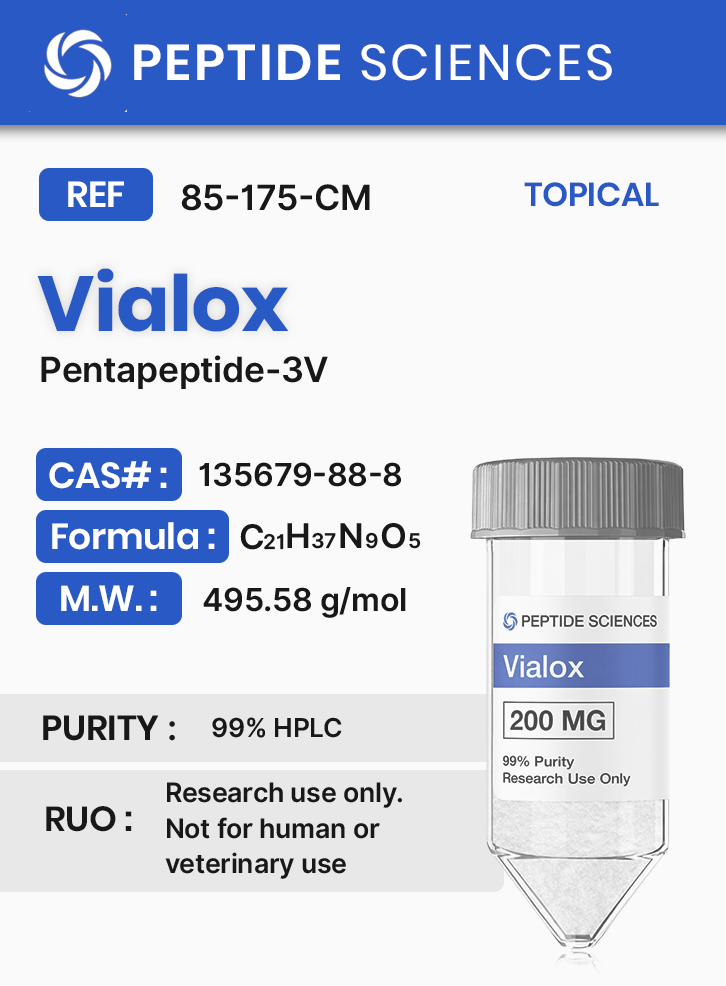
Vialox (Pentapeptide-3V) 200mg (Topical)
$220.00
Vialox (Pentapeptide-3V) is a research peptide designed as a synthetic pentapeptide analog modeled after snake venom proteins, developed to study neuromuscular transmission and receptor-mediated peptide signaling. It interacts with nicotinic acetylcholine receptor (nAChR) pathways, influencing synaptic vesicle release and ion channel modulation in vitro. Vialox is utilized in experimental neurobiology and dermatological peptide research focused on muscle relaxation mechanisms and peptide–receptor communication.
For research use only. Not for human consumption.
References:
Tsetlin V et al., Annu Rev Pharmacol Toxicol, 2015 55:319–341
Utkin YN, Toxicon, 2013 71:133–155
Nirthanan S et al., Biochim Biophys Acta, 2003 1645(1):81–89
Overview
Vialox (Pentapeptide-3V) is a synthetic pentapeptide supplied exclusively for laboratory research applications. The peptide sequence is derived from a venom-associated protein fragment originally identified in snake venom. In preclinical and in vitro experimental systems, Vialox is investigated for its interaction with peripheral neuromuscular signaling pathways, specifically through modulation of nicotinic acetylcholine receptor activity.
Sequence (Three-Letter Code): Gly-Pro-Arg-Pro-Ala
Molecular formula: C21H37N9O5
Molecular weight: 495.58 g/mol
Biochemical Characteristics
Vialox is a short-chain synthetic peptide composed of five amino acids arranged to replicate the bioactive region of a venom-derived curaremimetic peptide. The sequence confers selective binding affinity toward peripheral nicotinic acetylcholine receptors in experimental models. Structural studies describe its interaction as competitive and reversible under controlled laboratory conditions.
Research Applications
Vialox is utilized in research settings to investigate peripheral neuromuscular junction signaling and receptor–ligand interactions. Experimental use includes in vitro neuromuscular junction assays and in vivo animal models to evaluate selective inhibition of acetylcholine-mediated signal transmission at muscle endplates, without engagement of central neuronal receptor populations.
Pathway / Mechanistic Context
Vialox functions as a competitive antagonist of peripheral nicotinic acetylcholine receptors (nAChRs). By occupying the receptor binding site, the peptide inhibits acetylcholine-induced ion channel activation at the neuromuscular junction. This interaction prevents downstream depolarization events required for muscle fiber activation, allowing detailed study of synaptic transmission dynamics and receptor specificity in laboratory models.
Preclinical Research Summary
Preclinical investigations involving Vialox include animal models and in vitro receptor-binding assays assessing neuromuscular signal modulation. Reported findings describe transient, reversible inhibition of acetylcholine receptor activity and corresponding changes in muscle contractile signaling parameters. These studies are used to characterize structure–function relationships of venom-derived peptide analogs under controlled experimental conditions.
Form & Analytical Testing
Vialox is supplied as a synthetic research-grade peptide. Identity and purity are typically confirmed using analytical techniques such as high-performance liquid chromatography (HPLC) and mass spectrometry (MS). Handling and storage should follow standard laboratory protocols applicable to peptide-based research reagents.
Referenced Citations
- Vialox. Available at: http://www.drskinspa.com/Ageless%20Derma/Vialox.pdf. (Accessed: 29th July 2016)
- Gupta, V. K. Biotechnology of Bioactive Compounds: Sources and Applications. (John Wiley & Sons, 2015).
- Servent, D. et al. Only Snake Curaremimetic Toxins with a Fifth Disulfide Bond Have High Affinity for the Neuronal α7 Nicotinic Receptor. J. Biol. Chem. 272, 24279–24286 (1997).
ALL ARTICLES AND PRODUCT INFORMATION PROVIDED ON THIS WEBSITE ARE FOR INFORMATIONAL AND EDUCATIONAL PURPOSES ONLY.
RUO Disclaimer
The products offered on this website are furnished for in-vitro studies only. In-vitro studies (Latin: in glass) are performed outside of the body. These products are not medicines or drugs and have not been approved by the FDA to prevent, treat or cure any medical condition, ailment or disease. Bodily introduction of any kind into humans or animals is strictly forbidden by law.
For Laboratory Research Only. Not for human use, medical use, diagnostic use, or veterinary use.